28 August 2026
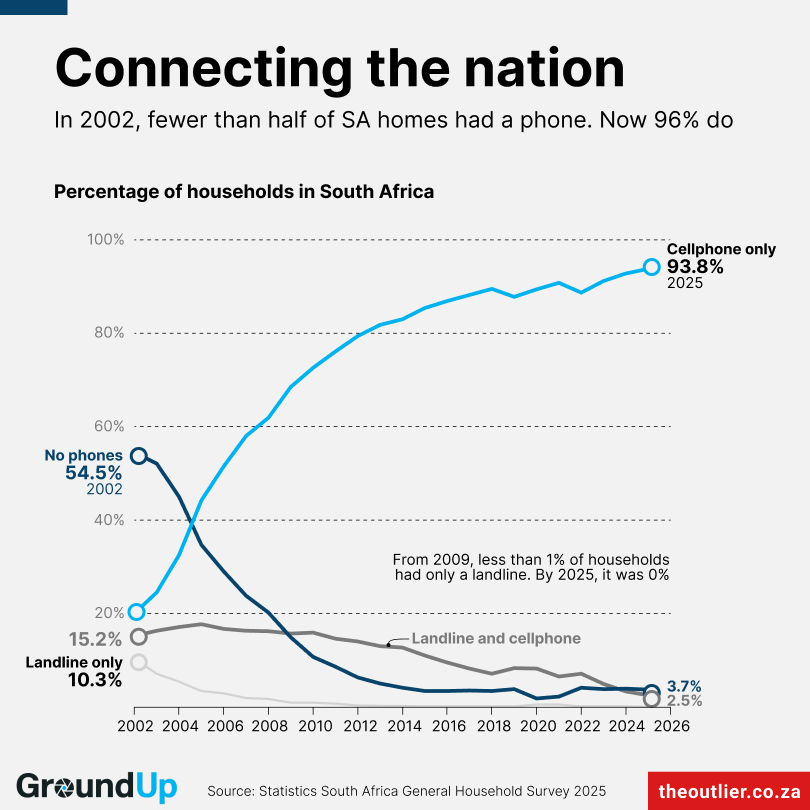
In 2002, nearly 55% of households in South Africa had no phones in their homes. By 2025, that number had dropped to 3.7% — about 740,000 households.
Cellphone penetration has risen steeply. In 2002, 20% of households had a cellphone, and 15.2% had both a cellphone and a landline. In 2025, 93.8% had a cellphone only and 2.5% had both a cellphone and a landline, while no households had only a landline.
While this data from Stats SA does not differentiate between cellphones with only SMS or voice connectivity, and smartphones that can connect to the internet, in a separate report by the Independent Communications Authority of South Africa (ICASA), 91% of people had smartphones in 2019.
Cellphones have enabled access to information, government services and job-seeking platforms, as well as mobile banking and money transfers for the unbanked. They have boosted informal trade through money services like e-wallets and Bluetooth or SIM-connected card machines.
There are downsides too: online gambling (R1.1-trillion was wagered by South Africans on betting in 2024), scams, cybercrime and the harms of social media.
The rise in mobile technology marks a revolution in connectivity for South Africa. In the 1990s and early 2000s, Telkom had a monopoly on telephone technology. It was tasked with rolling out telephone lines in areas previously underserved during apartheid.
While millions of new lines were connected, these were soon disconnected because households could not afford to maintain their subscriptions. The demise of fixed telephone lines was exacerbated by copper cable theft and the rise of more accessible, cheaper, prepaid mobile services.
Prepaid cellphone connectivity has enabled people in rural and less affluent areas to connect to cellphone towers without requiring copper cabling to individual houses or expensive subscriptions.
Telkom discontinued its prepaid copper-based telephone services in 2019 and migrated its landline customers to wireless and fibre services. Fixed phones that run on wireless or fibre are still referred to as “landline”.
The final decommissioning of Telkom’s post-paid copper telephone service is still underway. By 2024, Telkom had only 609,000 clients using copper lines for voice and broadband — down from more than 5-million at the turn of the century.
There is still work to be done. Mobile data is still too expensive. Cellphone connectivity is not universally available in all areas, and is still unreliable in many areas. The 3.7% of households – about 740,000 – without phone connectivity is not an insignificant number.
Poor households without phone connectivity will struggle to access government services, including the R370 SRD grant for unemployed people.
Chart produced by The Outlier in partnership with GroundUp
