7 September 2026
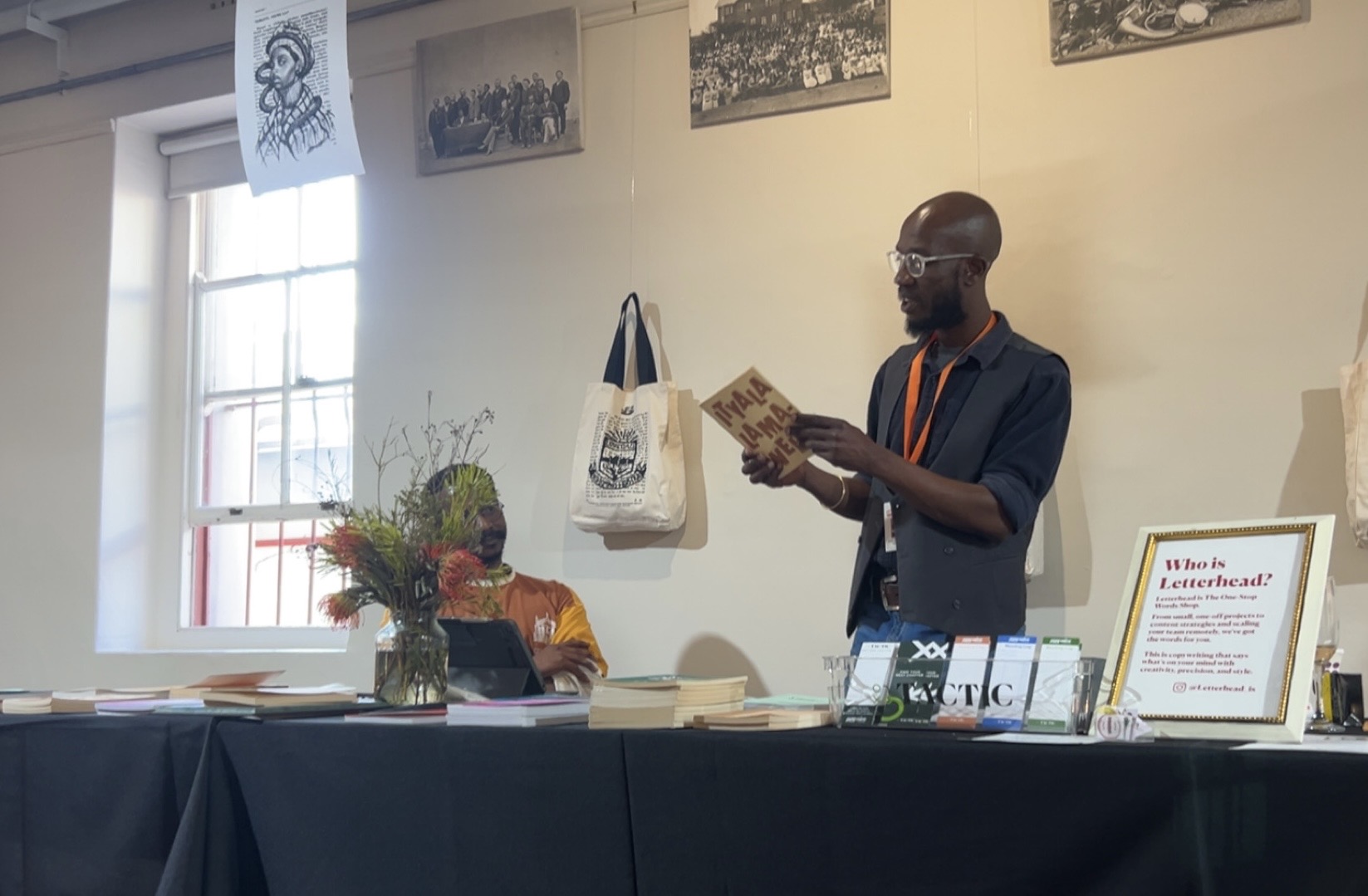
Sibusiso Mnyanda, head of curatorial research at Victory of the Word, talked about the history of the 200-year-old Lovedale Press on Saturday as part of the Open Book Festival in Cape Town. He held a copy of Ityala Lamawele, the first known novel in Xhosa, written by Samuel Edward Krune Mqhayi and published by Lovedale Press in 1914. Photo: Alice Scott
More than a century ago, the Lovedale Press published Ityala lamawele, the oldest surviving novel in isXhosa, written by Samuel Edward Krune Mqhayi and published in 1914.
Lovedale Press was established in 1823 by the Glasgow Missionary Society. Its printing press was destroyed twice in wars. The present press dates from 1861, according to Rhodes University Library.
Over the years, Lovedale published the work of black authors and also trained Black South Africans as apprentices in printing and bookbinding.
Now, it faces closure due to financial challenges.
We reported in 2024 that it owed about R1-million in rent according to the owner of the premises.
Former employees, who took over the business through an auction in 2001, haven’t been paid salaries for years.
On Saturday, Athi-Patra Ruga, a founder and director of Victory of the Word (VOW), discussed books like Ityala lamawele at the Homecoming Centre lounge, as part of the Open Book Festival in Cape Town.
Ruga and his colleague, Sibusiso Mnyanda, spoke about the history of the printing house as well as VOW’s efforts to save it amid the ongoing threat of closure.
VOW is an arts and research organisation started in 2020 to study and maintain the legacy of Lovedale Press.
“We are heading up work with the reimagination of the Lovedale Press for a new market and for art-loving people who see the threat of AI infringing on physical media,” Ruga said.
Ruga and Mnyanda said Lovedale Press had initially published religious and educational texts, including the first translation of the Xhosa Bible.
Ruga said the 18 former employees who took over the printing house in 2001 had become trustees. In 2018, there were only two of the 18 remaining. One of those employees, Lovedale’s master printer, who worked at the press for 40 years, died early this year.
The change in ownership coincided with the rise of the internet as well as a move away from learning Xhosa, Ruga said. By 2015, the Lovedale Press had printed its last book.
In 2024, GroundUp reported on the project to revive the printing house, led by the Thabo Mbeki Foundation, which also involved several Eastern Cape universities. The foundation’s restoration plans had been in place since late 2023.
But almost three years since those plans, the Lovedale Press continues to face the same financial issues and threats of closure. The building is filled with books, dusty boxes and printing machinery such as letter sets, embossing machines and binding machines that have gone unused for years.
Miguel Da Silva, a Cape Town resident who attended the event, drove through Dikeni (formerly Alice) recently. He only noticed the building because a young engineer pointed it out to him. “It’s barely identifiable,” he said. The walls are a faded beige and many of the windows are broken.
Ruga said VOW remains in collaboration with the Thabo Mbeki Foundation. He said VOW is “rushing against time” to preserve the written works, particularly Xhosa titles still stored at Lovedale.
VOW has been working on several initiatives to help fund the preservation project, such as selling Lovedale Press tote bags, supplying books to reading groups and hosting artists who want to learn about the press’s history. Ruga also sells prints featuring characters from different Lovedale books.
Still, Ruga said, it was unlikely that Lovedale would resume printing.
He said VOW’s vision for preservation involves converting Lovedale into an institute for contemporary art and knowledge. This includes digitising and relocating to nearby Hogsback.
“Alice is usually on fire around exam time,” Ruga said. “It’s very volatile because of the protests that always happen there.”
Despite the challenges that lie ahead, Ruga ended by saying that Lovedale’s history is ongoing — one that he believes will continue.
