
30 October 2026
View the map in full-screen mode.
Over the past year, in the lead-up to the local elections, GroundUp has reported from 28 municipalities across the country. We found municipalities failing to supply drinking water, treat sewage, and manage their finances.
More than 800 cases of gastrointestinal illness occurred this month in Bronkhorstspruit within the Tshwane municipality, which also had a deadly outbreak of cholera in 2023 due to its sewage and drinking water treatment failures.
There have also been outbreaks of gastrointestinal illness at Rhodes University in Makhanda and St Albans prison in Nelson Mandela Bay. Although initial investigations by the Department of Water and Sanitation (DWS) suggest the institutions’ internal water distribution systems are to blame, this does not let the municipalities off the hook: neither Makana nor Nelson Mandela Bay municipalities supply drinking water that meets the required national standards.
Tshwane, Makana and Nelson Mandela Bay are failing in their constitutional and legal duty to treat and supply clean water. They are among 83 municipalities in the country whose supply of drinking water was classified as either “bad” or “poor” or had not presented their mandatory test results on the DWS’s Integrated Regulatory Information System (IRIS) at the time of writing.
They represent 58% of the 144 municipalities which are water services authorities responsible for the provision of drinking water. (While there are 205 local municipalities across the country, in some provinces they have their drinking water supplied by district municipalities. This also applies to wastewater treatment.)
They fail to meet the required minimum standard for microbiological indicators, a measurement of how much faecal and other coliform bacteria is in the water. Faecal bacteria should be undetectable in a 100ml sample, with 10 or fewer total coliform bacteria, in the sample.
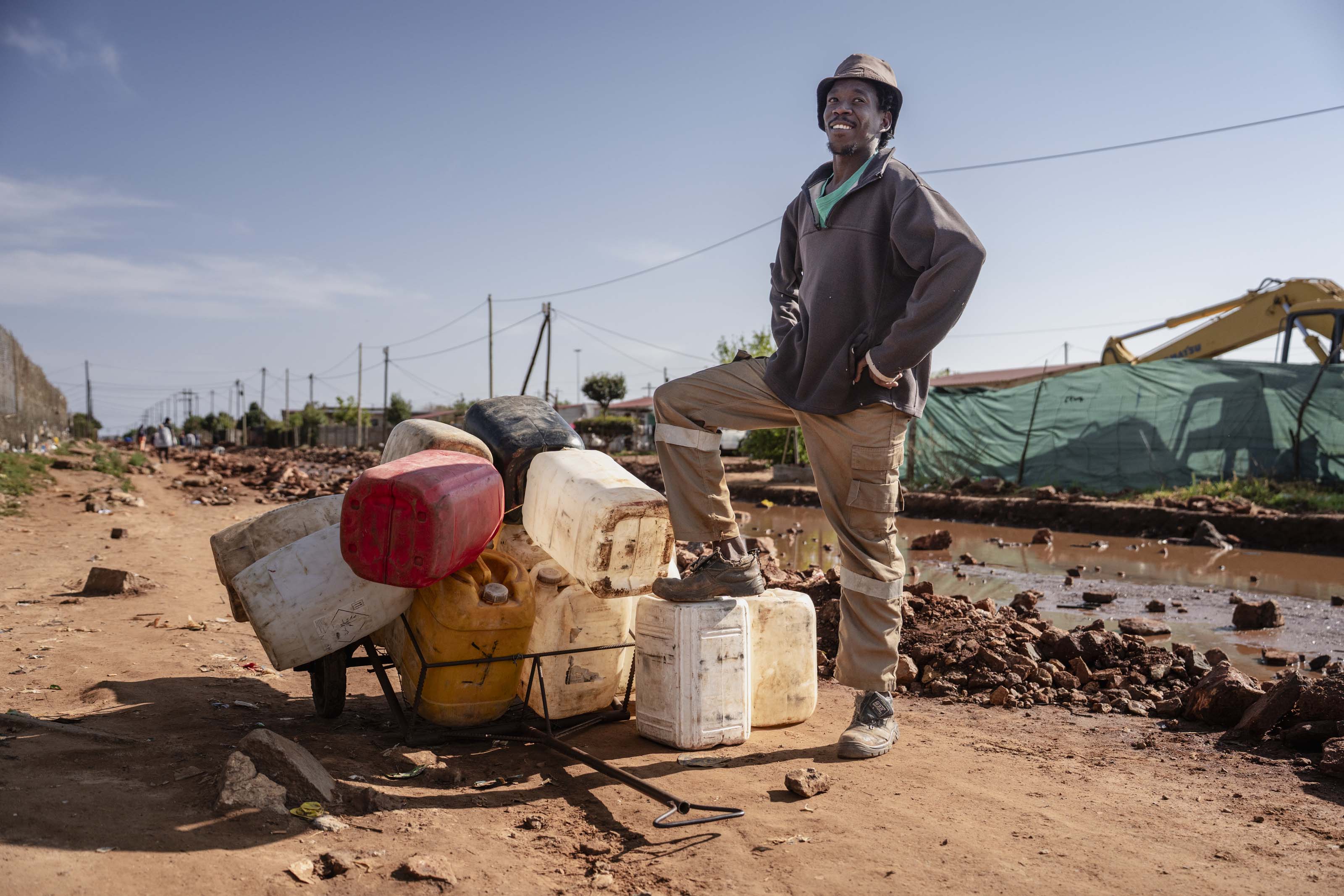
Ditsobotla Local Municipality resident Kabelo Molefe makes a living fetching water for other residents, charging between R5 and R7 for a bucket of 20 or 25 litres. Archive photo: Ihsaan Haffejee
Ten municipalities pass microbiological compliance but fail compliance or do not present results for chemicals that may have acute or chronic health effects.
Langeberg municipality in the Western Cape, for example, achieved 99.6% compliance for microbiological standards, but has zero compliance for chemicals that may have acute health effects, suggesting no testing took place. George and Cederberg are in the same position. Kopanong in the Free State and Ubuntu in the Northern Cape also present zero compliance for both acute and chronic health chemical indicators.
Additionally, many municipalities which do meet minimum drinking water standards suffer water shortages. These may, as in Johannesburg, leave areas without water for days at a time, or, as in Polokwane and Mangaung, leave rural areas short of water for years.
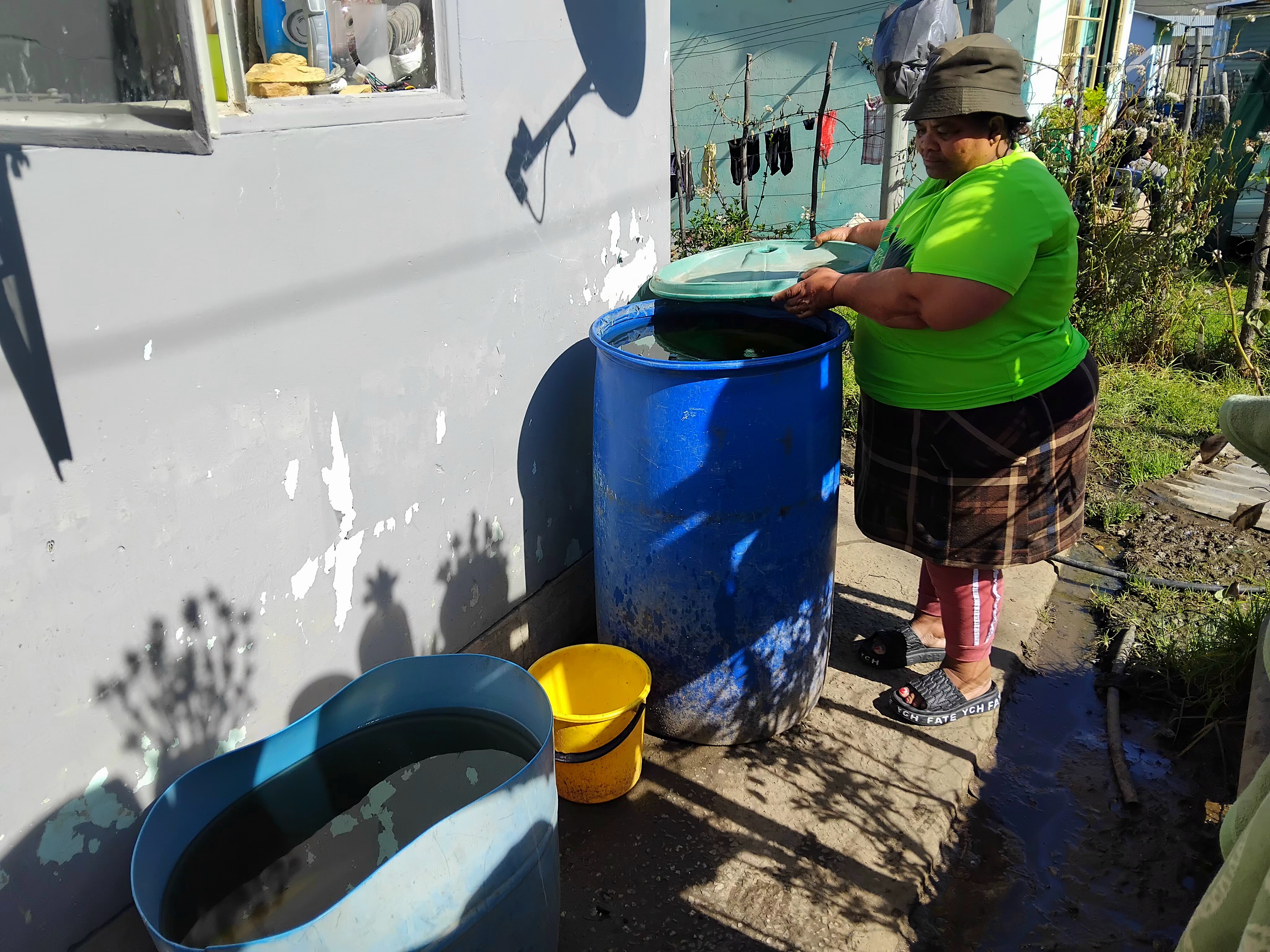
Misgund, under the Kou-Kamma Municipality, only gets water for an hour a day. Archive photo: Marecia Damons
The right to a clean environment free from pollution and ecological degradation is protected by the Constitution. Yet only 18 municipalities meet the standards for the treated effluent they release into streams, rivers and the sea.
Looking only at microbiological compliance, 78% of the municipal authorities responsible for wastewater treatment, or 112 of 144, are failing (scoring below 70% or not reporting results). A stricter reading of the DWS data which includes failure in chemical and physical compliance, shows that 88%, or 126 of 144, are failing.
Fourteen municipalities whose effluent meets microbiological standards fail – some absolutely – on chemical indicators (such as the amount of ortho-phosphates and nitrates) or physical indicators (such as electrical conductivity or oxygen demand).
Not only are more than three-quarters of municipalities – including seven of the eight metros (the exception is Ekurhuleni) – failing to treat sewage and other forms of wastewater at their treatment works, many are also polluting the environment with sewage that gushes daily across roads and fields due to blockages, breakages and pump station failures within the sewerage system, resulting in large quantities of sewage not even reaching the treatment plant.
The widespread pollution of South Africa’s water catchments and rivers not only destroys river ecosystems and the tourism and commercial opportunities that accompany healthy environments, it has a negative impact on farming and is a direct threat to clean drinking water and human health.
The deadly cholera outbreak in Hammanskraal in 2023 was linked to the failure of the Rooiwal wastewater treatment works in Tshwane, which releases what is supposed to be properly treated effluent into the Apies River. This river flows into the Leeukraal Dam, which is the raw water supply for the Temba water treatment works, which supplies much of Hammanskraal with drinking water.
Because South Africa’s water treatment works are not designed to treat highly polluted water, the Temba water treatment works could not purify the raw water to the required standards.
There are numerous municipalities which pollute their own drinking water sources this way, such as in Winburg in the Free State under the Masilonyana Local Municipality.
Sewage treatment failure means some municipalities are polluting the water sources for other towns. This is the threat to Gauteng’s source of drinking water, the Vaal Dam, for example.
Polluted rivers also threaten livestock and crop farming, with knock-on effects for human health.

The Matlosana Municipality in the North West is pouring sewage into the Vaal River. Archive photo: Ihsaan Haffejee
The Auditor-General’s report on municipal finances for the 2024/25 financial year notes limited progress in municipal financial management in this sixth administration compared to the fifth administration, which ended in the 2020/21 financial year. Three metro municipalities regressed.
Only 15% of South Africa’s municipalities – 29 of 257 metro, district and local municipalities combined – achieved clean audits in 2024/25.
The Auditor-General (AG) notes “the most prevalent [audit] outcome in 2024/25 was an unqualified audit opinion with findings”, with 117 municipalities (45%) in this category. While an unqualified audit with findings is better than a qualified one, the AG warned these municipalities “continue to exhibit high levels of non-compliance, together with significant weaknesses in financial and performance management”.
Unqualified with findings is not an outcome that should be “regarded as desirable”, states the AG.
Most concerning was that not one of the eight metropolitan municipalities achieved a clean audit in 2024/25. The metros are responsible for managing R336-billion (54%) of the estimated municipal expenditure budget affecting 46% of the country’s households.
Three metros – City of Johannesburg, eThekwini, Cape Town – had unqualified with findings as their audit outcome, while Buffalo City, Nelson Mandela Bay, Mangaung, Tshwane and Ekurhuleni all received qualified audit opinions.

A dust devil, formed in 37-degree heat, twists through the mounds of burnt debris at the unregulated Douglas landfill in the Northern Cape’s Siyancuma municipality. Archive photo: Steve Kretzmann
GroundUp has found only two municipalities that meet three basic criteria of treating wastewater, providing clean drinking water, and achieving clean audit outcomes. They are George and Witzenberg local municipalities in the Western Cape.
For this assessment, we counted only excellence in municipalities, where more than 90% of treated sewage samples met the E. coli standard, drinking water achieved an excellent DWS rating (>99% E. coli compliance), and the 2024/25 audit was clean.
Witzenberg excels on microbiological compliance, but is not as consistent in its chemical and physical wastewater compliance. George shows zero for acute health chemical compliance in drinking water.
George and Witzenberg are both DA-led coalition councils. George has had three mayors since November 2021 as the DA, FF+ and ACDP coalition broke up and reformed.
Witzenberg (Ceres and Tulbagh) has had more stable governance as a coalition of the DA, Witzenberg Aksie, ICOSA and FF+, but previous reporting has revealed it fails to properly manage its refuse. Additionally, some municipal facilities such as the campsite in Tulbagh have been largely abandoned.
Another outlier of interest is Lesedi Local Municipality with its head office in Heidelberg, Gauteng. Run by an ANC coalition with the Socialist Economic Freedom Movement, which gives it a one-seat majority in council, Lesedi meets microbiological compliance for wastewater and water quality, and obtained an unqualified audit opinion with findings.
Msunduzi Local Municipality (Pietermaritzburg) similarly ticks the boxes for wastewater and drinking water quality. Its ANC-led coalition with an independent councillor obtained an unqualified audit with findings. However, reporting has shown Msunduzi has failed to manage its public transport system, and has allowed municipal facilities to fall into decay.
Across the country, councils with DA mayors, the vast majority of which are in the Western Cape, are more likely to get clean audits: 65% of the DA’s 26 councils got clean audits in 2024/25, compared with 5% of the ANC’s 157 councils and 9% of the IFP’s 22 councils. These figures include councils where the party leads a coalition.
DA-led councils are also more likely to meet drinking water standards for E. coli: 73% have good or excellent ratings, compared with 45% of ANC-led and 36% of IFP-led councils.
Only 42% of DA-led councils have a good or excellent rating for E. coli in treated sewage (70% compliance or more), compared with 32% of IFP-led and 17% of ANC-led councils. Fewer still reach an excellent rating (90% or more): 19% of DA-led, 14% of IFP-led and 6% of ANC-led councils.
(These figures include councils served by district municipalities.)
GroundUp has been unable to obtain reliable nationwide municipal data on refuse removal and management, public transport management where applicable, and maintenance and management of municipal infrastructure, among other important municipal governance indicators.
We strongly suspect that, were these to be included, not a single municipality in the country could be considered to fully comply with the requirements of the Constitution.