1 September 2026
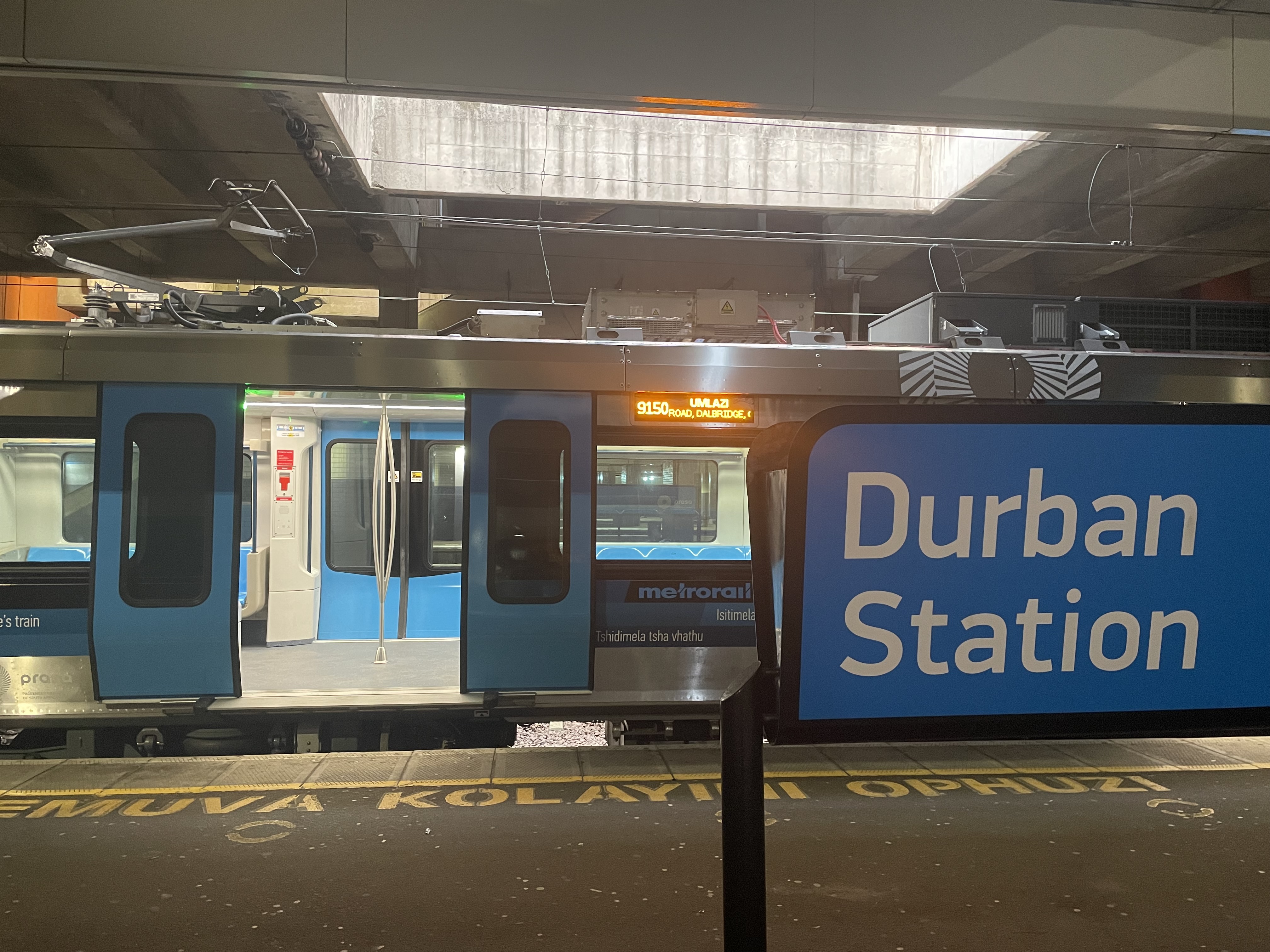
A train departs from Durban station. Photos: Joseph Bracken
Passenger numbers on Durban’s Metrorail have fallen by 41% within a year, despite recovery attempts by the Passenger Rail Agency of South Africa (PRASA).
Last year the average number of daily passengers dropped for the first time since the 2021/22 financial year. An average of about 33,000 passengers travelled on the train service daily in the 2025/26 financial year, down 41% from about 56,000 in 2024/25. The financial year runs from April to March.
The average number of daily passengers was about 281,000 in 2018. Then ailing infrastructure and large-scale unchecked vandalism during the covid pandemic caused years of decline. Numbers hit a low of about 9,700 in 2021/22.
After hundreds of millions of rands were invested to rehabilitate the service, passenger figures began to increase year on year. But last year they fell sharply.
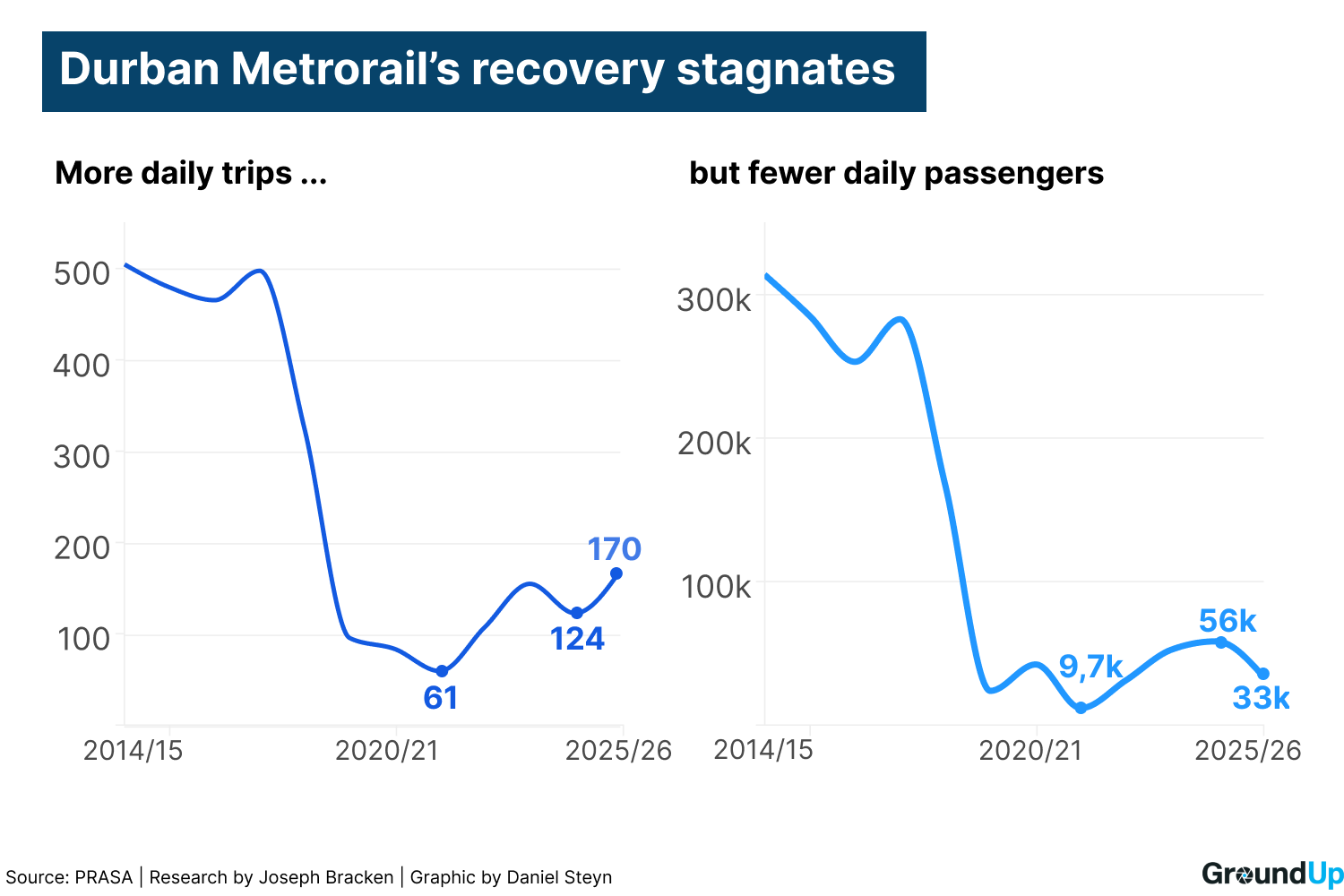
After hundreds of millions of rands of investment, Metrorail’s recovery in Durban has slowed.
PRASA spokesperson Andiswa Makanda said the drop in passengers throughout 2025/26 was due to difficulties in repairing damaged and vandalised infrastructure.
Makanda could not provide daily passenger statistics for the first few months of the 2026/27 financial year, but did provide monthly figures. These show some improvement in the past few months.
PRASA recorded an average of about 982,000 passengers a month from April to July 2026, compared to about 850,000 throughout the 2025/26 financial year.
The accuracy of PRASA’s passenger data is uncertain. Ticket offices at some stations are often closed, and passengers’ tickets are rarely checked. PRASA does not count passengers who travel without paying.
In 2024/25, Durban Metrorail trains made 124 trips a day on average. Currently, the daily average is 170 trips, said Makanda.
Makanda said PRASA is committed to arranging an interview with the newly appointed Regional Manager Thami Sithole to discuss future plans and challenges at the agency.
PRASA’s rehabilitation of the Durban Metrorail appears to have also slowed.
Some lines still operate with only one track between certain stations. These include the Chatsworth line between Merebank and Crossmoor, and the Old Main line between Rossburgh and Pinetown. Between these stations, trains can only travel in one direction at any time. Makanda said Crossmoor will be fixed in September and Pinetown by November.
The Southern Coast line, which previously terminated at Isipingo, has been extended and terminates five stops later, at Winklespruit. But repairs to the rest of the line are on hold pending the rebuilding of the Illovo bridge, which was destroyed by floods in 2022, said Makanda.
Only sections of the Northern Coast and the KwaMashu lines are operating. Overhead lines and signalling equipment have been stolen or vandalised and need replacing, said Makanda. Parts of these lines are owned by Transnet.
For at least two years, PRASA has been trying to finalise a memorandum of understanding with Transnet to get the lines fixed. PRASA told GroundUp in September 2024 that talks with Transnet were “at an advanced stage”.
The Bluff line remains closed.
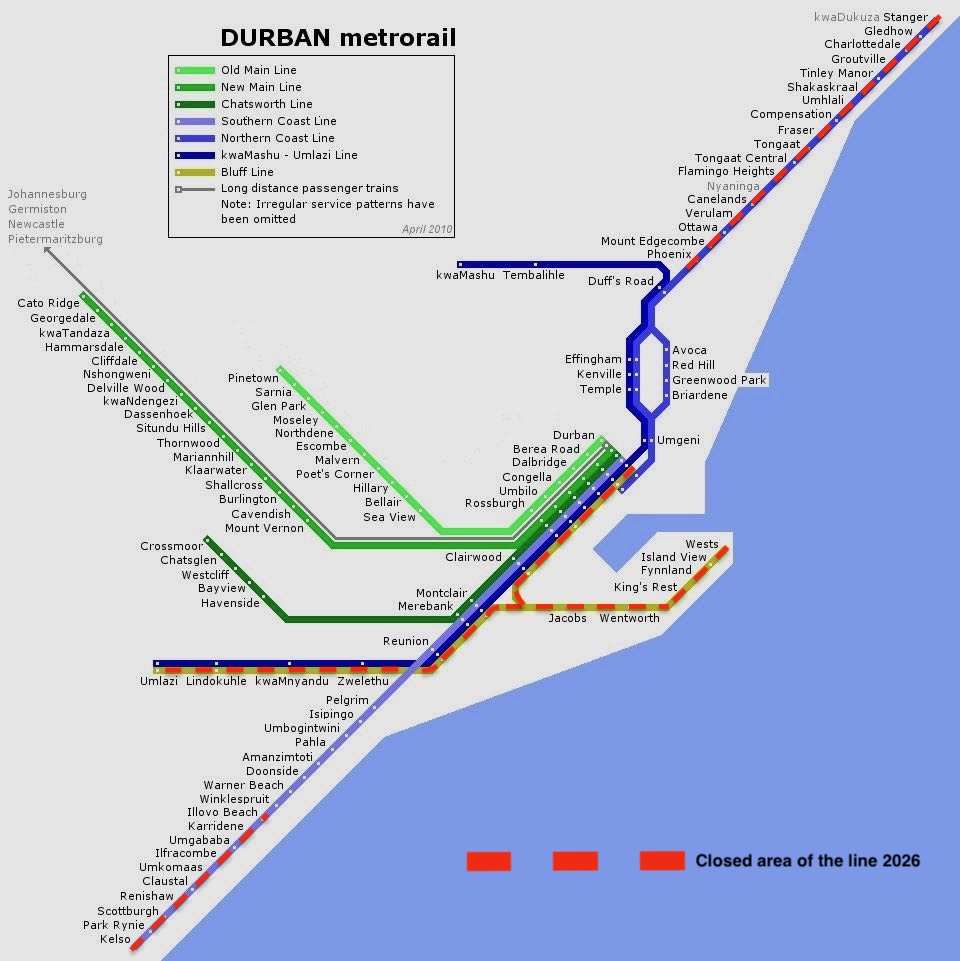
Map of PRASA’s Durban Metrorail network. Map by PRASA, with annotations by GroundUp.
Last week, GroundUp took the train from Durban to Reunion on the KwaMashu-Umlazi line. This is the only line that runs both north and south of Durban station. The line runs 17 return trips a day.
Stations and trains were clean and safe, and security officials were visible on platforms and in carriages.
The train was supposed to leave Durban station at 8:29am, but it only left at 8:36am. It was mostly empty, with about five passengers on board. About ten more passengers had joined by the time the train reached Reunion.
It took about 37 minutes to reach Merebank (last year it took 45 minutes), and then about 45 minutes to reach Reunion.
Along the way, we saw PRASA employees clearing foliage from the rails. But the area just outside Durban station appears not to have been cleaned up for months. There were mounds of rubbish, in some areas piled almost as high as the bridges above the tracks.
Fences at some stations remain broken, with gaps large enough for people to climb through.
At Reunion station, a pinned-up timetable said that the next train back to Durban would be at 9:43am, but it did not arrive. The timetable did not match the one pinned up at Durban station. An official told us the train would arrive at 10:30am, “or a bit before”. It arrived at 10:15am.
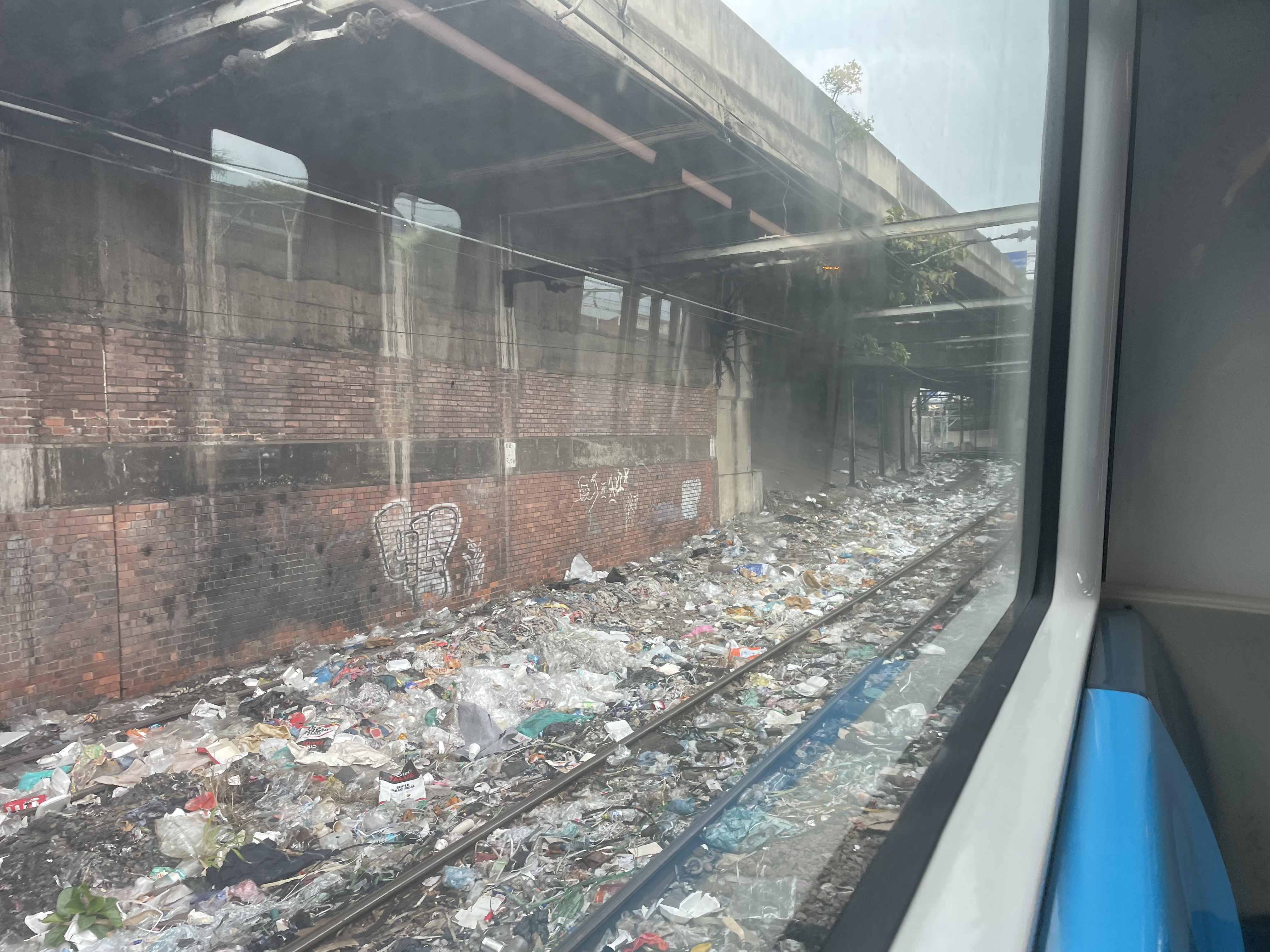
Rubbish appears not to have been cleaned up for months.
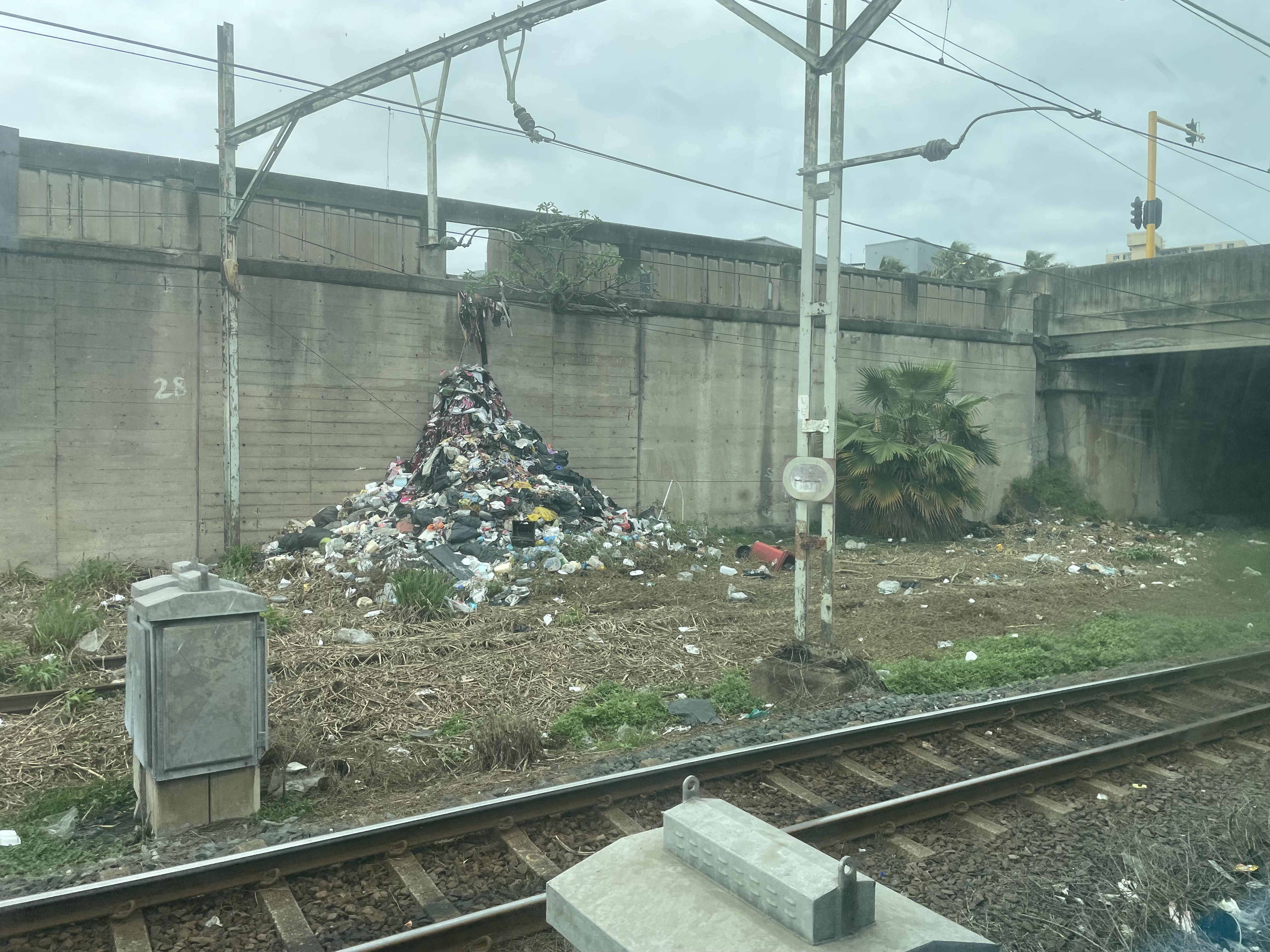
One of the large piles of rubbish along the Durban Metrorail line.
We noticed a few improvements to Durban station since last year. The two large digital boards in the station have been fixed and display the times for incoming trains. But the digital boards on the platforms are still out of order.
None of the escalators have been fixed. Makanda told GroundUp last year that they would be completely replaced as part of the “station modernisation” programme.
The station is one of 19 stations that now offer card machines to pay for tickets, according to Makanda. But when we tried to buy tickets, the official told us that digital payments were closed and that we would have to pay in cash. There was a card machine in the booth, but the official said the person who operated it was not available.
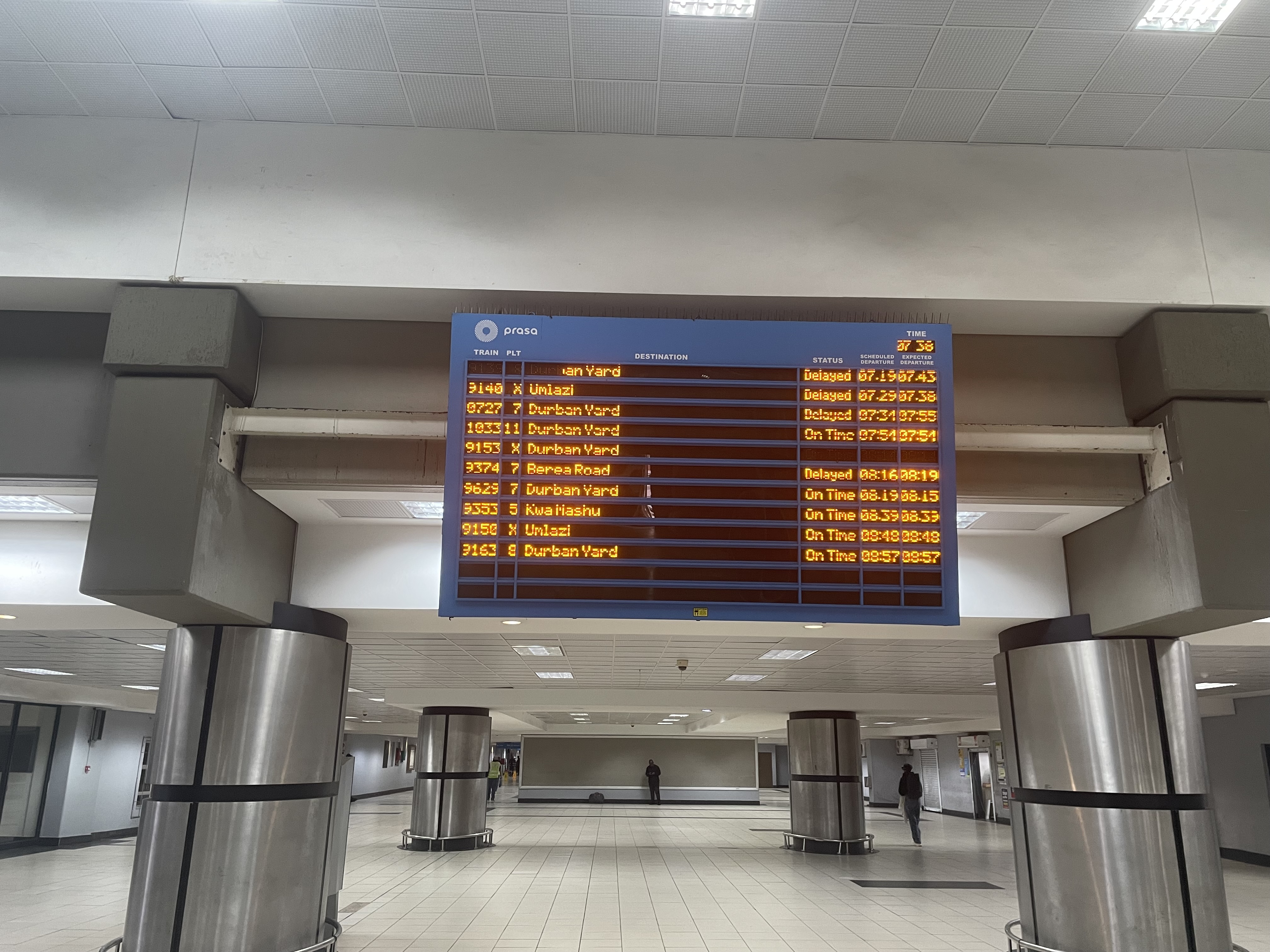
The large signboards at Durban station are working again, but those on the platforms are not.
