5 December 2025
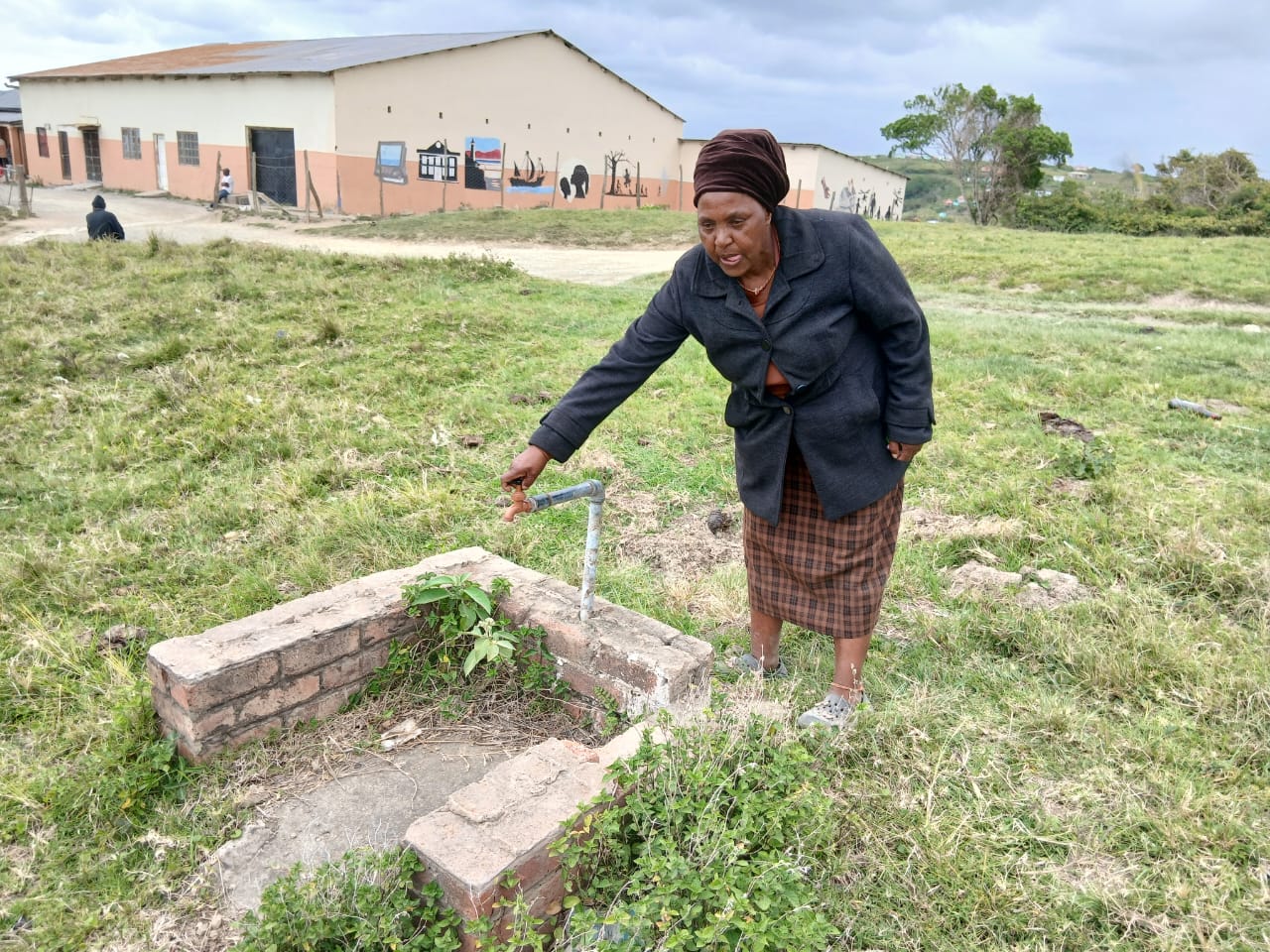
Resident Novelile Mrhobo at a communal standpipe in Mendwana village, which only had water for a few hours last month before drying up again. Photo: Nombulelo Damba-Hendrik
Last month, for the first time in years, villages outside Willowvale in the Eastern Cape had running water. But at two villages, it only lasted a few days before the taps dried up again. Some taps only had water for a few hours.
Residents of Lurhwayizo and Mendwane villages in the Dwesa region say they have now gone back to using untreated river water. They start queuing at the river from 5am, hoping to collect water before it gets too muddy. Some households rely on rainwater, but many do not own tanks.
We reported on the community’s plight in 2021 and returned to the area in November after residents told us their taps, installed in 2001 and without water since 2015, were running again. But by the time we got there, there was no water.
Novelile Mrhobo, a resident, said a contractor was in the village in October to fix the system and was there for nearly a month. During that time, water flowed again in most taps.
“When the contractor left, they told us everything was complete. But the moment they drove away, the water also stopped,” she said. “I wish you were here to see how happy we were when water came out of the taps. We rushed with buckets.”
ADM spokesperson Sisa Msiwa said the Dwesa Water Supply Scheme, which supplies the villages, was completed in 2010. But drought cycles, electricity problems and “ageing infrastructure” caused water disruptions.
The scheme was refurbished this year at a cost of R3.2-million. Pipelines, chambers and standpipes and air valves were renewed. This restored supply to all areas under the scheme, including Lurhwayizo and Mendwane.
But while the scheme is mostly operational, a booster pump station which feeds the two villages is affected by a power supply failure because of an “Eskom phase imbalance fault”, said Msiwa.
“Water pumping will resume only once Eskom restores power,” she said.
A proposal for further upgrades of R7.3-million funded by the Municipal Infrastructure Grant has been submitted, she said.
The municipality has had a string of negative audit findings in recent years and has been plagued by political instability. It is deep in debt, most of which it is unlikely to recover. In 2023, it spent 0.5% of its property value on repairs and maintenance — a figure that National Treasury recommends should be at least 8%.
National Treasury has recently warned the municipality that it may lose its conditional grant funding should it not put an end to unauthorised, wasteful and irregular expenditure. This comes after the municipality passed a budget for 2025/26 that it cannot fully pay for.
Mendwane resident Lungephi Thethi said people have lost hope in the government. “We vote in every election, but we are the most forgotten village. If something must be fixed, we fix it ourselves. But now we are pensioners living on grants. We cannot afford to fix everything,” he said.
Non-profit organisation Equality Collective has recently launched a project in the area, working with community-based organisations to monitor water outages and faults.
The organisation has had success with the nearby Mncwasa Water Scheme, which five years ago was barely operational. By providing real-time data of the scheme to the Amathole District Municipality, there has been an improvement in the maintenance and management of the scheme. Where water reliability was 39% in 2022, it now averages 80%.
The organisation hopes to replicate this approach at Mendwane and Lurhwayizo. Local government and paralegal service coordinator, Noluvo Mandukwini, said the process is still in its early stages.
“Our focus for now is on working closely with the municipality and the community to build a community monitoring system that we hope will help address the issue of water reliability in a collaborative way,” said Mandukwini.