14 August 2026
45% of people in South Africa aged 15-34 are NEET: not in employment, education or training, according to Stats SA. In 2012, it was 38%.
NEET includes those who did not work during the survey reference week and are not enrolled in education or training. It also covers people who are inactive for other reasons — caring for family, illness, or disability. Anyone who did even an hour of paid work is excluded, as is anyone in education or training, whether they work or not.
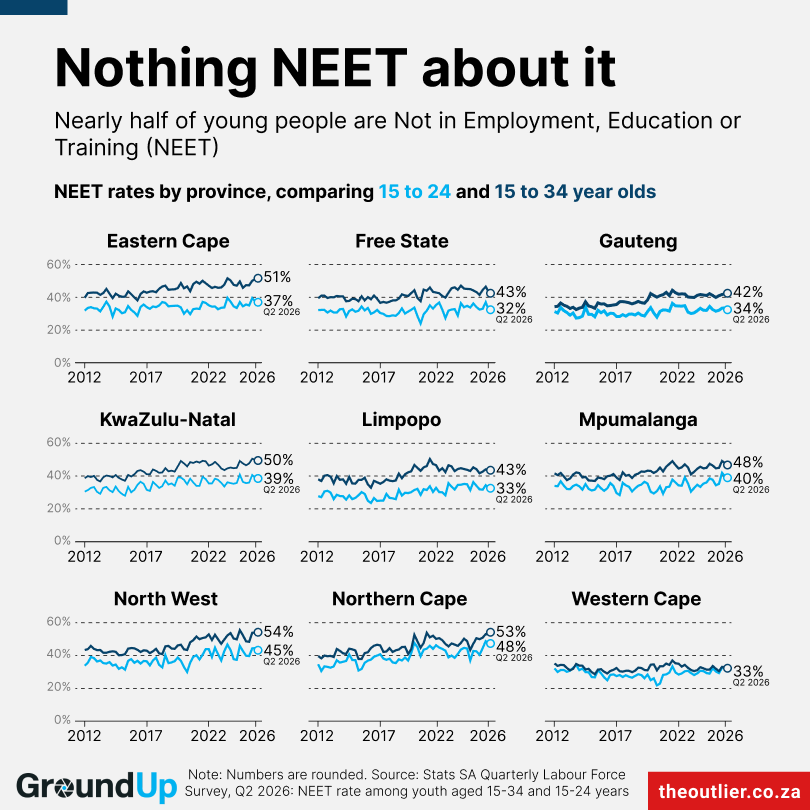
Our chart this week shows the NEET rate for 15- to 24 and 15- to 34-year-olds in each province from 2012 to the second quarter of 2026. The latest figures were released on Tuesday.
In most provinces, there is a gap between the two ranges. This is because people aged 15 to 24 are more likely to still be in school or in tertiary education. As they exit education, they mostly enter the NEET bracket because there are not enough jobs.
The Western Cape is an outlier. There is almost no gap between the two age brackets. This is the province with the lowest overall unemployment rate, where young people exiting education are more likely to be absorbed into the job market.
The NEET rate has also been more stable in the Western Cape than in other provinces.
The Northern Cape has the highest NEET rate: about 48% for 15 to 24 and 53% for 15 to 34-year-olds.
There has been some controversy over how Stats SA measures unemployment. In June 2025, former Capitec CEO Gerrie Fourie claimed that, based on the bank’s transactional data, people working in the informal economy are undercounted. He suggested the real unemployment rate was closer to 10%, rather than the official rate of 32.9% at the time.
Entrepreneur GG Alcock has suggested that should all owners and employees of informal businesses be counted as employed, the unemployment rate would be closer to 12 or 15%.
Stats SA pushed back on Fourie’s claim, pointing out that it does measure the informal economy. It acknowledged that this can be improved.
Fourie also argued that many people who receive social grants may not be honestly answering labour force surveys when asked if they earn any income from employment.
This has not been empirically tested, but if this is the case, young unemployed people who rely on the R370 SRD grant may not be declaring that they occasionally work, as earnings above R624 a month would disqualify them from receiving the grant.
Cutting it the other way, the threshold of one hour of work in a week is a low bar. People who are frequently active in the informal economy should be excluded from NEET.
Produced by The Outlier in partnership with GroundUp
