20 October 2026
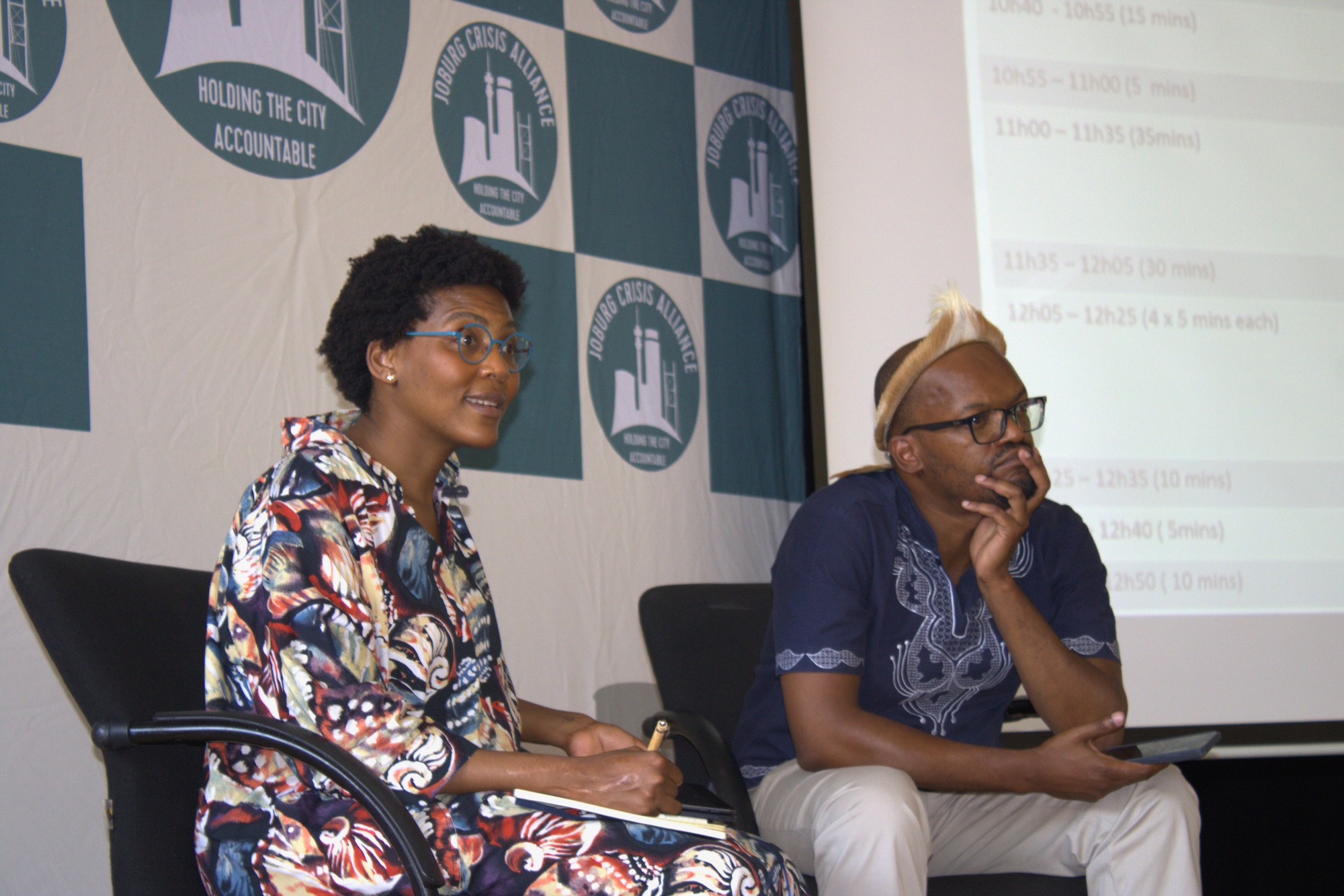
Dr Sithembile Mbete and Khaya Sithole said that reversing low voter turnout is important for the upcoming local elections. Photo: Seth Thorne
Johannesburg, the City of Gold, has lost its shine for many of its estimated 4.8-million residents.
“Johannesburg’s residents struggle with unreliable water and electricity, deteriorating infrastructure, unsafe neighbourhoods, corruption and declining public services,” the Joburg Crisis Alliance (JCA) said at its tenth summit, at which more than 250 people gathered in Parkview, Johannesburg, on Saturday, 17 October.
To fix the city, every one of the City’s 270 councillors needs to commit to accountable governance, said the JCA – a coalition of residents, activists, and organisations working to “end corruption, restore governance, and improve service delivery”.
Water is one of the starkest examples of declining services, with residents citing persistent, prolonged water disruptions. Between June 2025 and June 2026, more than 50,500 leaks were reported, mainly from old pipes. In 2024/25, an estimated R2.8-billion worth of water was lost. Johannesburg Water said it is financially hamstrung and needs more than R64-billion over ten years for its turnaround strategy.
The city’s electricity supply is in a similar state. In 2024/25, Joburg reported over R5.6-billion worth of electricity losses. In May, Eskom threatened to cut supply to parts of the city over a R5.2-billion debt owed by the City and City Power (this has since been settled). But prolonged outages due to years of underinvestment in substations and infrastructure and pervasive cable theft persist.
Rubbish is piling up too. Pikitup’s collection fleet was largely grounded this winter by strikes due to frequent late payments to casual workers employed by City service providers. The metro’s centralised cash management had also left Pikitup unable to pay many of its providers. The striking workers were also demanding to be employed directly by the municipality. The City is also running out of landfill space.
The City’s sewage system has also been deteriorating. The national regulator found half of Johannesburg’s sewage treatment plants in a critical state. The City’s score has fallen in every audit cycle, from 91% in 2011 to 49% in the 2025 report.
At the JCA summit, Dr Sithembile Mbete of the Public Affairs Research Institute said that behind the service failures lies a municipality in financial and administrative distress, despite collecting over R81-billion in revenue in 2024/25.
The Auditor-General gave the municipality’s 2024/25 financial statements a qualified opinion, finding nearly R3.7-billion in irregular expenditure and almost R2.4-billion in unauthorised expenditure.
The metro adopted an unfunded budget, and received a warning letter from finance minister Enoch Godongwana in April that the City could lose a tranche of its national grant if it did not get its books in order. The minister cited creditor debt of over R25-billion among other financial woes. R3.6-billion in funding was temporarily withheld until financial recovery commitments were made.
President Cyril Ramaphosa flagged the city’s collapsing infrastructure, financial mismanagement and electricity and water interruptions. He created the Johannesburg Presidential Support Working Group in 2025, and Mayor Dada Morero set up a “Bomb Squad” linked to it.
But the JCA summit noted that national and provincial interventions have not moved the dial on fixing Joburg.
Mbete described the upcoming elections as “consequential”.
The JCA says its compact is non-partisan but built on feedback from residents across the City’s regions. At the summit, the alliance launched a Residents’ Call to Save Joburg.
“Residents have repeatedly told us they want leaders who are honest, visible, competent, accountable and who deliver results,” said the JCA, challenging every election candidate to commit to:
As a non-partisan alliance, the JCA is not endorsing any party or candidate, but said that residents should ask every candidate whether they will publicly make these commitments.
The JCA said that it is committed “to sustained civic action to restore accountable governance and reliable service delivery in Johannesburg”. Ten priority actions that the JCA said it will monitor during the first year of the new administration include:
The summit resolved to set up a Civic Watchdog to “follow the money” by scrutinising budgets, procurement and expenditure. JCA member Lisa Seftel noted that the City collects billions in revenue while services crumble.
The summit called for an independent ‘Madlanga-type commission’ to act as evidence emerges, civilian oversight of the JMPD, and a specific focus on Joburg by national enforcement agencies.
Summit attendees pointed to six administrations since 2021 and expressed concern that unregulated coalitions and patronage would perpetuate instability.
The JCA has urged parties with elected councillors to prioritise the city’s interests over their parties’ interests, avoid deals across municipalities, form a majority government that prevents small parties from wielding undue power, and adopt a coalition management framework and minimum common platform rather than opportunistic alliances.
To form the next administration, the JCA proposes allocating mayoral committee portfolios in proportion to votes received, publishing a coalition agreement that informs the City’s Integrated Development Plan, and introducing measures to limit political interference in the administration.
It also recommends restricting motions of no confidence unless criminality is shown and establishing independent dispute resolution, preferably through an external mediator.
The summit also heard warnings about disinformation. Mbete and Wade Manning of Defend Our Democracy cautioned that, with 75 parties on the ballot, results may take longer than usual and social media accounts will claim ballot-stuffing.
A News24/SABI mayoral poll has Helen Zille (DA) leading on 36%, followed by the ANC on 27%, and Herman Mashaba (ActionSA) on 13%.
The ANC has not named a final mayoral candidate and has only listed Dada Morero, Loyiso Masuku and Frank Chikane as possibilities. Masuku, the deputy mayor, said the party must rebuild trust through accountable councillors, better revenue collection, and urgent action on failing services. Mayor Morero has pitched Joburg as a city that is functioning despite decay.
Helen Zille’s five pledges revolve around reliable water and electricity, working roads, 200,000 new jobs, law and order, and a professional, modern government. The fourth pledge includes reclaiming hijacked buildings and tackling corruption.
ActionSA’s Herman Mashaba wants 2,500 more metro police officers over five years, tighter municipal control of City Power and Johannesburg Water, and a revived programme to redevelop hijacked inner-city buildings. He wants future appointments vetted through public interviews, and puts a strong emphasis on “removing undocumented migrants”.