3 March 2026
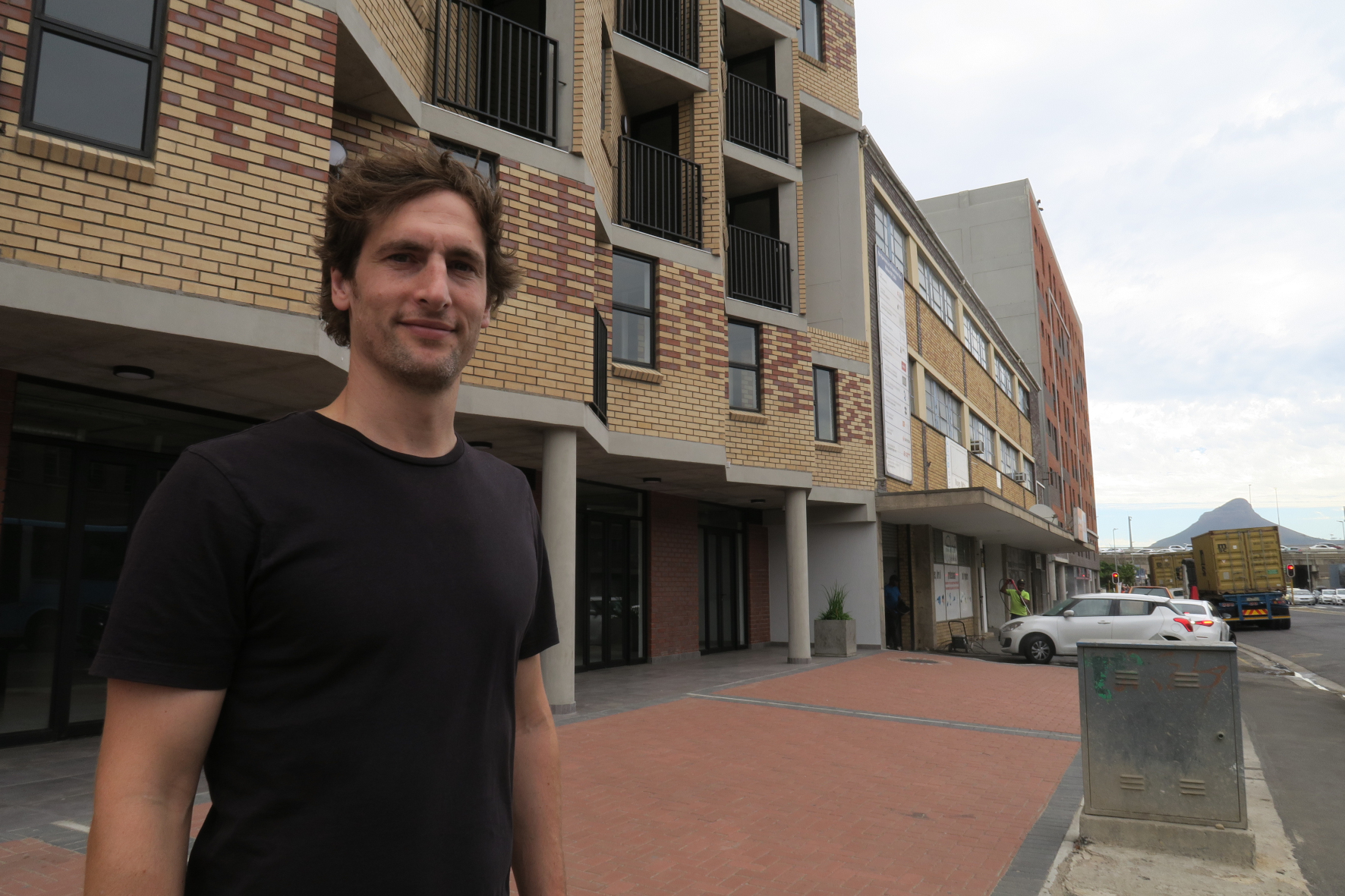
Shaun Reznick outside Maitland Ark’s affordable housing development, The Cube. Photo: Steve Kretzmann
Amidst a severe shortage of affordable housing in Cape Town, a company is building affordable apartments which are helping to change the face of west Maitland.
Maitland Ark, the company which has bought several properties along Voortrekker Road at the western edge of the suburb, is backed by wealthy families, including philanthropist Anthony Tabatznik, who is one of four active directors.
The aim, said Shaun Reznik, who is managing director of BlueBuck Projects, the company managing the two large housing developments on the properties, was to “disrupt affordable housing challenges in Cape Town”.
“We decided to build a building and see how cheap we could get (the rental) while still achieving a reasonable return,” said Reznik.
Speaking while sitting in a one-bedroom show apartment in the newly-built, 241-unit The Cube development, Reznik said the building was already half-full with tenants just four weeks after opening. Their first development, 143-unit The Prime, just two doors down the block, had a steady 97% occupancy and collection rate.
He said West Maitland was well situated for apartment blocks for low to mid-income residents.
A long, thin suburb bordered on the east by Goodwood, Maitland is centred along the urban Voortrekker Road corridor joining Salt River to Bellville. Reznik said Maitland Ark chose the Salt River end of the suburb as it is well-located for residential apartments. The Koeberg train station on the northern line is little more than a block away, Voortrekker Road is a MyCiTi bus route, the M5 connecting to the N1 and N2 is a block away, and the city centre is in easy reach.
Properties closer to the city centre, such as Woodstock or Salt River, were too expensive to be able to achieve their aim of building affordable apartments.
However, Reznik notes that what is deemed “affordable” depends on who is defining the term. As officially determined by the Financial Sector Charter, the upper limit for affordable housing is now at R34,400 gross income per month. But at least 70% of Cape Town’s households earn less than R25,600 per month.
“We try come in at (household income of) R25,000 or less, given about 30 to 40% of that income being used for rent,” says Reznik. Water and electricity is pre-paid, and fast uncapped internet is offered to tenants at a very competitive R350 per month.
The fair sized, semi-furnished one-bedroom apartments go for R7,900 per month. Two-bedroomed semi-furnished apartments are rented from R9,800 a month, with three-bedroom apartments costing R12,000 a month. A group of people, such as students, can also rent their own bedroom in a shared apartment, each with their own lease, for R4,900 each.
Comparatively, one-bedroom apartments in Woodstock cost about R10,000 per month, with two-bedroomed apartments going for anything between R12,500 and R30,000 per month.
He said they chose to build rental apartments rather than apartments for sales.
“We’re not selling these units as we don’t think the market in Maitland is willing or able to buy the units at the price we’d need to sell them, but that could change down the line.”
Additionally, the idea was to keep the apartments affordable. If they were for sale, “someone with money can buy our affordable units and flip them, which takes them out of the affordable housing stock”.
Affordable rentals are possible because the company is willing to accept a lower return than most private sector developers.
He said they were looking to make a first year yield of about 9%, whereas developers normally aimed for as close to a 20% profit as they could get.
Providing a figurative example, he said if the development cost Maitland Ark R100-million, and it cleared R9-million after expenses, it would be a 9% yield.
He said it was also lucky there were “a couple of properties” for sale close together in Maitland that had bulk available in terms of available floor factor, and no rezoning was necessary. So they have been able to turn two dowdy one-story properties into two eight and nine-story blocks of accommodation without having to evict residential tenants, with more on the way.
There are also light industrial and commercial buildings in the same precinct, and the completed Maitland Mews social housing project is around the corner, turning this part of Maitland into a functional, bustling mixed-use precinct.
Although private developers are desperately needed to ease Cape Town’s housing crisis, there’s been little assistance from the municipality.
Reznik said incentives such as waiving development charges (these are uniformly levied on developers), electricity and water connection fees, building approval fees, and offering a rates holiday would greatly assist private developers seeking to offer more affordable housing.
He said as far as he knew there was no legislation enabling the City to provide these incentives, or even payment holidays for privately funded developers. If they were available, the company could have provided more one and two-bedroom units at the same rentals.
“These [one and two-bedroom] units are larger and have massive demand, but their rental rate per square metre is lower than a studio.”
These economics result in more studio apartments being developed by private developers, which exclude families from accommodation.
He believes incentives could entice developers to make some of their units available for inclusionary housing. (See this GroundUp article for the affordable housing landscape in Cape Town.)
Asked why Maitland Ark and BlueBuck Projects are providing affordable apartments despite the lack of incentives, and for lower financial returns, Reznik said: “There are some wealthy people with good intentions who want to see Cape Town transformed and progress.”