11 May 2026
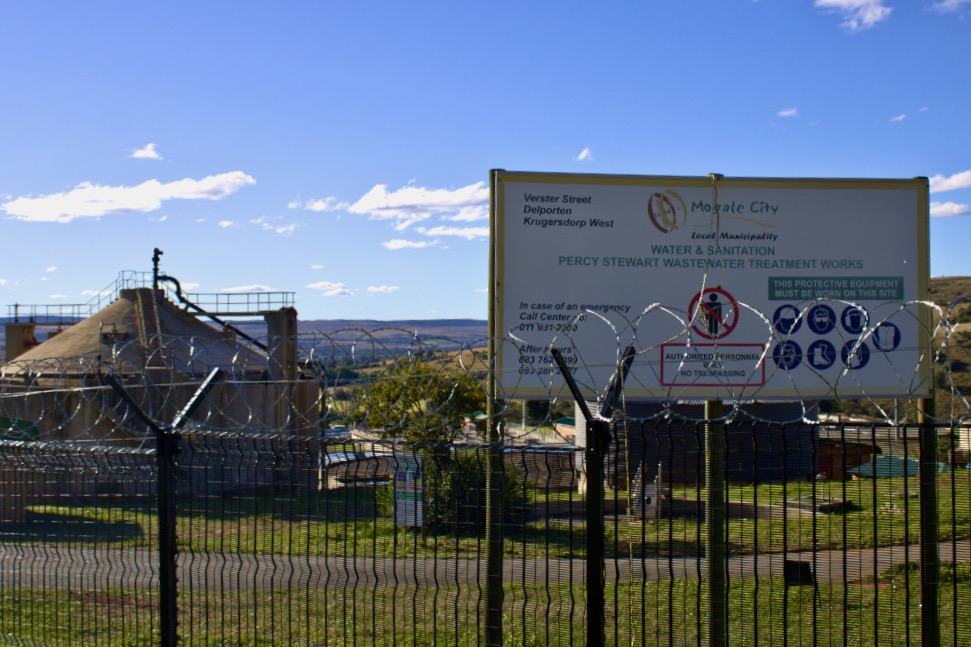
A report by the CSIR identifies the Percy Stewart Wastewater Treatment Works as a primary threat to the Cradle of Humankind world heritage site. Photo: Seth Thorne
Failures in sanitation management in Mogale City Local Municipality on Gauteng’s West Rand has left rivers and the wider environment contaminated, placing communities, heritage and ecosystems at risk. It is home to 440,000 people and large parts of the Cradle of Humankind world heritage site (CoHWHS).
Mogale City’s Green Drop score went from 75% in 2013 to 65% in 2021, and fell below 30% in 2025, placing it in the critical category, “the largest regression [in Gauteng], falling from average to critical performance”, noted the report.
The Green Drop Report from the Department of Water Sanitation (DWS) is the country’s benchmark audit to assess the state of wastewater treatment works (WWTWs).
All three of Mogale City’s WWTWs are in a critical state: Flip Human at 30% (down from 64% in 2021); Percy Stewart at 30% (down from 68% in 2021); and Magaliesburg at 27% (down from 49% in 2021).
The City received 0% rating for microbiological and chemical compliance. Microbiological and chemical compliance checks for harmful pathogens (like E. coli) that pose health risks, as well as chemical pollutants (such as nutrients, organic load, and heavy metals) that can degrade water quality and harm aquatic ecosystems.
DWS has issued a Red Regulatory Notice that requires the municipality to submit a Corrective Action Plan by the end of May. The plan must give a detailed, time-bound strategy for restoring its treatment works.
Trevor Brough, director of CoHWHS Association, said, “To call it an absolute disaster is an understatement.” He said facilities continue to discharge raw sewage into rivers already battling more than a century of acid mine drainage.
He described the Blougatspruit and Bloubankspruit, where Percy Stewart WWTW has its output, as “rivers of disease”.
A 2024 Water Resources Status report by the Council for Scientific and Industrial Research (CSIR) identifies the Percy Stewart WWTW as a primary threat for the Cradle of Humankind site, with the worst pollution downstream of it. Here E. coli counts consistently exceed 2,419 per 100ml, far above the CSIR’s “extreme high risk” threshold of 1,000 MPN/100ml. The stench of raw sewage is overwhelming.
Andreas Oberlechner, chairperson of the Roodekrans Neighbourhood Watch, said that for 15 years the Percy Stewart facility was “basically pumping [raw sewage] straight back into the river … It has killed off the ecosystem of the Cradle of Humankind”.
Twelve of Mogale City’s 14 sewerage network pump stations were found to be non-functional. As a result, significant volumes of sewage never even reach the treatment works.
Of the sewage that does reach the three WWTWs, which have a combined design capacity to deal with 89,500 kilolitres (kL) of effluent a day, only 53,500 kL/d can be processed. The actual operational flow reaches 59,720 kL/d, resulting in about six-million litres a day of untreated sewage re-entering the environment from the works.
The department said that Mogale City has the lowest operational staff ratio in Gauteng with less than two qualified staff per plant. The City is also short three supervisors and seven qualified process controllers.
Under the National Water Act, the department has referred one criminal case for persistent pollution or negligence to the National Prosecuting Authority.
It has also issued one formal Notice of Intention to Issue a Directive, which serves as a final administrative warning before greater intervention or legal steps are taken.
The department had said it is also ring-fencing water grants for repairing and refurbishing the failing pump stations and treatment works.
Queries were sent by GroundUp over a week ago, but Mogale City’s executive management had not approved the responses at the time of publication.
