21 October 2026
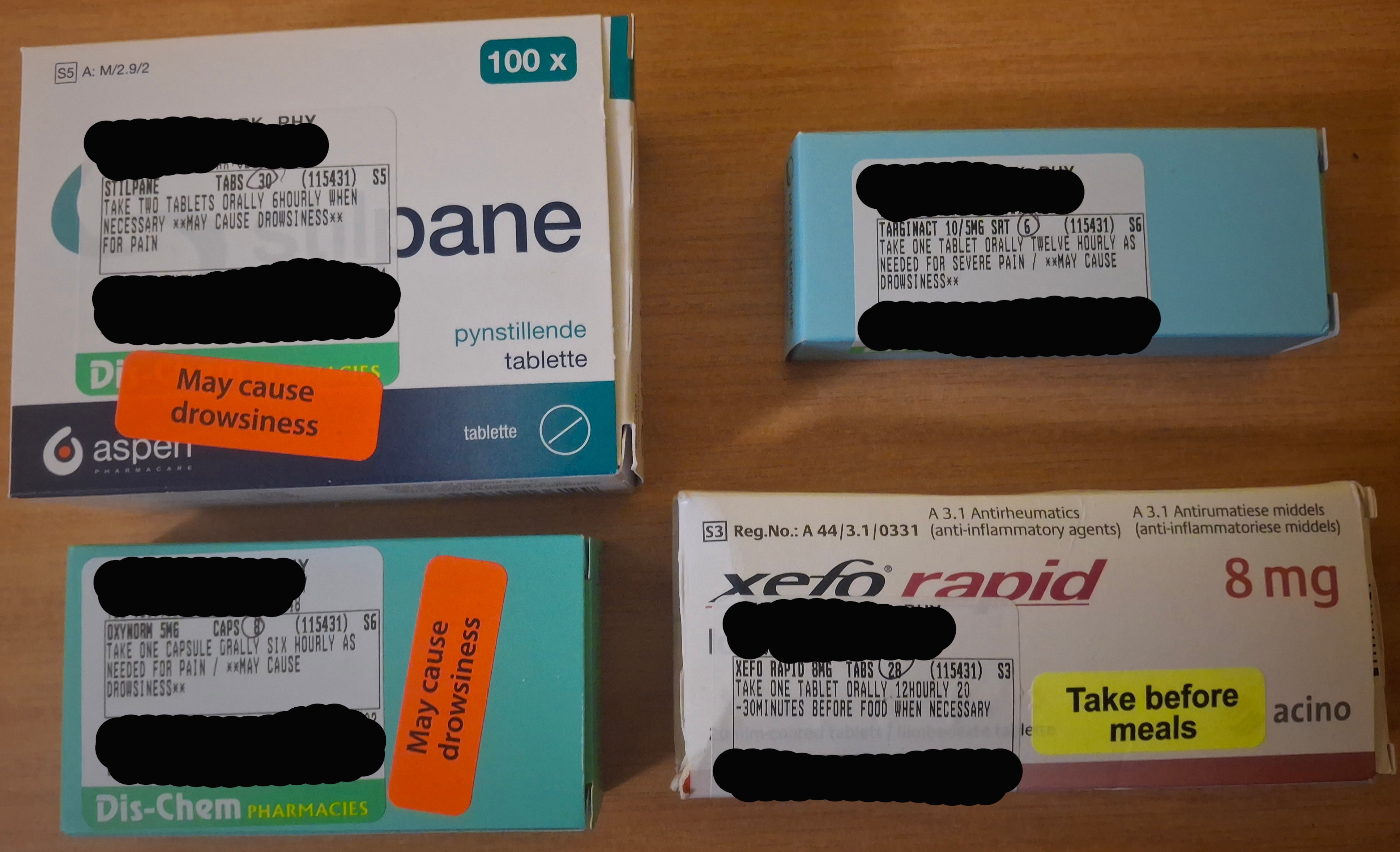
The author was given all these pain medicines after a minor operation. (Identifying information has been blacked out.) Photo: Nathan Geffen
I had surgery on my shoulder under general anaesthetic a few months ago. About one in seven South Africans have medical insurance. I am fortunate to be one of them. I was operated on about a month after an injury that necessitated it. The operation took place in a very comfortable private day hospital. The surgeon, anaesthetist and nurses all treated me well. The operation went well. I had very little post-op pain and my shoulder has recovered well.
It’s unlikely I would have had a similarly positive experience in the public health system. If surgery were even an option, the wait would have been much longer and it would not have been in such comfortable surroundings. At an academic hospital like Groote Schuur I would likely have had very good doctors and nurses, but perhaps not at most other public hospitals.
But there were two serious problems I encountered that run through the private health system: a dangerous approach to pain management and spiralling costs. In this article I deal with pain management. (I’ll discuss costs in another.)
Managing pain is a vital part of health care. Modern medicine has not only made great strides at curing diseases and increasing our lifespans, but also at reducing pain. Nevertheless, pain management is a balancing act; many pain medicines are addictive and dangerous.
The workhorses of pain medicines are paracetamol (which most people know by the brand name Panado, but there are much cheaper generics) and nonsteroidal anti-inflammatories (NSAIDs) such as ibuprofen. Used properly together these are effective against moderate pain. They are not addictive and they have fewer side effects than most other pain medicines. But they are not 100% safe. Overdoses occur. Paracetamol can harm the liver and ibuprofen can harm the kidneys. People who use them frequently should be getting medical advice. 
Professor Romy Parker is an expert on pain management at UCT. She explained to me that too much emphasis is put on using drugs for mild pain relief when often people can overcome such pain by doing deep breathing or using ice packs.
I was discharged with four cartons of pain medicines, branded as Targinact, OxyNorm, Stilpane and Xefo Rapid, shown in the photo for this article.
All of these are questionable. And all four together are especially dangerous.
Targinact (10/5mg): The pain relief drug in Targinact is oxycodone. If you’ve read Empire of Pain or watched Painkiller on Netflix, you will know that this is the drug at the centre of the US prescription opioid epidemic, responsible for hundreds of thousands of deaths, and many more broken lives. It is highly addictive. There is a place for oxycodone. People suffering severe pain, for example because of some types of cancer, benefit from it. But it is definitely not something that should be matter-of-factly given, as standard practice, to someone who has had relatively minor surgery.
The price of this carton is R873 (all prices as of 20 October).
OxyNorm (5mg): This has the exact same pain relief drug as Targinact — oxycodone, except it acts quicker and is half the dose. There was no need to prescribe either of these medicines, but even less need to prescribe both of them. The Australian government’s website states: “OxyNorm is indicated for the short-term management of severe pain for which other treatment options have failed, are contraindicated, not tolerated or are otherwise inappropriate to provide sufficient management of pain.” This was definitely not my situation, nor that of most post-op patients.
The price of this carton is R415.
Stilpane: The pain relief drugs in this are paracetamol, codeine and meprobamate. (It also contains caffeine.) Paracetamol is reasonable. Codeine is also an opioid and addictive. It has its place in pain relief, but it is far too widely used over-the-counter in South Africa.
A 2024 study in the journal South African Family Practice says that easy access to over-the-counter codeine has created a perception that it is harmless. Long-term use can lead to stomach ulcers and bleeding, and the drowsiness it causes is risky for driving.
But even more concerning is meprobamate. This tranquiliser from the 1950s has been replaced by safer, more effective alternatives. Andy Gray, a leading pharmacologist, is sceptical it should even be on the market. It’s too easy to become dependent on this drug.
The price of this carton is R186.
Xefo Rapid 8mg: This contains an NSAID called lornoxicam. It is similar to ibuprofen. This was the one sensible drug I was given, and the only one here I actually took (along with generic paracetamol at 30c a pill that I keep at home). Except it is nearly R19 per tablet versus generic ibuprofen which is just over R3 per tablet. There is no compelling evidence that lornoxicam is any better than ibuprofen.
I asked Gray what’s behind this overprescription. He offered two reasons: traditional prescription practices that go back decades, and the influence of drug reps who visit doctors and oversell the benefits of these drugs. An anaesthetist in private care offered a further reason: some patients in private care who have these kinds of operations experience significant pain and can be very demanding of pain medicines. So doctors pre-empt this by overprescribing.
There are patients who do need something stronger than paracetamol and a NSAID. But if these drugs aren’t doing the job, that should entail a discussion with their doctor before getting a stronger, properly considered, prescription. One doctor told me that he gives post-op patients a prescription for stronger painkillers, but explicitly tells them not to use the prescription unless ibuprofen and paracetamol are failing to relieve their pain. This is a reasonable approach.
There’s a further problem with overprescription of these medicines. A study led by New Zealand researchers found that most people don’t finish their pain medicines. I didn’t finish the Xefo and I didn’t touch the others. So what happens? The drugs languish in the medicine cupboard, and perhaps months or years from now get offered to a family member, or thrown in the garbage and collected by the local binpicker. There are potentially tragic consequences of both these options. Flushing them down the toilet is not environmentally friendly; Cape Town’s fish life, for example, already has detectable levels of various human-used drugs.
Parker explained to me that the correct thing to do is to ask my local pharmacist to dispose of the drugs. I didn’t know that and I imagine most people don’t.
I don’t blame my doctors for this situation; it has become ubiquitous. What is needed is for doctors’ organisations, like the South African Medical Association, with the Pharmaceutical Society of South Africa, to publish advice on better, more rational, approaches to pain prescriptions. Gray told me that the public sector’s guidelines are based on the best evidence, and consider affordability, so can also be relied upon. The pharmaceutical companies might push back, but we don’t want the kind of deadly opioid epidemic that the US has had to deal with to be imported to South Africa.
Sean Christie’s articles in GroundUp this year have shown how desperately short of pain relief medicines the public health system is. The private health system has exactly the opposite problem. Both problems are curable.