
27 November 2026
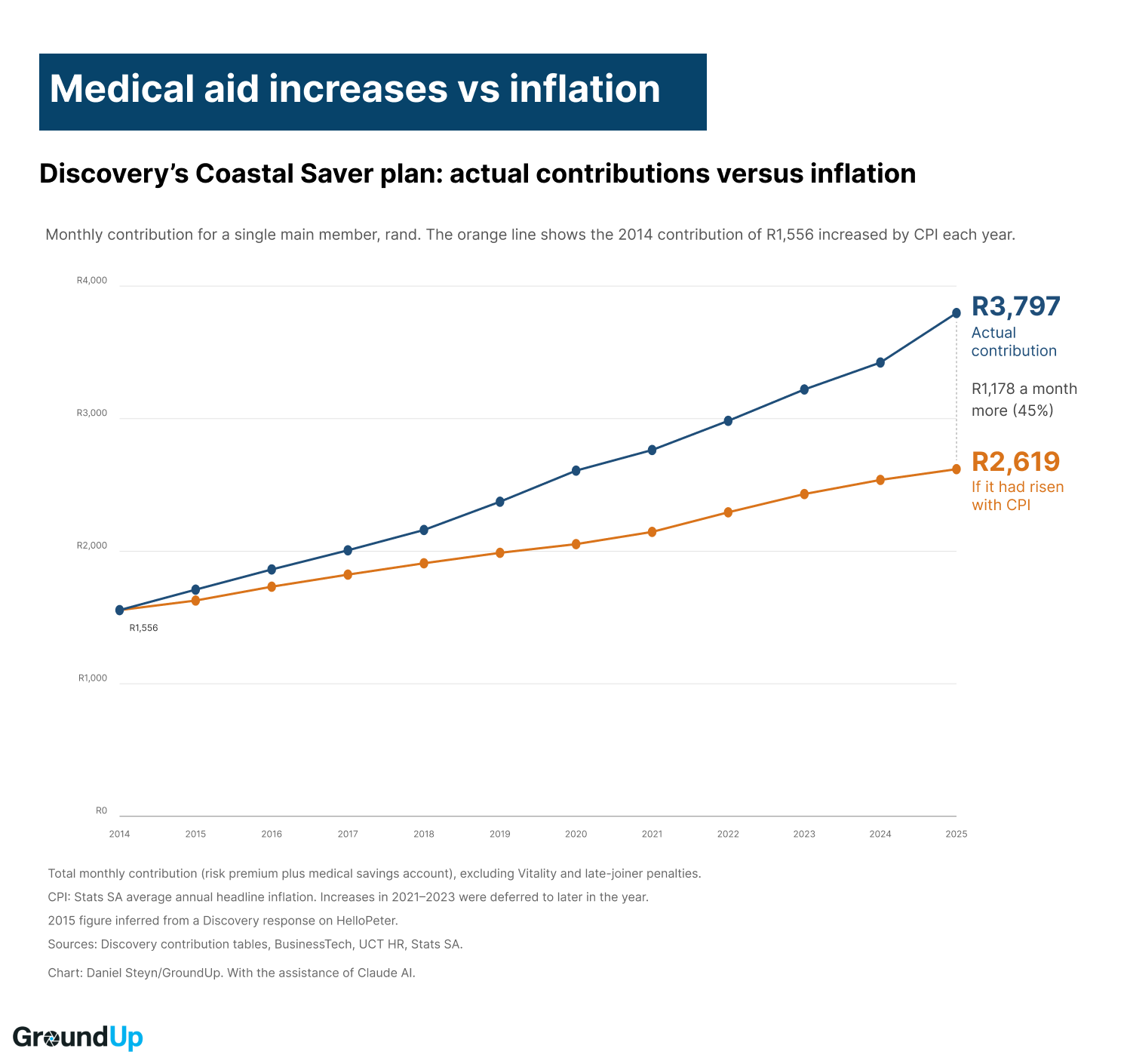
The author’s medical aid contribution has increased more than double the rate of inflation since 2014. Illustration: Lisa Nelson
A few days before I was due to have an operation on my shoulder, the anaesthetist’s office sent me a projected bill. R16,700 for a two-hour operation.
I phoned his office.
“Is that the medical scheme rate?” I asked his receptionist.
“It’s 300%,” she said. “Don’t you have gap cover?”
“No. ”
“Well then you can ask the doctor for a discount,” she explained.
So, a few minutes before my operation, the anaesthetist, who seemed a very nice man, introduced himself. There I was lying half-naked in a hospital robe, neither confident nor dignified, but I plucked up the courage. “Umm, sorry to ask you this. But I don’t have gap cover. Is there any possibility you could discount your rate?”
He was astonished that I didn’t have gap cover. To his credit, after lecturing me on the necessity of buying said cover, he did substantially discount his invoice, and I only ended up paying a few thousand rand on bills for over R30,000 for the procedure. Discovery medical scheme covered the rest.
Gap cover was introduced to help patients cover shortfalls when their medical schemes don’t pay out. But that private sector patients now pay for insurance on top of their insurance is a symptom of a sick system, with runaway costs. Moreover, gap cover encourages doctors to charge more, to go up to the maximum amount that the gap cover company, together with the medical scheme company, will pay.
Discovery recently announced its premiums for 2027. It’s a reminder that medical inflation is much higher than the CPI. I’m on Coastal Saver and it costs over R7,000 per month to insure two of us. So I started looking at the options in this pamphlet.
There are eight plans: Executive, Comprehensive, Priority, Saver, Smart Saver, Smart, Core and Key. Most of them have options. In all I count 26. The pamphlet is filled with jargon: prescribed minimum benefits, day-to-day benefits (which are divided into extensive and limited), hospital benefits, network benefits, Extender Benefit, Above Threshold Benefit, Annual Threshold Benefit, Personal Health Fund, Medical Savings Account. And that’s before we get to what diseases are covered and to what extent. Dentistry is its own thing. Once you’ve got to the bottom of all this, you need to check PDF files to see which GPs, specialists and hospitals are covered by your specific plan.
It’s frustrating trying to understand this and make an optimal choice. After an hour or two, even with the help of AI, I gave up, bleary-eyed, confused and bored. Becoming an expert in the minutiae of medical schemes has never been a life-dream. I understand one can consult a broker, but that raises a bunch of questions about trust and cost. Choosing medical insurance should not be this complicated.
The table below shows how Discovery’s Coastal Saver option rose from R1,556 to R3,797 between 2014 and 2025, an increase of about 144%, more than double inflation.
Discovery Coastal Saver: monthly premium for a single main member, 2014–2027 (rand per month).
Click a total to open its source. (Generated by Claude LLM. Checked and edited by the author.)
|
Year |
Premium (R) |
Savings (R) |
Total (R) |
Increase % |
CPI % |
|---|---|---|---|---|---|
|
2014 |
1,167 |
389 |
– |
6.1 |
|
|
2015 |
n/a |
n/a |
9.9 |
4.6 |
|
|
2016 |
n/a |
n/a |
8.9 |
6.4 |
|
|
2017 |
n/a |
n/a |
7.8 |
5.3 |
|
|
2018 |
n/a |
n/a |
7.6 |
4.7 |
|
|
2019 |
n/a |
n/a |
9.9 |
4.1 |
|
|
2020 |
n/a |
n/a |
9.9 |
3.3 |
|
|
2021 (from July†) |
2,211 |
552 |
5.9 |
4.5 |
|
|
2022 (from October†) |
2,387 |
596 |
8.0 |
6.9 |
|
|
2023 (from April†) |
2,577 |
643 |
7.9 |
6.0 |
|
|
2024 |
2,911 |
512 |
6.3 |
4.4 |
|
|
2025 |
3,228 |
569 |
10.9 |
3.2 |
|
|
2026 (from April†) |
3,484 |
614 |
7.9 |
pending |
|
|
2027 (announced) |
3,775 |
666 |
8.4 |
– |
Premium is the risk contribution that pays for insured benefits. Savings is the portion paid into the member’s medical savings account. Total is what the member pays each month. Figures exclude Vitality and late-joiner penalty.
‡ Inferred from Discovery response on HelloPeter.
† Discovery deferred its increase to the month shown. Members paid the previous year’s rate until then.
The savings share of the total fell from 25% (2014) to 20% and then 15% (2024), so the risk premium has risen faster than the total: from R1,167 to R3,775 between 2014 and 2027.
CPI is Statistics South Africa’s average annual headline consumer inflation for each calendar year. 2026 will be published in January 2027.
I have singled out Discovery because it is the largest scheme in the country. But Bonitas, the second-largest open scheme, and GEMS, the largest closed scheme (it’s only for civil servants), are also complicated and expensive. I’ve had experience with both of these medical schemes and they are at least as frustrating to deal with as Discovery.
South Africa’s two health systems are divided very unevenly. The public health system was allocated R277-billion from the National Treasury in 2024/25. It is a system characterised by long waits, drug shortages and uneven service. It’s often impersonal and uncomfortable. There are centres of excellence that in many ways exceed any private facility, like Groote Schuur Hospital, and public sector doctors are often better at treating TB and HIV than private ones. But there are good reasons why most people who can afford to, avoid the public health system.
By contrast, in 2024 medical schemes paid R259-billion in benefits, and their members paid a further R46-billion out of their pockets. About 15% of the population is insured. More money was spent on their health care than on the entire public system. (Many uninsured people also use the private health system at least some of the time, so private health expenditure was much higher than this.)
Private health is usually comfy, with short waiting periods. Care is much more personal. But it is absurdly expensive, and prone to over-treating and over-prescribing.
One of our systems, the public, has too little, and the other, the private, too much. Compared to countries with similar per capita health expenditure, our health outcomes are poor. For example, Colombia has a life-expectancy of approximately 78, compared to our 67 years.
Medical scheme membership is stagnating, growing more slowly than the population. The schemes themselves are meant to be not-for-profit, but they contract profit-making companies to administer them. Discovery Health Medical Scheme, for example, is run by Discovery Health (Pty) Ltd, a subsidiary of the JSE-listed Discovery Limited. The scheme covered fewer beneficiaries at the end of 2025 than two years earlier, yet Discovery Health’s profit rose 7% and then 9%, reaching R4.6-billion. It’s not only medical insurance that’s doing well. Hospital groups and private specialists are also doing splendidly; patients, less so.
The ANC government has been stuck in the ideological trap of National Health Insurance; three decades later and we’re nowhere close to implementing it. The desire to have an equitable health system is right but good politics means trying to do what’s possible, not pursuing utopian dreams. Our state does not have the capacity to run an efficient health system and people on medical schemes vehemently oppose NHI because they rightly see it as a threat to the much more functional, albeit exclusive, private system.
A more responsible health ministry would have alleviated the burden on the public health system by better regulating the medical scheme industry, so that more people can use the private system. Instead, we now have an increasingly unaffordable private health system.
There are reasonable alternatives to the grossly unequal current system and the unimplementable NHI one.
Universal Healthcare Access Coalition (UHAC) is an alliance of organisations and people working to change this system. (Join them.) UHAC has put forward excellent proposals to make universal health care possible over a five-year timeline (see policy brief 4 in particular). It wouldn’t break the private system and it would create incentives for the public system to perform better. In an upcoming article we’ll explain their proposal. It won’t be easy getting there, though. The medical schemes and the gap cover companies will oppose it (even though the former have a clear, albeit less profitable, role in it), and the health ministry isn’t taking any steps to realise it.
Meanwhile, what can you do if you’re a medical scheme member? The schemes frequently refuse to pay for interventions they legally should cover. But only a small percentage of people contest those refusals. Let’s change that. Contest every single payment your medical scheme refuses to pay. In another upcoming article we’ll explain the process for doing that.