3 July 2026
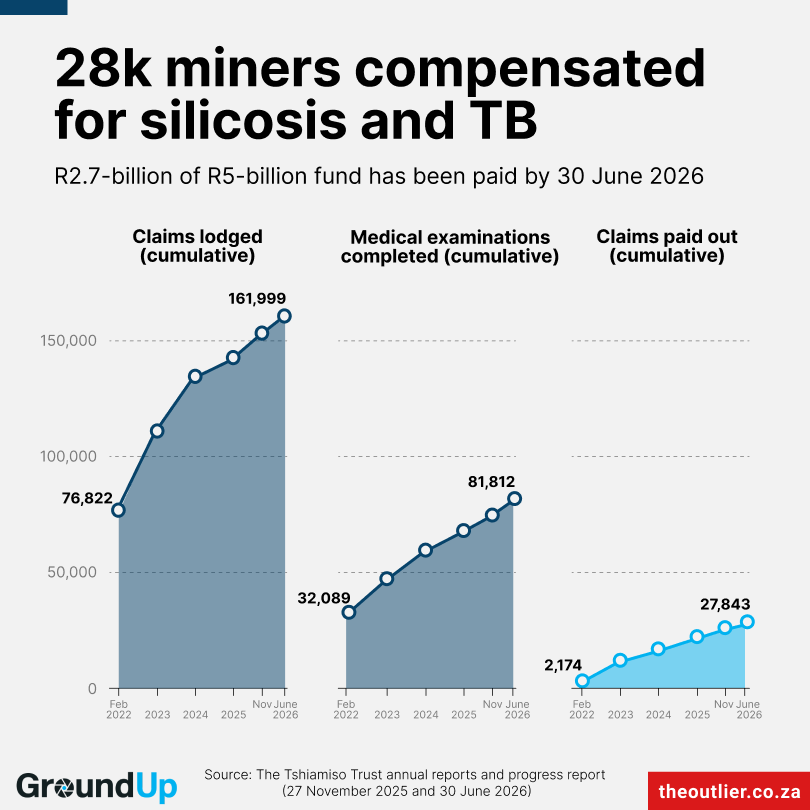
The Tshiamiso Trust has paid out R2.7-billion in compensation to gold mineworkers who died from or became ill with silicosis and TB from working in South African mines.
The R5-billion trust was established in 2020 following a landmark class action settlement with six gold mining companies.
As of 30 June, 17% of claims have been paid out. This is partly because a large proportion of claims, 47%, have been found to be medically ineligible. Another 34% still need to be examined. The remainder are at other stages in the claims process.
Mineworkers who developed tuberculosis or silicosis, as well as the dependents of mineworkers who died from these diseases, will still be able to lay claims until 10 December 2029.
Lesotho is the region with the most beneficiaries to date, more than any South African province, or other neighbouring countries. About R1-billion has been paid to former mineworkers from Lesotho. About R621-million has been paid to mineworkers from the Eastern Cape.
Trust CEO Dr Munyadziwa Kwinda said in Maseru last week that thousands more eligible people are expected to come forward before the 2029 deadline.
“We continue to urge former mineworkers or their families who believe they may qualify for compensation to come forward without delay,” Kwinda said.
He also encouraged former mineworkers who were previously found medically ineligible to reapply if their health has deteriorated, as they may now qualify for compensation.
Many applications are incomplete or supported by documents that do not meet the legal and medical requirements, said Kwinda.
The biggest obstacle involves claims submitted by families of deceased mineworkers. Many death certificates do not specify silicosis or occupational tuberculosis as the cause of death.
To address this, the trust previously amended its rules to allow families to submit medical certificates stating the cause of death instead. But the amendment led to a wave of fraudulent medical certificates.
Payments to claimants in Lesotho were briefly suspended in 2024 after South Africa’s Medical Bureau for Occupational Diseases, which pays out compensation claims separately to Tshiamiso Trust, lost R1.4-million to fraudulent death claims in Lesotho.
The Tshiamiso Trust has since tightened its verification requirements. Medical certificates must now be certified copies of the original records, authenticated by authorised health facility officials, and comply with World Health Organisation standards before they can be accepted.
Former mineworkers who are still alive can also no longer rely on Occupational Diseases in Mines and Works (ODMWA) certificates from the medical bureau alone, because the criteria differ from the trust’s. Instead, they must undergo a Benefit Medical Examination, conducted by the trust’s accredited service providers. This examination is the only medical assessment recognised under the trust deed.
Kwinda announced a recent amendment that could enable more widows and dependents to qualify for compensation.
Previously, some deceased mineworkers had X-rays but had not completed lung-function tests to confirm the presence of silicosis.
Under the new rules, the trust may now use other medical evidence associated with silicosis to determine the level of impairment where lung-function tests are missing.
Kwinda said the change does not broaden eligibility but provides an alternative way of assessing qualifying claims so that families are not unfairly excluded because of incomplete medical examinations.
To improve access, the trust plans another round of mobile outreach services alongside its seven permanent lodgement centres in Lesotho. South Africa has 24 permanent centres, Mozambique has 5, Zimbabwe has 3, Botswana has 2, and eSwatini has 1.
“We remain committed to working alongside the government of Lesotho and all stakeholders to ensure that no eligible claimant is left behind,” Kwinda said.
Chart produced by The Outlier in partnership with GroundUp.
