7 July 2026
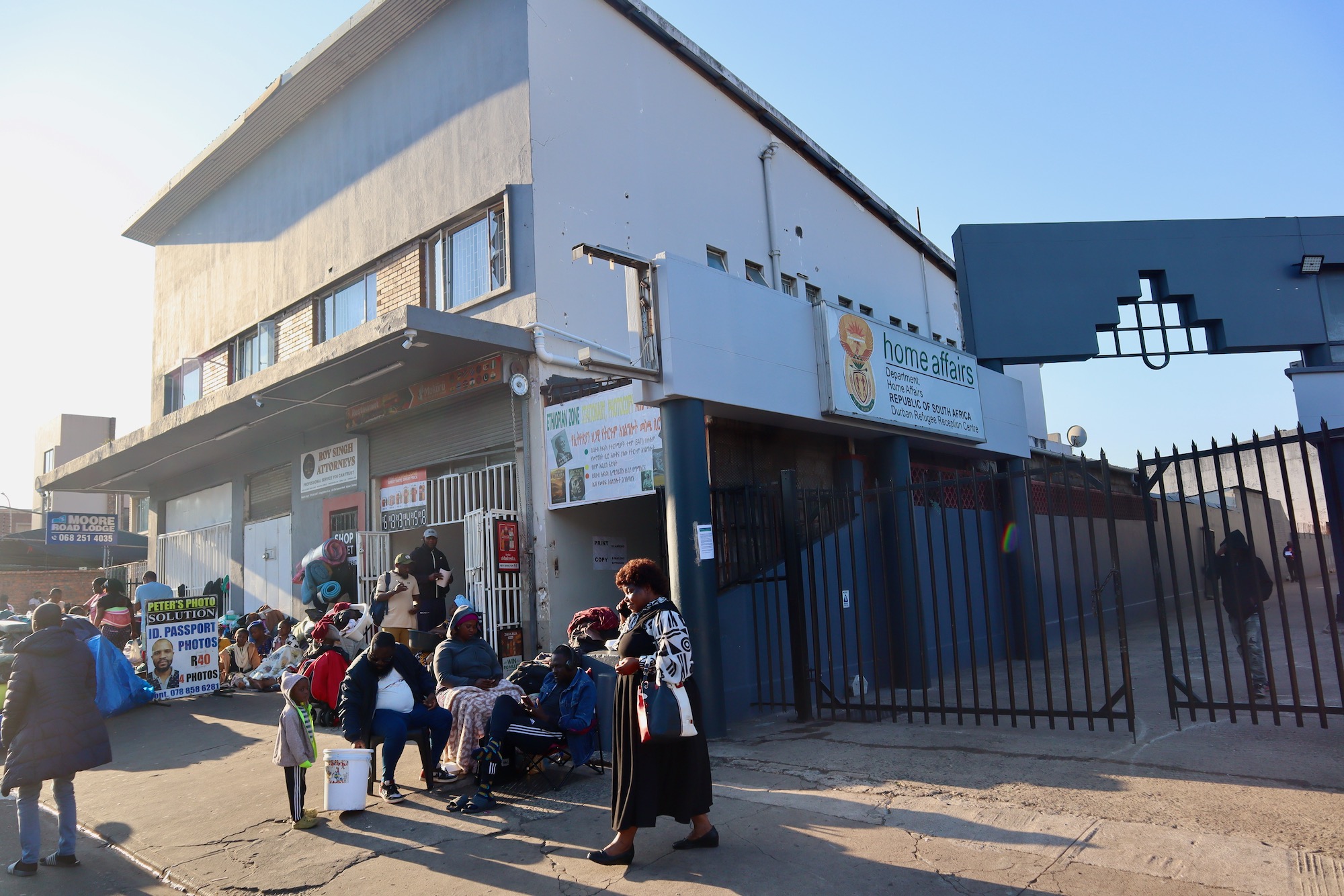
The gate to the Home Affairs centre on Che Guevara Road, Durban. Photos: Joseph Bracken.
Hundreds of refugees legally in South Africa have spent a month camped outside the Home Affairs Refugee Reception Centre on Che Guevara Road in Berea, Durban.
Many were forced to leave their homes and businesses after being threatened and assaulted. They spent three days at the Diakonia Centre seeking safety, before they were sent to the Home Affairs centre on 22 May.
Home Affairs processed them the same day and most of the first group of 150 people were found to be documented and legally in the country.
The camp has now grown to about 400, according to Raphael Bahebwa, president of the Congolese Solidarity Campaign. The group has been turning away anyone who cannot show they are legally in the country.
When GroundUp visited the camp on 6 July there were around 150 people on the site. One of them, Wivine Bahati, explained that many others were away, looking for food and places to shower. The camp has only a few portable toilets.
Bahebwa said they are struggling to get help from the government even though they are legally in South Africa.
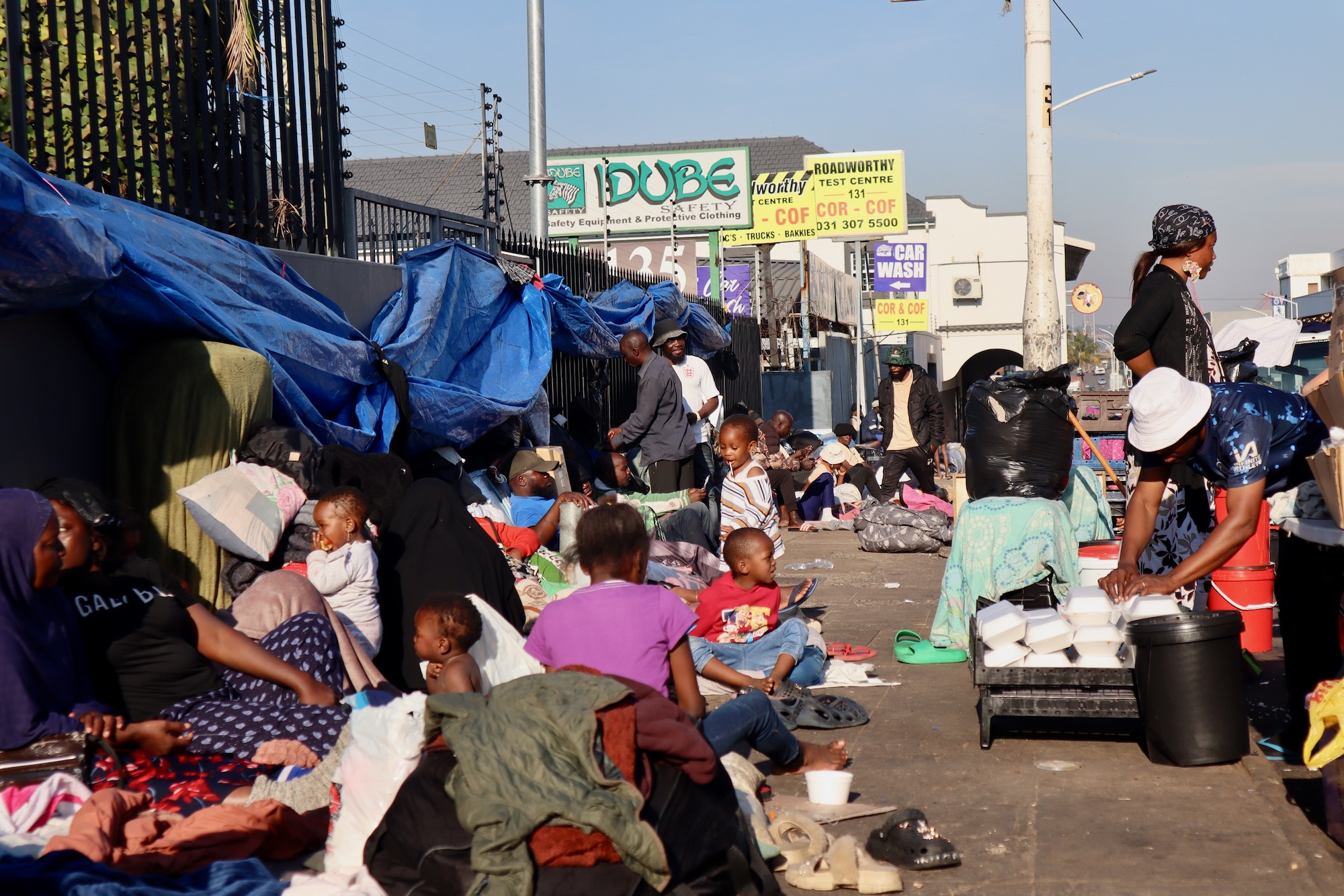
Women sit with their children (left) whilst food is packaged by activists (right).
Last week, eThekwini Mayor Cyril Xaba told the media that the refugees camping outside of the centre were asking for “free housing”.
Bahebwa said this was not the case, and that they had only asked for safe, temporary shelter.
Siyafana Sonke – a collective of 160 organisations against xenophobia and afrophobia – released a press statement on 3 July condemning the mayor’s statement as “actively feeding into a scapegoating narrative which deflects blame for South Africa’s societal ills onto the refugee and migrant community”.
“Stating that the refugees are demanding ‘free housing’ is an unnecessary and politically expedient act of dishonesty, which will simply inflame the heightened tensions in the eThekwini area.”
The collective said the municipality has constitutional and international obligations to provide refugee communities with safety, security and shelter.
Bahebwa said they have turned to civil society and international bodies, such as the United Nations High Commissioner for Refugees (UNHCR), for help. Civilians and activist groups have been assisting with food, water and facilitating meetings with government.
Mayoral spokesperson Mluleki Mntungwa said, “On 7 June the Inter-Ministerial Committee on Migration, led by Minister Mamoloko Kubayi, visited them and gave them two options, either to reintegrate because they have been verified and found to have proper documents, or go to Lindela Repatriation Centre. They have taken none of the options.”
The City is still urging them to take one of the two options, he said.
Several of the refugees explained to GroundUp why returning to their homes was not an option.
Christian Tchizungu, a refugee from the DRC who came to South Africa in 2008, said he and his family fled Sydenham, Durban, after a mob, wielding sticks, tore down his salon and assaulted him and his customers. The attackers injured his seven-year-old and nine-month-old daughters. Tchizungu said friends rushed them to King George Hospital.
Last time he attempted to return, he says he was assaulted before he could even reach his home.
“I’ve lost my car, my home and business,” he said.
Claude Bikorimana fled Burundi in 2018 after most of his family was killed and he was shot in the leg.
He worked as a mechanic’s assistant in Newlands, Durban. He was cornered at work by a group of men who beat him with a metal rod. He sought treatment at several hospitals but was blocked by anti-immigrant groups, he said.
They told him to return to his country of origin. “I have nothing to return to. My whole family is dead,” he said.
The Department of Home Affairs and the UNHCR had not responded to GroundUp’s questions at the time of publication.
