8 December 2025
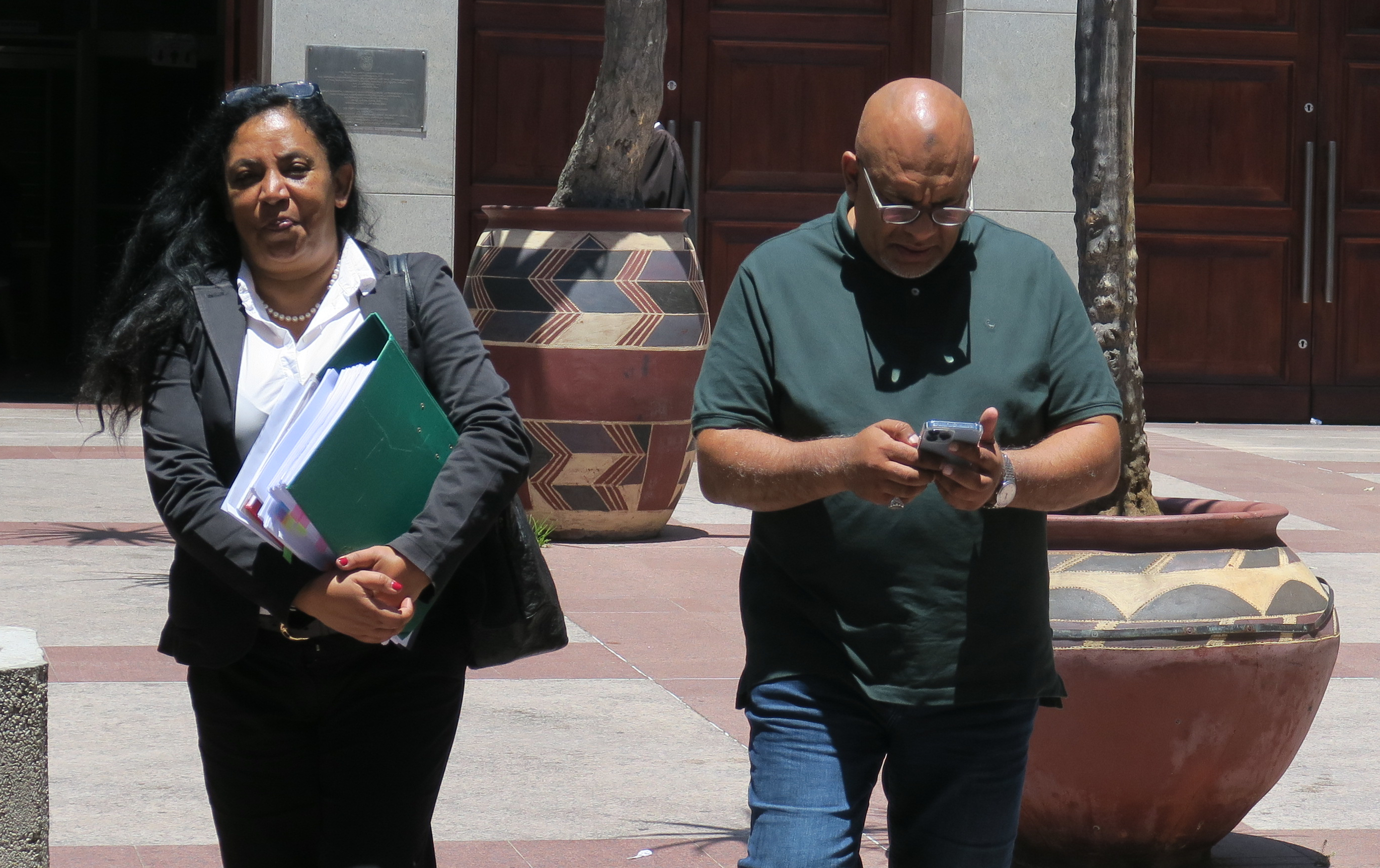
Cheryl Sjoberg and Nadir Mohiudeen leaving court on Monday. Photo: Steve Kretzmann
The state witness in the case against former PRASA regional manager Mthuthuzeli Swartz failed to arrive at the Gqeberha Commercial Crimes Court, where the case continued after months of delay on Monday.
The state’s first witness, Adrian Samuels, was due to take the stand for cross-examination by Swartz’s advocate Mzwamadoda Mnyani, and Cheryl Sjoberg, advocate for co-accused businessman Nadir Mohiudeen.
Swartz and Mohiudeen are accused of fraud and theft for uplifting 42km of Transnet railway line between Sterkstroom and Elliot (now Khowa) in the Eastern Cape in 2012. The rails are worth millions of rand as scrap metal. Samuels and his cousin Cedric Samuels allegedly paid R1.5-million as a deposit for the rail, which Swartz and Mohiudeen allegedly told them was clear for upliftment.
Samuels first testified in March, when the case got underway after six years of delays. He was due to return in June, but was ill, and proceedings were postponed until the end of July. The July hearings were postponed until 8 December because Mohiudeen changed lawyers – for the fifth time – and magistrate Thabisa Mpimpilashe agreed that Mohiudeen’s legal team needed more time to familiarise themselves with the case.
But on Monday, state prosecutor Gerrit van der Merwe told magistrate Mpimpilashe that he had been informed at about 6am, that Samuels was still in Dubai, where he was currently working. This was despite flights from Durban – Samuels’ home town – and accommodation in Gqeberha having been booked for the three days set down for the continuation of the case.
Van der Merwe then applied for the case to proceed, with Samuels testifying via an online Teams link, which he had indicated he was able to do.
He said this was allowed by the Criminal Procedures Act, and the court had the necessary facilities.
Sjorberg said she “strongly objects” to the application, arguing that it impinged on Mohiudeen’s rights to a fair trial.
Sjoberg said Samuels was warned to be at court, and with a virtual presence, his “demeanour” would be harder to read, which was an important part of cross-examination.
“We were not informed of this. We came ready to proceed,” she said.
Mnyani said they were also only informed on Monday morning, and echoed Sjoberg’s arguments, adding there were no substantive reasons given by the state why Samuels was not before the court.
It was also a “bad precedent” to allow witnesses “to go as they please”.
He also said there were documents Samuels was supposed to provide to the court, and the defence needed to have view of the documents in order to challenge their contents. Technical glitches with virtual appearances were also common and hindered Swartz’s right to a fair trial.
He said that while the Criminal Procedures Act does provide for witnesses to be virtually present, that should be arranged in advance.
Van der Merwe countered that “not one of the objections is valid” as all could be dealt with as they arose. Documents could be digitally shared, and technical glitches could be fixed. “We will be able to see the witness testify in real time.”
He said when initial arrangements were made in early August, Samuels believed his Dubai contract would be completed, but it had been extended in the meantime. Additionally, Samuels had flown from Dubai at his own cost in July to attend court, only for matters to be postponed.
He said he was not aware that Samuel’s Dubai contract had been extended, as he was not allowed to communicate with him while he was under cross-examination.
After a brief recess to consider the matter, magistrate Mpimpilashe said the court would reconvene on Tuesday to consider a substantive application for Samuels to testify and be cross-examined online.