3 December 2025
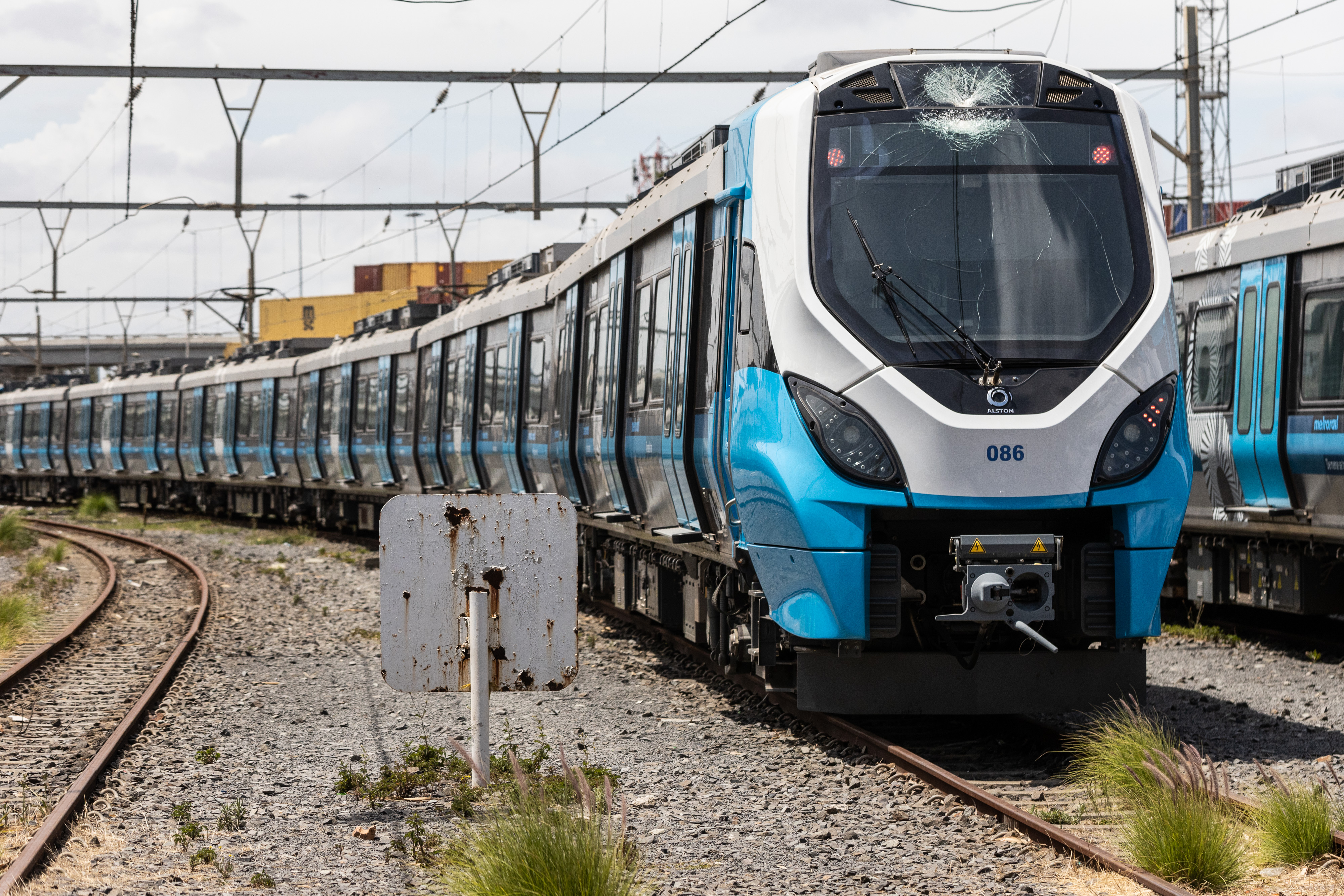
One of the new air-conditioned Metrorail trains. Archive photo: Ashraf Hendricks
GroundUp took the Western Cape’s Metrorail Northern and Southern lines to assess the quality of the train service since our last report in December 2024. Although the trains are safe and mostly on time, issues such as ticketing and a lack of visible security persist.
We took the Southern Line several times, as far as Fish Hoek, and the Northern Line several times from Cape Town to Stellenbosch via Eersteriver, a journey that typically takes over two hours.
At present, trains run every 15 to 20 minutes during peak hours (6am-10 am and 4pm-7pm) on the Northern and Southern lines and every 20 to 30 minutes during off-peak hours. Trains also run on weekends.
You can find schedules and plan journeys here.
Tickets can only be purchased in person with cash. This results in long queues at stations, although tickets are also sold on board the train.
If you time your journey well on the Southern Line, it is faster than going by car or taxi during rush hour. But travelling between Stellenbosch and Cape Town is probably faster by car (but not necessarily by taxi), because of the changeover at Eersteriver. However, travelling by train is cheaper than by car or taxi.
A Metrorail ticket costs R14 from Stellenbosch to Rondebosch for a single one-way trip. For R80, you can get a weekly return ticket.
On our journeys we often did not need a ticket to enter a station, as stations on both the Northern and Southern lines have no ticket access gates and sometimes there were no staff checking tickets. Often trains did not have visible security.
But there were spot checks by PRASA employees. On one trip between Eersteriver and Bellville, two male commuters were caught riding free and were removed from the train as they did not have money to purchase tickets.
There were digital displays and voice-overs on trains, but not at stations, except for Cape Town and Bellville.
The recent addition of a direct train from Du Toit (Kayamandi) to Cape Town at 5:30am has become a lifeline for some commuters. Kayamandi resident Abigail Makhawula, a domestic worker in Blackheath, said she used to have to change trains at Eersterivier and Bellville.
“I now arrive at work on time, not 10 or 20 minutes late, like I did before,” she said.
We were however left stranded at Stellenbosch on Friday, 28 November, when the 6:55am train was suspended until the afternoon, due to “delays in another station”.
And on Wednesday, 19 November, after departing Strand station, heading towards Eersterivier, the train stopped in the middle of nowhere for about eight minutes.
Giovani Stuurdom from Kuils River, who has been using the train for the past three years, told us that overall the trains are reliable these days.
At Rondebosch the ticket booths were often closed. On one trip, we boarded without a ticket. We could not buy a ticket even though we wanted to. When we got off at Kalk Bay, there was no one there checking or selling tickets either.
During peak hours (8am to 10am and 4pm to 6pm), the trains from Rondebosch to Cape Town were often at capacity, with many passengers standing or sitting on the floor. Some commuters even brought their own folding chairs.
At Fish Hoek, people exiting the train were funnelled into two lines: one for ticket holders and one for non-ticket holders (or “defaulters”) .
Those without tickets were directed to go and purchase one. However, the lines were not clearly marked, confusing some commuters, who found themselves in the wrong queue.
Apart from the ticketing issues, the trains running between Fish Hoek and Rondebosch were clean and safe, with guards patrolling the carriages.
We noticed several carriages had cracked windows and doors, with one having a warning sign not to lean on the glass. Another GroundUp employee noticed that the digital displays at Retreat, which is a major hub, had stopped working on the day he was recently there.
The Northern Line offers two routes from Cape Town to Bellville, one via Goodwood, the other via Century City.
Eyethu Dayimani, who works at Century City and commutes from Ysterplaat, said she went back to using trains when services were restored in recent years.
The new trains are safer and more reliable than the ones running before the Covid shutdown, she said.
Taking trains instead of taxis has saved her about R800 a month, she said. Also, the train is more direct. “When I take a taxi, I have to go via Nyanga, which is a harder trip,” she said.
Metrorail, a PRASA service, remains a crucial service for commuters. From our experience the service has improved substantially since the lowpoint of several years back. But Metrorail has struggled to rebound to pre-Covid passenger numbers. In the Western Cape it currently transports over 150,000 passengers a day with just over 290 train trips, according to PRASA spokesperson Andiswa Makanda.
Makanda says PRASA is modernising its ticketing system to a cashless system and digital cards for validation.
We asked what the timeline was for the rollout of card machines and paperless ticketing, but this was not provided.
PRASA also intends to modernise its train signalling system, but this is on hold after an investigative report was recently completed following allegations that advance payments amounting to almost R2.7-billion had been fraudulently made to Maziya General Services, which had won a tender to automate the system.
According to Makanda, Maziya will not continue to install the modernised signalling system while the investigative report is under review by the Department of Transport.
“Currently, trains are being operated safely through an approved method, called Manual Train Authorisation, while the signalling systems are still being repaired,” he said.
PRASA plans to have the new signalling system fully operational in the 2029/30 financial year, said Makanda.