25 February 2026
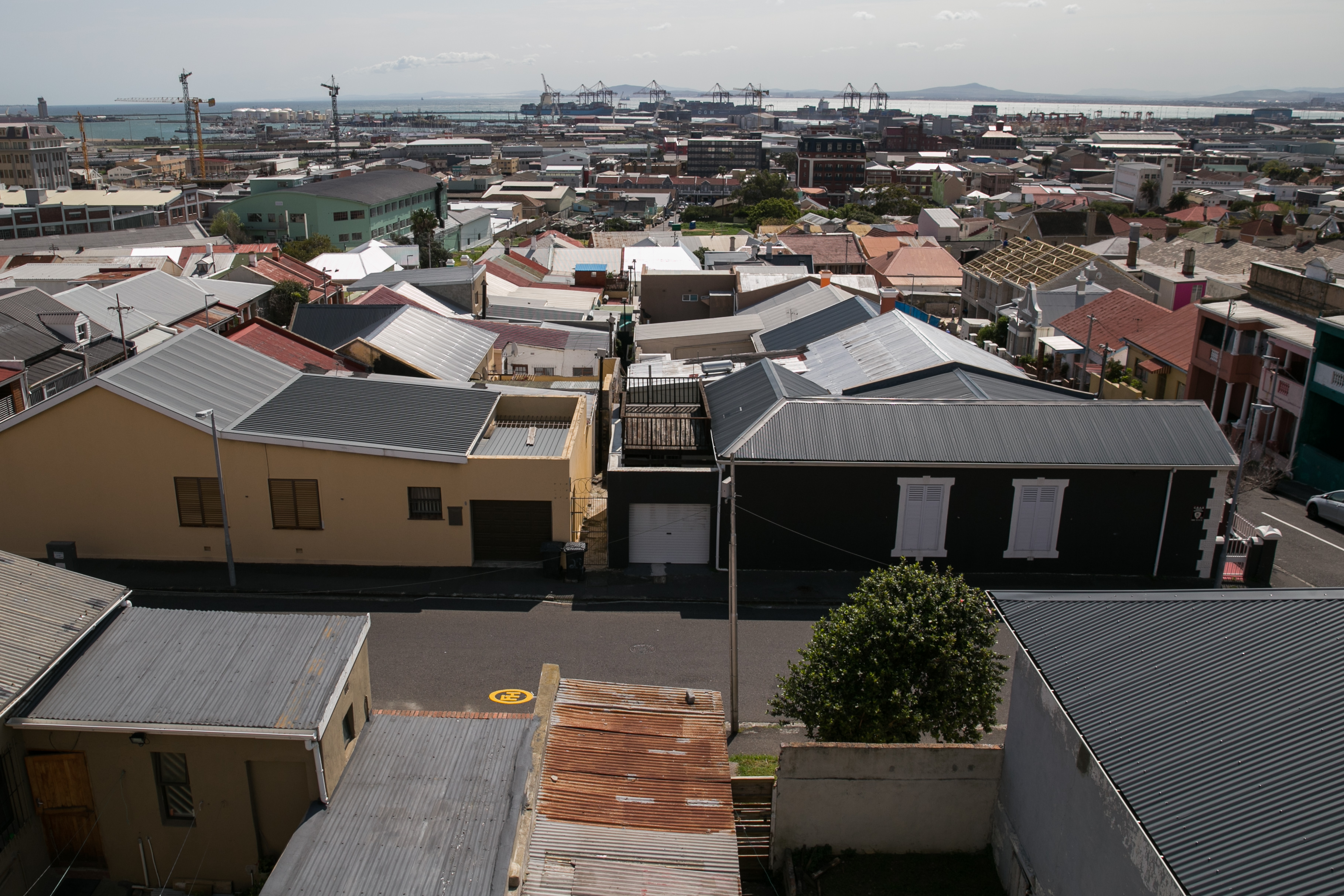
The view over Woodstock, Cape Town, from Taliep Petersen Bridge. Archive photo: Ashraf Hendricks
Although Cape Town can rightfully claim to be the leading municipality in the provision of state-funded housing, it has a housing crisis. According to Mayor Geordin Hill-Lewis the city has a shortfall of about 600,000 homes. Meanwhile, less than 2,500 state-funded homes have been handed over each year on average for the past five years.
Internal migration is increasing the Western Cape population by about 16,000 people per year, most of whom settle in Cape Town. And with millions of rands in budget cuts to the province made by the National Department of Human Settlements, there is no likelihood state-funded housing will ease the growing pressure.
Meanwhile, fewer than 11,000 new residences were completed by the private sector in the Western Cape province last year, according to StatsSA.
Without even addressing new demand, if all the private sector homes were built just in Cape Town and combined with state-funded housing, it would still take 45 years to clear the current backlog.
With demand outstripping supply, Cape Town has the highest property prices in South Africa. The average listing price for a two-bedroomed unit in Cape Town last year was R2.7-million, and for a one-bedroomed unit R2.2-million.
According to a standard bond calculator, an income of R72,000 per month is required to fully bond a R2.2-million property. Yet the 2024 City of Cape Town Household Survey shows only 6.5% of Cape Town households earn above R51,201 per month, and almost 70% of households earn between R1,601 and R25,600 a month.
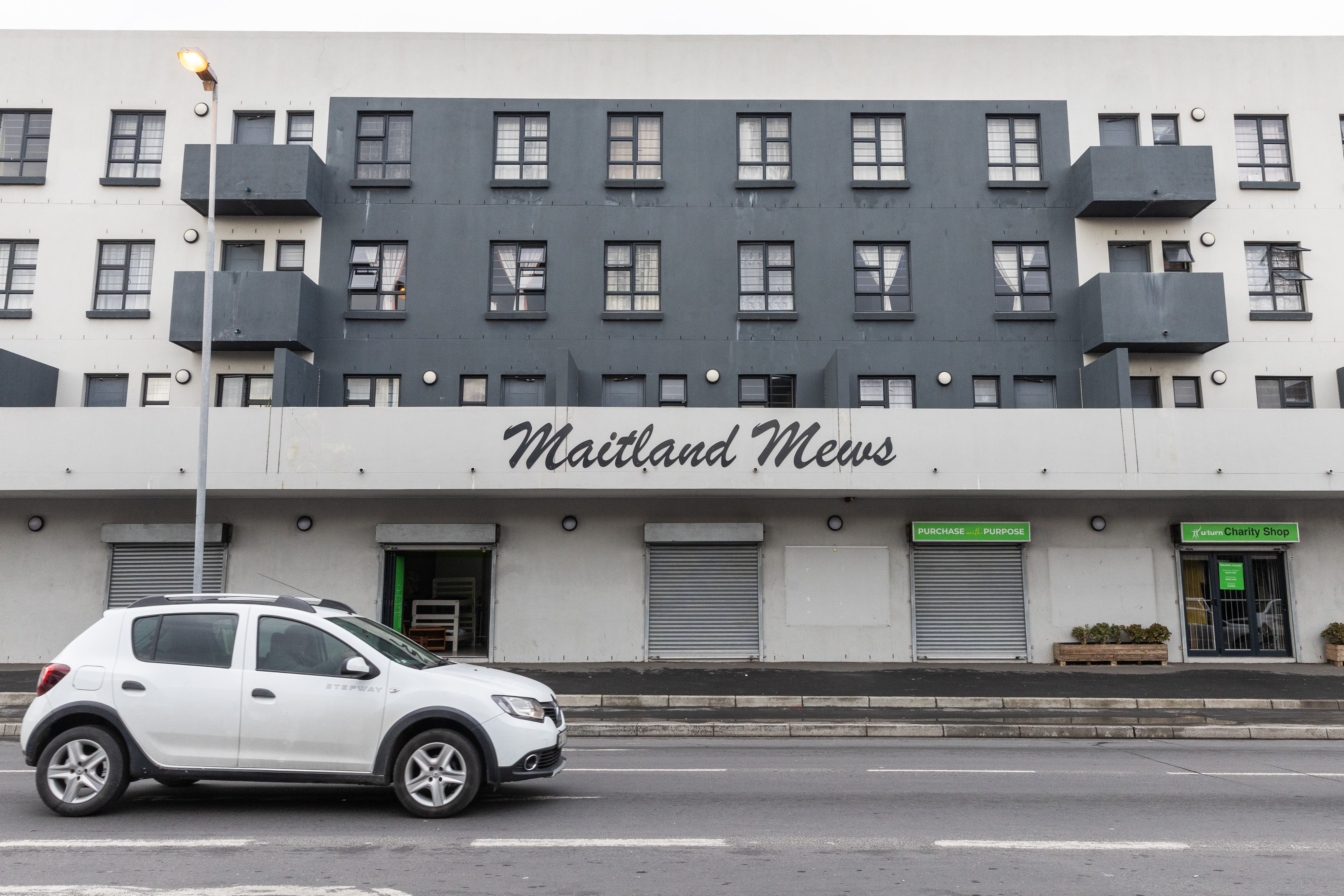
Maitland Mews, a social housing development built on land previously owned by the City of Cape Town, was completed in March 2023. Archive photo: Ashraf Hendricks
After years of housing activism, the City of Cape Town is now pushing for more affordable housing on land that is not on the city’s outer edges.
In 2017, following the release of an Affordable Housing Prospectus for Woodstock, Salt River and the Inner-City, the municipality announced the sale of 11 land parcels for social and mixed-income housing. These include Pine Road, Dillon Lane and Pickwick Road in Woodstock, Salt River Market, and the Maitland Mews. As far as GroundUp is aware, only Maitland Mews is tenanted, with not a brick yet laid on any of the other sites.
In 2022, the mayor made the release of municipal land for affordable housing a priority programme. More sites, such as the Fruit & Veg site on Roeland Street, have been released.
A June 2023 report notes that releasing vacant and underused public land at a discounted price to developers to build social and mixed-income housing “offers great potential for urban inclusion”. Such units are rented rather than sold, and they remain affordable for future generations of qualifying households.
The municipality has also this month put properties that are packaged and ready for development out to tender for private developers to build affordable housing. However, these are in Blue Downs and Atlantis, far from the city centre and do not address the legacy of apartheid spatial planning.
Somewhat better located land – in Ottery, Lansdowne, and Brackenfell – was also put out to tender in January for affordable housing developments.
The municipality is also auctioning 50 sites this week, but with no proviso for affordable housing. Some of these, such as the Good Hope Centre, would make prime sites for well-located affordable housing. This has sparked protest action against the land sales.
UCT graduate Sofia Vy Menell Briel, in her 2022 masters dissertation in city and regional planning, observed that “in the context of Cape Town, the private sector has an important role to play in the provision of affordable housing both via state-subsidised housing programmes and private development”.
She argued the municipality needs to provide both regulation and incentives for the private sector to step in and deliver affordable housing.
One regulatory mechanism is inclusionary zoning. This is a form of land regulation which, the City states in its Inclusionary Housing concept document, requires “large new developments to make some contribution to the provision of affordable housing, usually in cases where developers are applying for additional rights”.
Developers must include housing units that are affordable to low and middle income households within the development, provide affordable housing in a nearby or suitable site, or contribute fees to be invested in a social housing or an affordable housing development.
But the City of Cape Town has yet to finalise its inclusionary housing policy, mooted nine years ago. The municipality did not respond to questions from GroundUp on when this would be finalised.
While the inclusionary housing policy sits in the wings and the municipality auctions off well-located land, changes have recently been made to the Municipal Planning By-law in a bid to ease the housing crisis.
Mayco member for spatial planning and environment Eddie Andrews said the changes make it “easier to build and develop in the city”. He said this will assist with densification, including mixed use developments, in “appropriate locations”.
He said one of the changes is an Incentive Overlay Zone for development in Athlone, Maitland, Parow/Elsies River, Bellville and Diep River. The overlay zone does away with land use applications, so only building plans are needed, saving time and cost.
Properties within the overlay zone get additional development rights for increased height, number of floors, the area of the property which can be built on, shorter setbacks from the street and adjacent properties, and “additional use rights”.
Andrews said the City has also allowed for the property owners to develop affordable rental flats as an additional use right in selected areas. He said this “encourages micro- and small developers to invest in areas where the demand for affordable rental accommodation is greatest”.
The areas where these additional use rights are applied are mostly where state funded housing has been built and where household incomes are in the low to mid range.
An owner of an RDP house in Dunoon, for instance, can now legally build two storeys to create up to eight flats, or up to 12 flats if they have a larger property.
“This form of housing delivery contributes to creating a vibrant township economy driven by people’s own enterprise, ingenuity and investment and generates vital income for poor homeowners who put their property assets to productive use,” said Andrews.
However, these micro-developments are still subject to a development charge to upgrade or maintain infrastructure such as sewers and stormwater pipes.
Andrews said “third dwelling rights” were also approved as an amendment to the by-law in 2019. This means property owners may create up to three separate dwellings on their property (main house and two “granny flats”, for instance) without having to get prior approval from the City or neighbours.
Michael Clark, urban land researcher at the Development Action Group, says there are many financial and regulatory incentives the City could still offer to increase the provision of affordable housing.
Financial incentives include waiving the development charge developers have to pay, and waiving or lowering planning and building fees. The municipality could offer rates exemptions and service fee subsidies, particularly in developments housing people who qualify for indigent grants.
Clark said on the regulatory side, there are town planning assistance incentives where planning approvals, rezoning applications, geotechnical studies, and increased bulk infrastructure approvals can be fast-tracked, as these take a lot of time, which impacts the profitability of developments.
Lowering or removing parking requirements, particularly for developments close to public transport hubs, would also allow developers to build more apartments, so they could maintain their return on investment but offer their apartments at lower prices because they could build more units.
He said the City could also offer height and density bonuses to enable developers to build more apartments in a single complex.
In return for these incentives, which lower capital costs for the developer, the municipality could insist on inclusionary housing being part of the development.
He said the municipality is already doing some of these things.
Clark said Stellenbosch has approved its inclusionary housing policy and has since approved at least 900 inclusionary housing units, with 114 already developed.
The Garden Route District Municipality has developed a draft policy on incentives, both financial and regulatory, “so people are actually thinking about this”, he said.