
Five claims by March and March’s leader — and what the evidence actually shows
“We’re not xenophobic, but …”
 Add GroundUp on Google

A picket against anti-immigrant sentiment at St George’s Cathedral in Cape Town, May 2026. Archive photo: Matthew Hirsch
March and March’s leaders say their movement is not xenophobic. They say it is a peaceful organisation. But the facts say otherwise, and March and March is playing with fire.
Its founder, former radio journalist Jacinta Ngobese-Zuma, casts her movement as legitimate activism in the best interests of the country. She has convinced some of her supporters that she is not xenophobic, that she supports legal immigration, and that all she wants is efficient law enforcement.
But Ngobese-Zuma’s rhetoric draws on South Africa’s long history of violent xenophobic protests and tropes that dehumanise and scapegoat Africans from other countries, whether here legally or illegally.
In the past few years, anti-immigrant sentiment has been stoked by social media in what appears to be a coordinated campaign. In recent months, March and March has been a leading voice. It is yet to disclose where it has got the money to purchase T-shirts or organise transport for leaders and supporters to travel to marches across the country.
There have also been several copycat protests recently, inspired but not organised by March and March. They have been violent. People have been forced from their homes, houses have been burnt, and immigrant-owned shops have been looted. At least two people were killed in Mossel Bay during anti-immigrant protests this past weekend.

At a press conference last week, Ngobese-Zuma made several misleading and divisive claims. We debunk them below.
Claim 1: Immigrants are criminals
“We … are the voice of the voiceless, the unemployed, the drug addicts, the women who are raped and trafficked every day from this country by foreign nationals. And we now say enough is enough,” she said.
South Africa has a rape crisis. About 120 women are raped every day. But immigration is not the cause. Studies have found that 28% to 34% of South African men have admitted to committing rape.
As for trafficking, according to the US government, South Africans and immigrants are victims. And both South Africans and foreigners – primarily from Asian and African countries – are perpetrators of this crime.
There is no evidence that immigrants are disproportionately involved in this, yet delivery drivers, spaza shop owners, informal traders and corner shopkeepers are the primary targets during March and March’s protests.
South Africa is a key link in the global illicit drug trade. International criminal groups from countries including Eastern Europe, China, Zimbabwe, Mexico, Tanzania, and Nigeria have established operations in South Africa. These criminals often conspire with South African immigration officials to commit fraud and enter the country unlawfully.
But statements by Ngobese-Zuma, such as “Nigerians are selling drugs in South Africa and destroying the future of this country,” reinforce stereotypes. Nigerians are among the smaller immigrant groups in South Africa. Gangs from South Africa and other countries make a far greater contribution to the transnational drug trade.
Anti-immigrant groups say that there is a disproportionate number of non-South Africans in our prisons – 27,000 out of 156,000. But the vast majority – 65% – of immigrants in prisons are only there for breaking immigration laws.
The immediate deportation of undocumented immigrants will not solve serious crime in the country. Immigrants should not be blamed for the government’s failure to investigate and prosecute criminals.
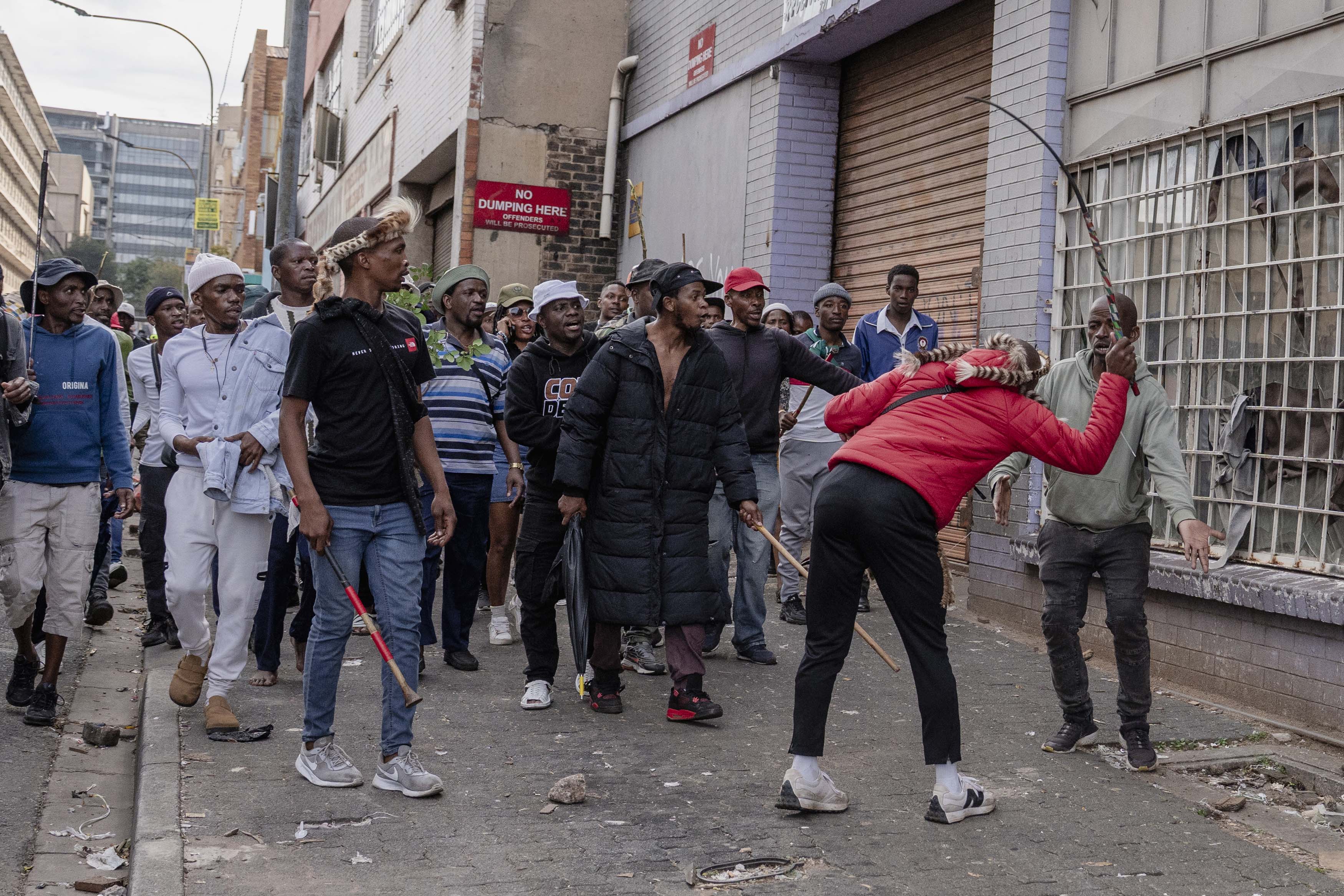
A man is attacked with a sjambok at an anti-immigrant March and March protest in Jeppestown in April. Archive photo: Ihsaan Haffejee.
Claim 2: Spaza shop mafias are running the country
Ngobese-Zuma claims that “the township economy contributes approximately R900-billion into the GDP of this country. This contribution is now shrinking due to the hijacking of our economy.”
Somali, Pakistani and Ethiopian “cartels” and their “spaza shop mafias” are “running our country,” she said.
While the R900-billion estimate is credible, it is not shrinking. In fact, it is likely growing.
Many spaza shops are run by immigrants. Over the past few decades, formal retailers (Shoprite, Pick ’n Pay, Boxer, etc), and immigrant-owned shops have replaced South African-owned spaza shops in some townships. Studies have found that foreign-owned shops in the informal market tend to be better priced than South African-owned shops, primarily thanks to sophisticated and centralised supply and distribution networks.
The Helen Suzman Foundation has suggested that, instead of targeting foreign-owned shops that contribute billions of rands to the economy and create hundreds of thousands of jobs, the government could do more to enable South African informal traders to be competitive.
Claim 3: South Africa is being invaded
“We demand that the sovereignty of our country be protected. South Africa is currently being invaded,” Ngobese-Zuma said, echoing Donald Trump’s rhetoric.
The government has failed to secure South Africa’s borders. But the reasons for thousands of people entering the country illegally are complex, and it is debatable that this constitutes an “invasion” that poses a national security threat.
It’s hard to know the number of non-citizens living in South Africa but, depending on the source, it is about three- or four-million. This is about 5% of the population. In countries like Australia and Canada, more than 20% of the population is made up of immigrants. In the US and in Europe, it is between 10% and 20%.
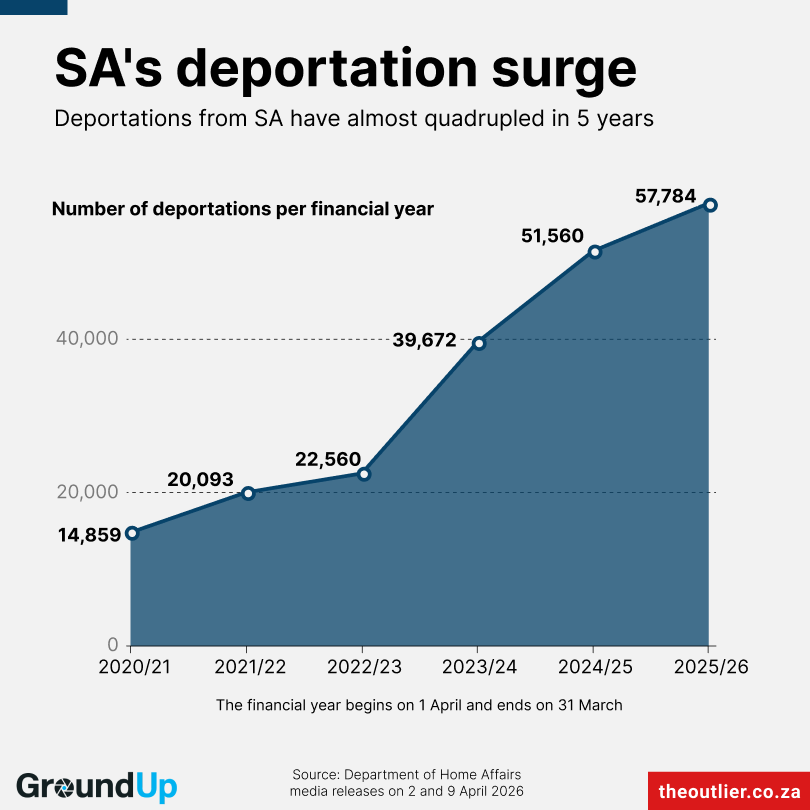
That we do not know how many undocumented immigrants there are in the country is a failure of the government. Every year, border management officials intercept and deport tens of thousands of people trying to enter the country without proper documentation. The government appears to be stepping up efforts, and more people are being deported or intercepted at the border.
“We know that there is no way that immigration officers can screen 457 immigrants in less than three hours when ordinarily it takes a whole day to screen one immigrant,” said Ngobese-Zuma, demanding that more immigration officers be recruited.
Ngobese-Zuma appears to be confusing the role of the country’s 800 immigration officers (who check passports and visas at border posts) with refugee status determination officers (who assess asylum applications). Immigration officers have to work quickly and let through people who have valid passports and visas.
The asylum system, on the other hand, is notoriously inefficient. To get refugee status takes months if not years. Many people who try to enter the country legally end up undocumented because of government incompetence. It is also common for asylum seekers to experience corruption from South African officials who solicit bribes.
The Department of Home Affairs has a backlog of 161,000 people who have appealed the rejection of their asylum applications and are awaiting the outcome. About 71,000 of them renew their asylum-seeking permits every six months; 90,000 have dropped off the government’s radar.
The department’s attempts to make the asylum system more efficient by limiting it have been the subject of several court cases, with refugee rights organisations challenging the constitutionality and alignment with international law.
Fewer asylum applications are now being accepted: there were about 5,300 new asylum applications in 2025, down from 20,000 in 2024. Because of various barriers to complying with the asylum system, many asylum seekers end up undocumented.
Claim 4: There aren’t enough jobs or resources for immigrants
“South Africa is currently on the verge of a collapse. The economy is crumbling,” Ngobese-Zuma said. “There are no resources left for South Africans, and there’s certainly not enough resources for foreign nationals.”
The departments of health and education cannot “service South Africans properly because they end up having to service a lot more foreign nationals than they should”, Ngobese-Zuma said.
South Africa’s economy had only 1.1% growth in 2025 and an unemployment rate of 42%. More than a third of people aged 15-24 were neither working nor at school or in training. The government’s purse is under pressure, and over the past few years, spending on health and education has decreased in real terms.
But the Department of Basic Education has explicitly debunked claims that foreign learners are “placing undue pressure on the education system”. Only 1.8% of learners in South Africa are foreign.
Health departments have been plagued by corruption and incur billions in wasted and irregular expenditure every year. More is lost to fruitless expenditure than it costs to provide health services to immigrants. Poor budget planning for population growth and internal migration also places facilities in some areas under more strain than others.
Ngobese-Zuma wants jobs like Checkers Sixty60 driving to be “reserved only for South Africans for us to win the war against inequality and poverty”. She claims illegal immigrants are working for Checkers Sixty60.
Checkers Sixty60 uses a third-party service provider who employ delivery drivers as “independent contractors”. Many of them are immigrants. The service provider requires proof of a work permit for them. There have, however, been a few cases of drivers being arrested for breaking immigration law.
For various reasons, immigrants have come to dominate some sectors. Immigrants are sometimes more likely to accept much lower wages than South Africans.
There are many factors to blame for South Africa’s low economic growth and lack of jobs. Immigrants are not one of these. If all undocumented migrants were to magically leave today, our unemployment rate would likely stay unchanged, perhaps even increase.
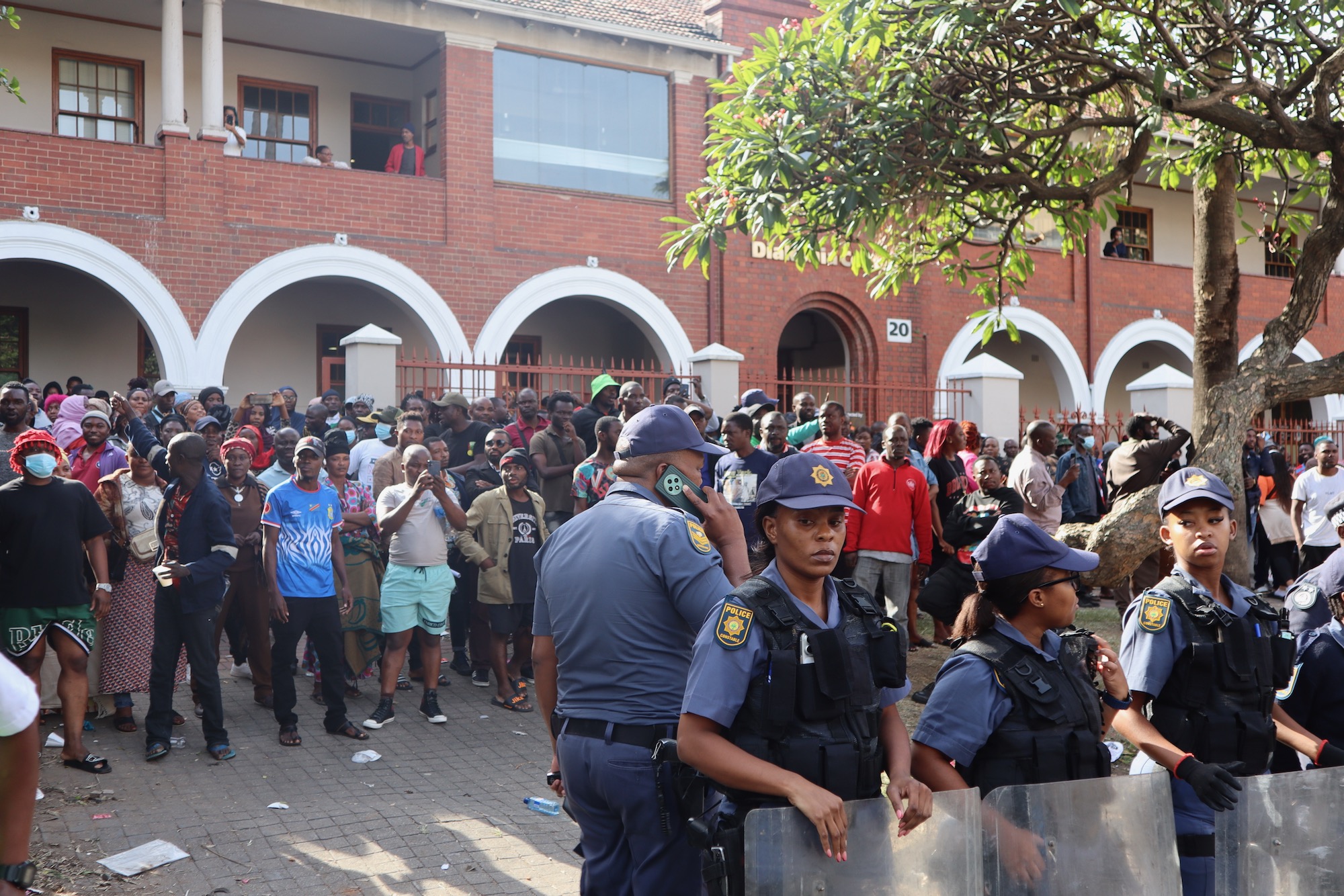
In May, a group of about 300 immigrants sought refuge at the Diakoni Centre in Durban, fearing for their safety. Police had to form a barricade to stop March and March supporters from reaching the immigrants. Archive photo: Joseph Bracken
Claim 5: Immigrants are being armed by NGOs
During the question and answer session after her speech, Ngobese-Zuma made the following claim:
“I think South Africa is currently facing a huge security threat, more than a lot of us realise. South Africa has NPOs and NGOs that are foreign-funded and have millions of rands. The money goes to buying arms … I’m saying this having received this information in confidence … I want anyone who says I’m lying to go and research what I’m saying and tell me I’m wrong. So there are a lot of guns that are hidden by these so-called refugees that they have to protect themselves ….”
What evidence Ngobese-Zuma has for these bizarre claims has not been presented.
Some politicians in South Africa have at times baselessly accused NGOs, which take the government to court, expose government failures, and hold the government to account, of being foreign agents. GroundUp, which is funded by several international and local organisations, has received such accusations.
There is no evidence that foreign-funded NGOs, especially not those that have gone to court to protect the rights of immigrants, are involved in buying arms for immigrants.
“The government of Lesotho said that young people in Lesotho are coming here to be trained for the military,” Ngobese-Zuma went on to claim. “The South African government doesn’t even see a problem.”
GroundUp first reported on the rumours of military camps. It was a claim originally made by the Lesotho Police Chief – that Basotho people are being trained in South Africa to launch an insurgency in Lesotho (not South Africa). The truth is murky. Preliminary investigations by the South African police found no evidence of the camps.
GroundUp requested an interview with Ngobese-Zuma. She responded:
What makes you think I would want to do an interview with a media house that goes out of its way to lie about the actual events that are happening in our country instead of just reporting the truth?
Support independent journalism
Donate using Payfast

Don't miss out on the latest news
We respect your privacy, and promise we won't spam you.
© 2026 GroundUp. This article is published under the GroundUp Republication Licence Version 1.0. Email [email protected] to request permission to republish.