
Durban marchers call for safer streets for blind people
More than 50 people marched to the city hall on International White Cane Day
 Add GroundUp on Google
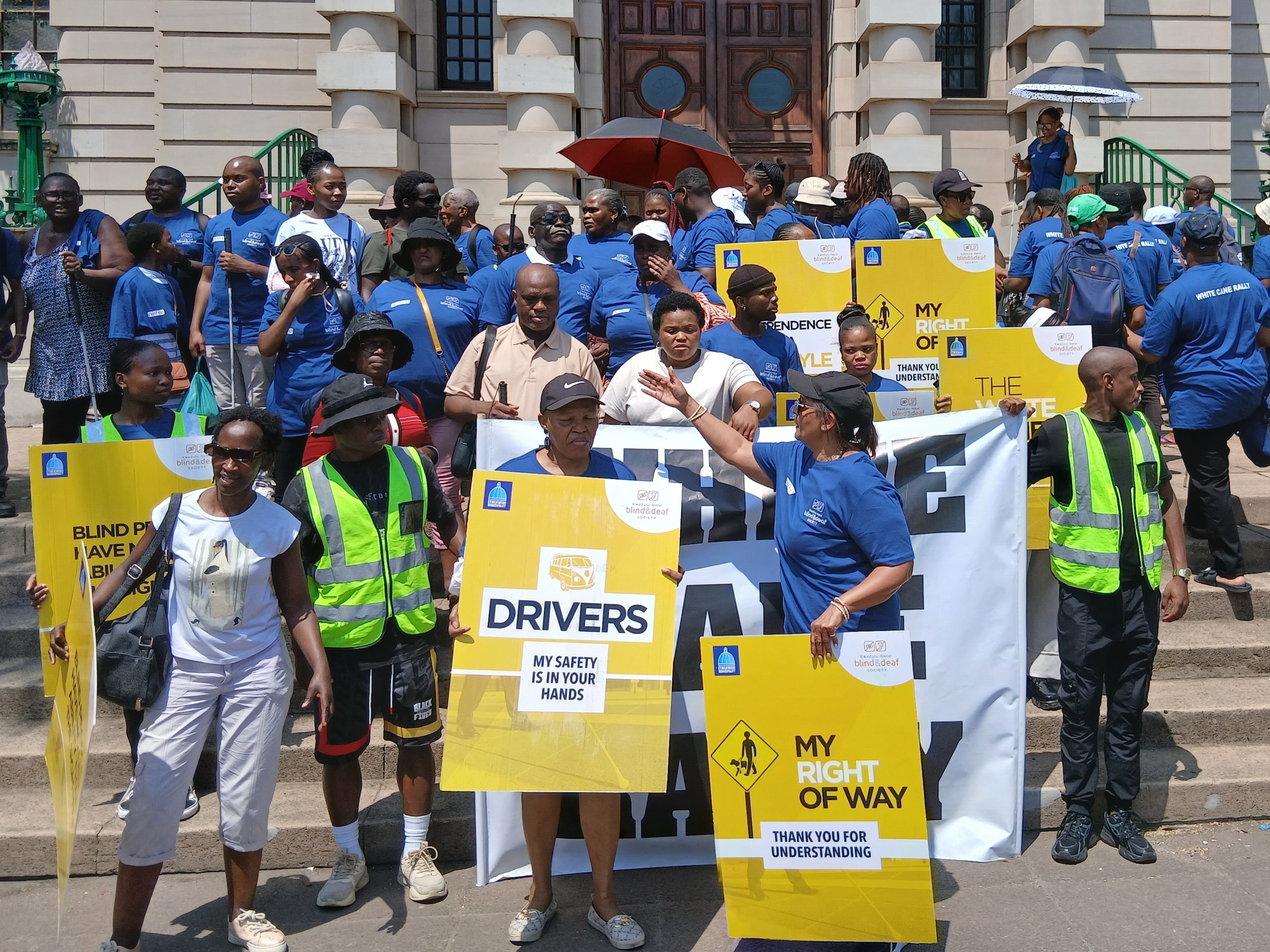
Dozens of people marched to the Durban city hall on International White Cane Day to raise awareness about the rights of visually impaired people. Photo: Tsoanelo Sefoloko
More than 50 people walked through Durban on Thursday to mark International White Cane Day and to call for greater awareness of the rights and needs of visually impaired people.
Organised by the KwaZulu-Natal Blind and Deaf Society, the group walked from Ismail C Meer Street to the Durban city hall, where they held up posters that read: “Drivers, my safety is in your hands” and “Give blind people the respect and dignity you would like for yourself”.
International White Cane Day, observed annually on 15 October, raises awareness of the white cane as a mobility aid and aims to promote safer, more accessible public spaces for visually impaired people.
Organiser Clive Govender said the day was an opportunity to educate the public about the right to move safely through the city.
“We want the drivers to understand that we are human beings and they need to be patient with visually impaired people,” said Govender.
Among the marchers was Senzekile Cele, who began losing her sight in 2013. She had worked as a cashier until her contract ended in 2008, leaving her unemployed. Years later, she said she developed a bad headache and was taken to hospital. Several days later, she battled to see.
Cele said the KZN Blind and Deaf Society helped her adjust to life with her visual impairment and regain her confidence.
At the city hall, councillor Vathiswa Ncukana, representing the mayor’s office, said the municipality was willing to work with blind and deaf residents. Ncukana handed out three white canes to participants on behalf of the municipality.
Some participants in the march said the municipality could have provided more, at least 20 canes.
KZN Blind and Deaf Society president Veetha Sewkuran said the organisation, approaching its 90th anniversary, continues to provide rehabilitation, mobility training, education and skills development.
“Blind people are here. We are active. We are capable. We are working, studying, travelling, raising families, participating in sport and contributing to our communities.
“We ask only that society recognises our presence, respects our rights and helps create an environment in which everyone can move safely and independently,” she said.
Support independent journalism
Donate using Payfast

Don't miss out on the latest news
We respect your privacy, and promise we won't spam you.
© 2026 GroundUp. This article is published under the GroundUp Republication Licence Version 1.0. Email [email protected] to request permission to republish.