
Failing water systems will cost R400-billion to fix, says minister
73% of water authorities in South Africa have “poor” or “critical” water systems
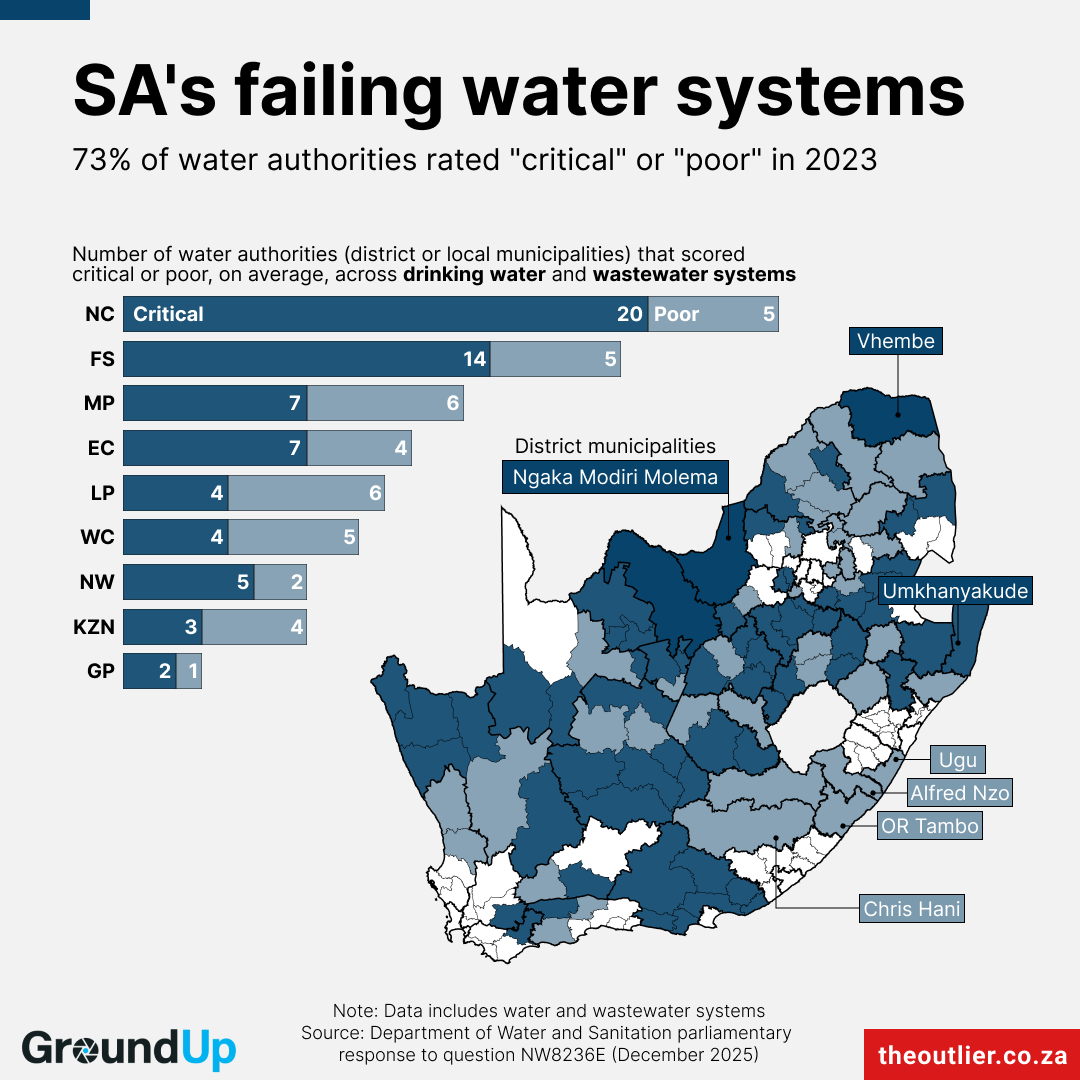
The nationwide maintenance backlog on water and sanitation systems will cost about R400-billion to rectify, said Water and Sanitation Minister, Pemmy Majodina, in response to a question in Parliament in December.
But only R26-billion total expenditure on Water and Sanitation services was budgeted for the 2025/26 financial year, including grants to municipalities.
Municipalities are supposed to fund their maintenance of drinking water infrastructure with the revenue they generate from water sales. But large amounts of water go through municipal systems without earning any money. This “non-revenue water” is driven by leaks and bursts due to ageing infrastructure, billing issues, and free water supplied to poor households.
“The decline in water and sanitation services is mainly attributed to municipalities not prioritising funding for operations and maintenance,” said Majodina.
There are 144 water services authorities in South Africa. These are local and district municipalities meant to provide drinking water and sanitation systems.
The water systems in 104 of these municipalities were rated “poor” or “critical” by the Department of Water and Sanitation’s most recent Green and Blue Drop assessments in 2023. The assessments consider the condition, capacity, and maintenance of water infrastructure.
38 municipalities were rated “poor”, and 66 were rated “critical”.
Chart produced by The Outlier in partnership with GroundUp.
Support independent journalism
Donate using Payfast

Don't miss out on the latest news
We respect your privacy, and promise we won't spam you.
© 2026 GroundUp. This article is licensed under a Creative Commons Attribution-NoDerivatives 4.0 International License.
You may republish this article, so long as you credit the authors and GroundUp, and do not change the text. Please include a link back to the original article.
We put an invisible pixel in the article so that we can count traffic to republishers. All analytics tools are solely on our servers. We do not give our logs to any third party. Logs are deleted after two weeks. We do not use any IP address identifying information except to count regional traffic. We are solely interested in counting hits, not tracking users. If you republish, please do not delete the invisible pixel.