
Climate Week kicks off with a train trip from Cape Town to Khayelitsha
Journey aims to highlight how climate change affects communities
 Add GroundUp on Google
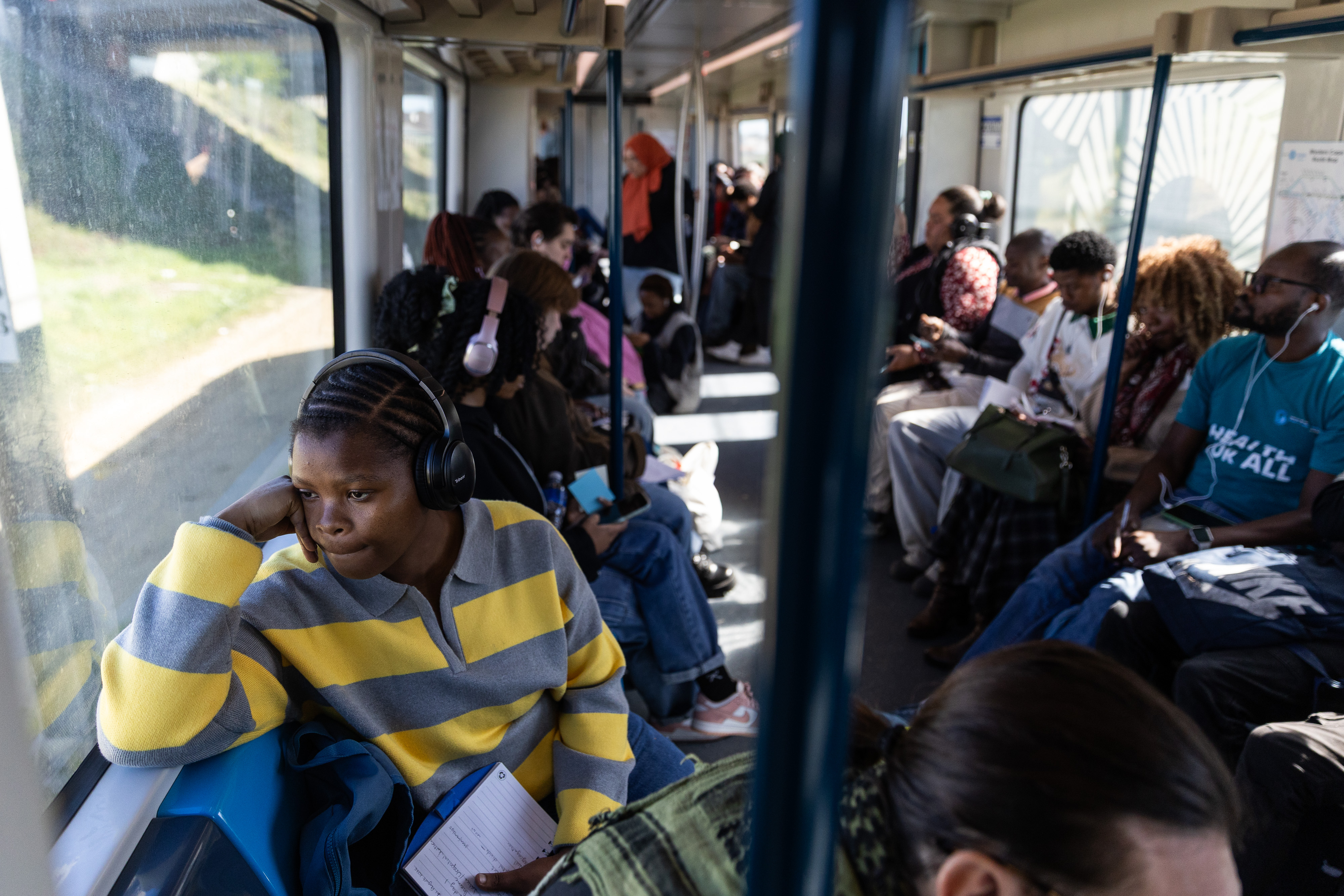
About 50 passengers joined a train ride from Cape Town to Khayelitsha with the African Climate Alliance. Photos: Ashraf Hendricks
To kick off Climate Week, about 50 people joined a train trip from Cape Town Station to Khayelitsha to explore how apartheid-era spatial planning still influences where people live, how they travel and their exposure to climate-related risks.
Video: Ashraf Hendricks
During the trip, passengers listened to audio recordings of people talking about how their lives are affected by climate change challenges.
The Train of Thought audio tour was organised by the African Climate Alliance as part of the annual Cape Town Climate Week under the theme Spatial Justice.
La’eeqa Martin of the African Climate Alliance said the organisation selected a train ride because it allowed participants to think visually about spatial inequality and ways to resolve it.
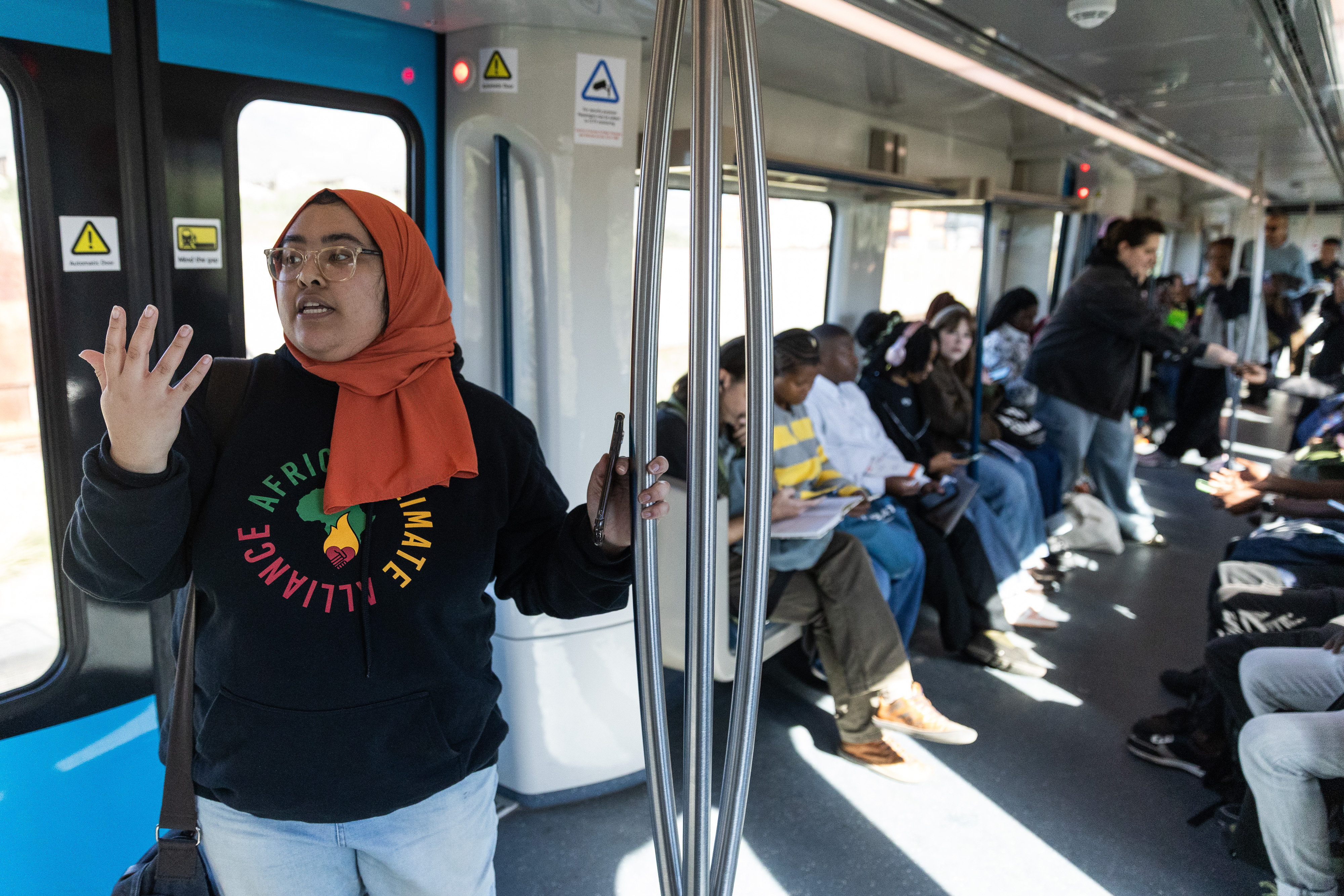

La’eeqa Martin of the African Climate Alliance says they hope the train trip helped passengers see how access to land and infrastructure such as roads and railways has created divisions between different communities.
“It was deeply important for us to think about spatial justice through the lens of transportation, but also through spatial apartheid, looking at the changing landscapes, housing, access to land, and the ways in which infrastructure such as roads and railways have created divisions between different communities,” Martin said.
People were encouraged to pay attention to how the landscape, housing and environment changed as the train moved through communities like Pinelands to Langa then to Mitchells Plain, ending in Khayelitsha.
Passing through Philippi, passengers saw the wetlands where an informal settlement had been built.
The audio tour gave passengers some background to Cape Town’s apartheid-era railway system, when black people were forced to live on the outskirts of the city.
One person described how trains are so overcrowded that commuters struggle to find space to sit or even stand safely. A long commute to work is still part of the daily reality of people who live on the Cape Flats.
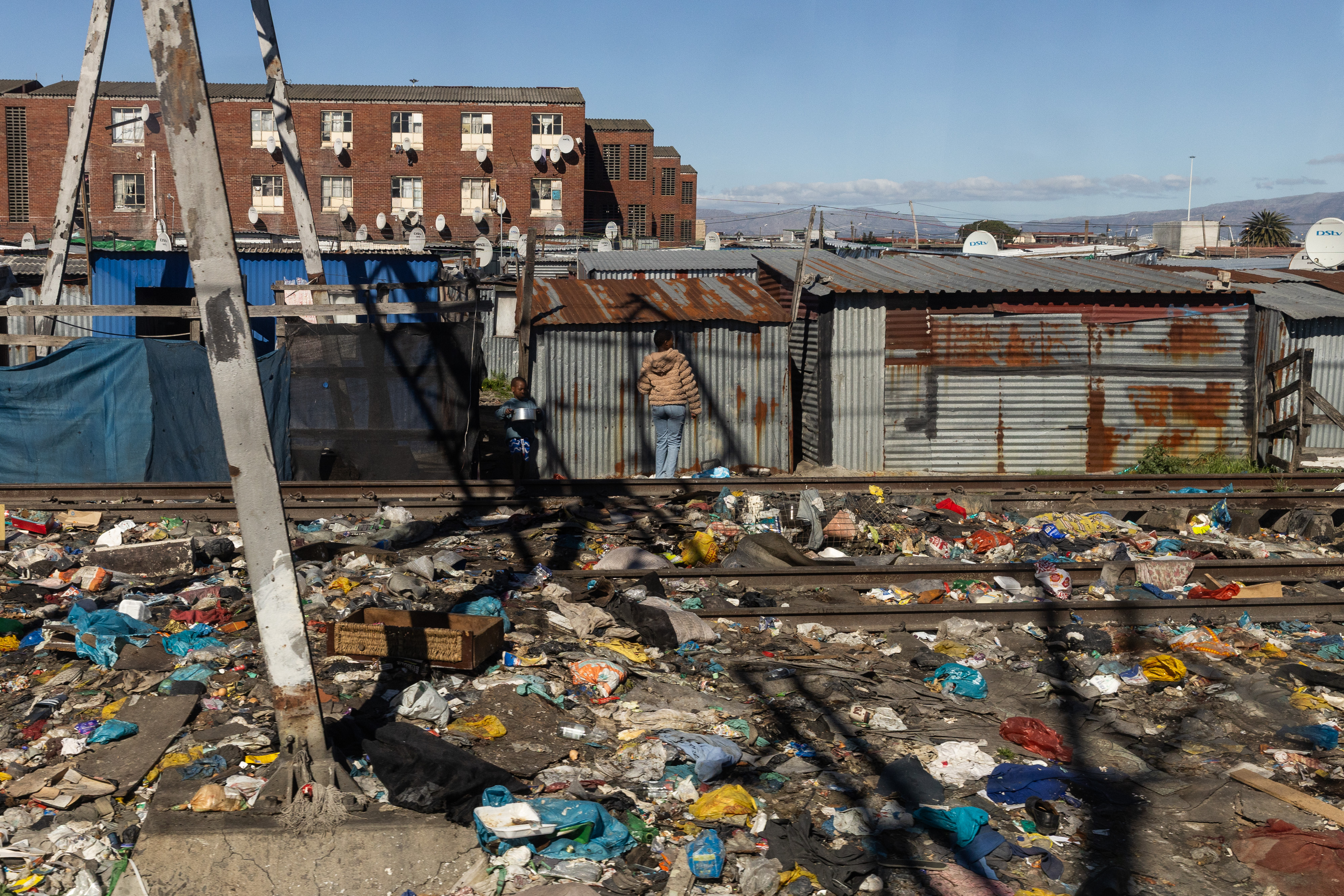
Children stand on a dirty railway line behind a row of shacks as the train moved through townships like Langa and Philippi.
As the train passed areas including Woodstock, Salt River, Langa and Bonteheuwel, the audio tour explained how these communities were deliberately separated under apartheid.
When passengers arrived in Khayelitsha, they walked to the Isivivana Centre, where they heard more about how climate change disproportionately affects low-income communities, from Ndifuna Ukwazi and Violence Prevention through Urban Upgrading (VPUU).
Zamindlela Mkhwanazi, a researcher with Ndifuna Ukwazi, said people living in informal settlements are often more likely to lose their belongings due to flooding. When flooding becomes more frequent due to climate change, these communities can become stuck in a cycle of displacement, he said.
“For 10 years you’re experiencing displacement, and now it’s even getting worse because of climate change,” Mkhwanazi said. “So now, the rains are heavier and the sun is more scorching.”
Ndifuna Ukwazi and VPUU also discussed solutions such as climate-resilient housing and community organising.
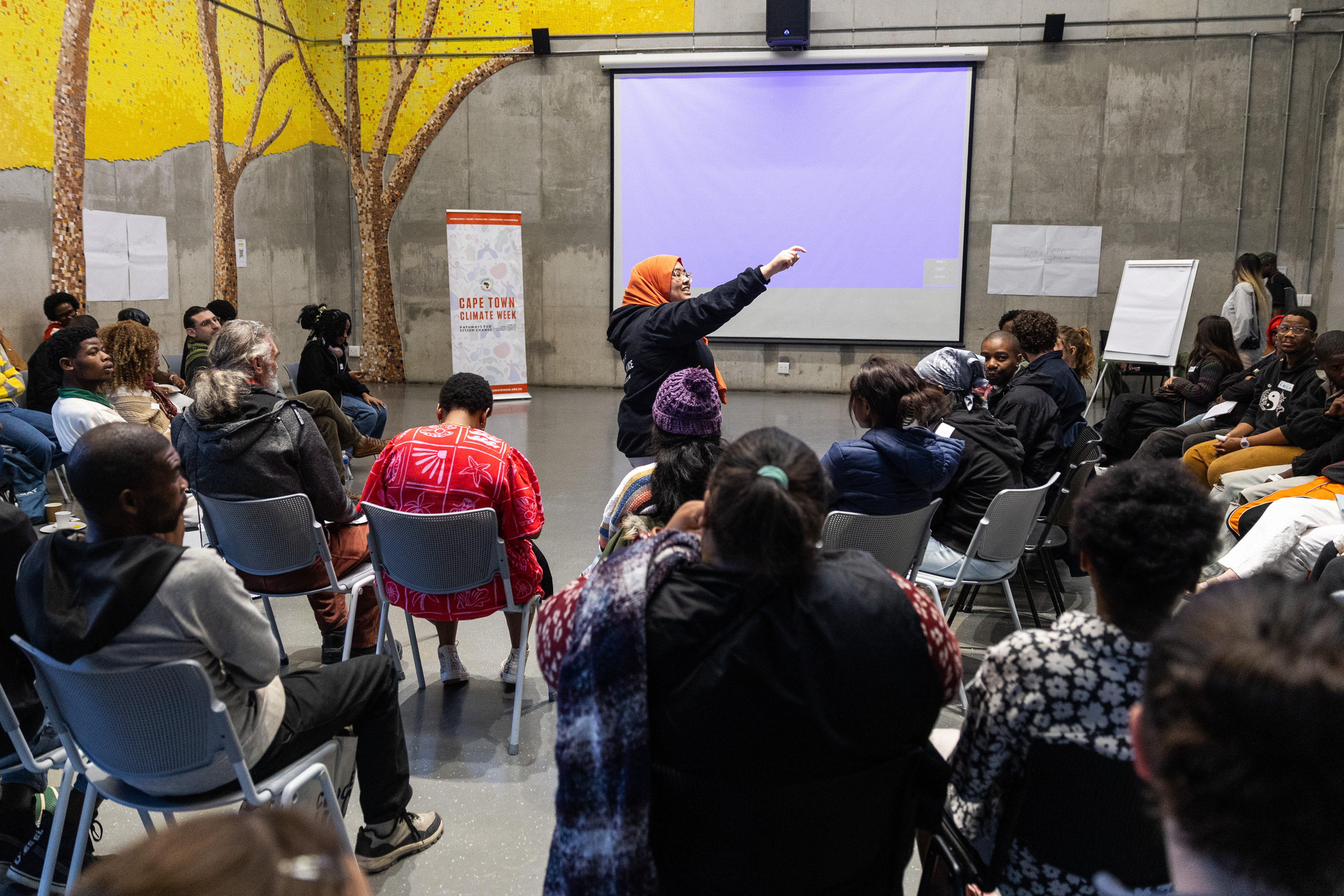
The day ended with workshops at the Isivivana Centre in Khayelitsha.
Support independent journalism
Donate using Payfast

Don't miss out on the latest news
We respect your privacy, and promise we won't spam you.
© 2026 GroundUp. This article is published under the GroundUp Republication Licence Version 1.0. Email [email protected] to request permission to republish.