
Hundreds march on Parliament demanding an increase in alcohol tax
“In our communities we have shebeens that operate 24 hours”
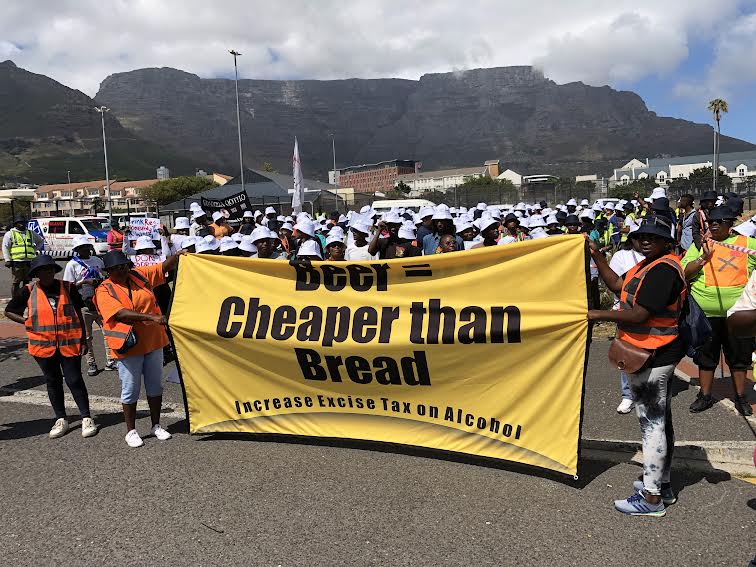
Hundreds marched through Cape Town’s city centre on Wednesday to demand higher alcohol taxes. Photos: Mary-Anne Gontsana
- Marchers from Gugulethu, Khayelitsha, Manenberg and Mitchell’s Plain went to Parliament on Wednesday to demand higher taxes on alcohol.
- The march was led by the Southern African Alcohol Policy Alliance (SAAPA).
- In their memorandum, the marchers said alcohol tax should not be seen only as revenue but also as a way to prevent violence.
Hundreds of people marched to Parliament on Wednesday, demanding an increase in alcohol taxes.
Led by the Southern African Alcohol Policy Alliance (SAAPA), the marchers included civil society organisations, community health workers, neighbourhood watch members and members of community policing forums.
SAAPA’s Odwa Nakani said: “The situation in our communities is dire. We have unlicensed shebeens all over the place. Sometimes you’ll find that one street has five shebeens. Some of these shebeens are located next to schools and churches.”
“Alcohol is a contributing factor to rape, gender-based violence and car accidents. Our children are school dropouts because they chose to give themselves to alcohol.”
“We want government, the Liquor Board in particular, to sit down with us and explain how obtaining a liquor licence works. We want other government spheres as well to meet with us because alcohol also affects health and education. A solution needs to be found,” said Nakani.
Wearing bucket hats on which was written “The true cost of alcohol”, marchers sang loudly as they marched to Parliament. Placards reading “Tax the bottle, fund the future”, “Drink less, live more” and “Alcohol increases GBV in our communities” were waved in the air.
A skit on violence and alcohol was put on display. Pamela Booysen from the Gugulethu Development Forum wore fake bloodied bandages around her head and arm, and Inga Mkalali from the Malmesbury Arts and Culture group pretended to be drunk and to beat up Booysen.
“It is a common occurrence in our communities, where people go out drinking, return home drunk, argue with their spouses and end up beating them. Some unfortunately do not make it out alive,” said Booysen.
“Male breadwinners finish their money on alcohol, leaving their families hungry and struggling.”
Marchers came from Gugulethu, Khayelitsha, Manenberg and Mitchell’s Plain.
Nomisile Maputuka, a neighbourhood watch member from Gugulethu, said she came across many violent crimes involving drunkenness. “In our communities, we even have shebeens that operate 24 hours. At 4 or 5am while patrolling, you get a person on the street, drunk, coming from a shebeen and heading home.”
In their memorandum, the organisations called on Parliament’s Standing Committee on Finance “to champion fiscal policies that protect public health and community wellbeing.”
“Alcohol taxation must not be viewed solely as revenue collection, but as a powerful prevention measure capable of reducing violence, injuries, and long-term health costs.”
“Communities ask that resources generated through alcohol taxation support prevention programmes, youth empowerment initiatives, treatment and recovery services, and community-led solutions.”
The memorandum was accepted by Parliament chamber assistant Gilbert Jood.
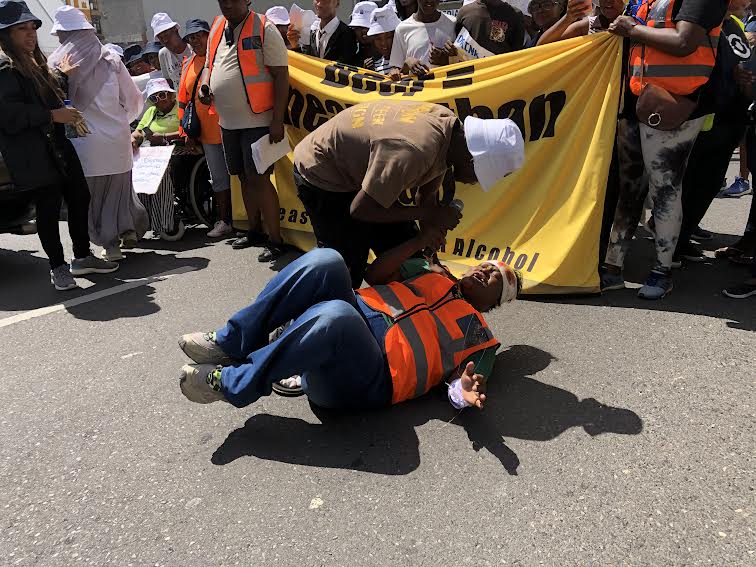
Pamela Booysen from the Gugulethu Development Forum and Inga Mkalali from the Malmesbury Arts and Culture group presented a skit on gender-based violence.
Support independent journalism
Donate using Payfast

Don't miss out on the latest news
We respect your privacy, and promise we won't spam you.
Next: “I fought for freedom, and now I am going to die without water” says Mpumalanga pensioner
Previous: Cofimvaba: a town without public toilets
© 2026 GroundUp. This article is licensed under a Creative Commons Attribution-NoDerivatives 4.0 International License.
You may republish this article, so long as you credit the authors and GroundUp, and do not change the text. Please include a link back to the original article.
We put an invisible pixel in the article so that we can count traffic to republishers. All analytics tools are solely on our servers. We do not give our logs to any third party. Logs are deleted after two weeks. We do not use any IP address identifying information except to count regional traffic. We are solely interested in counting hits, not tracking users. If you republish, please do not delete the invisible pixel.