
Hundreds of Soweto residents protest in Pretoria for a flat rate electricity tariff
They want the regulator to introduce a flat rate of R350 for poor households
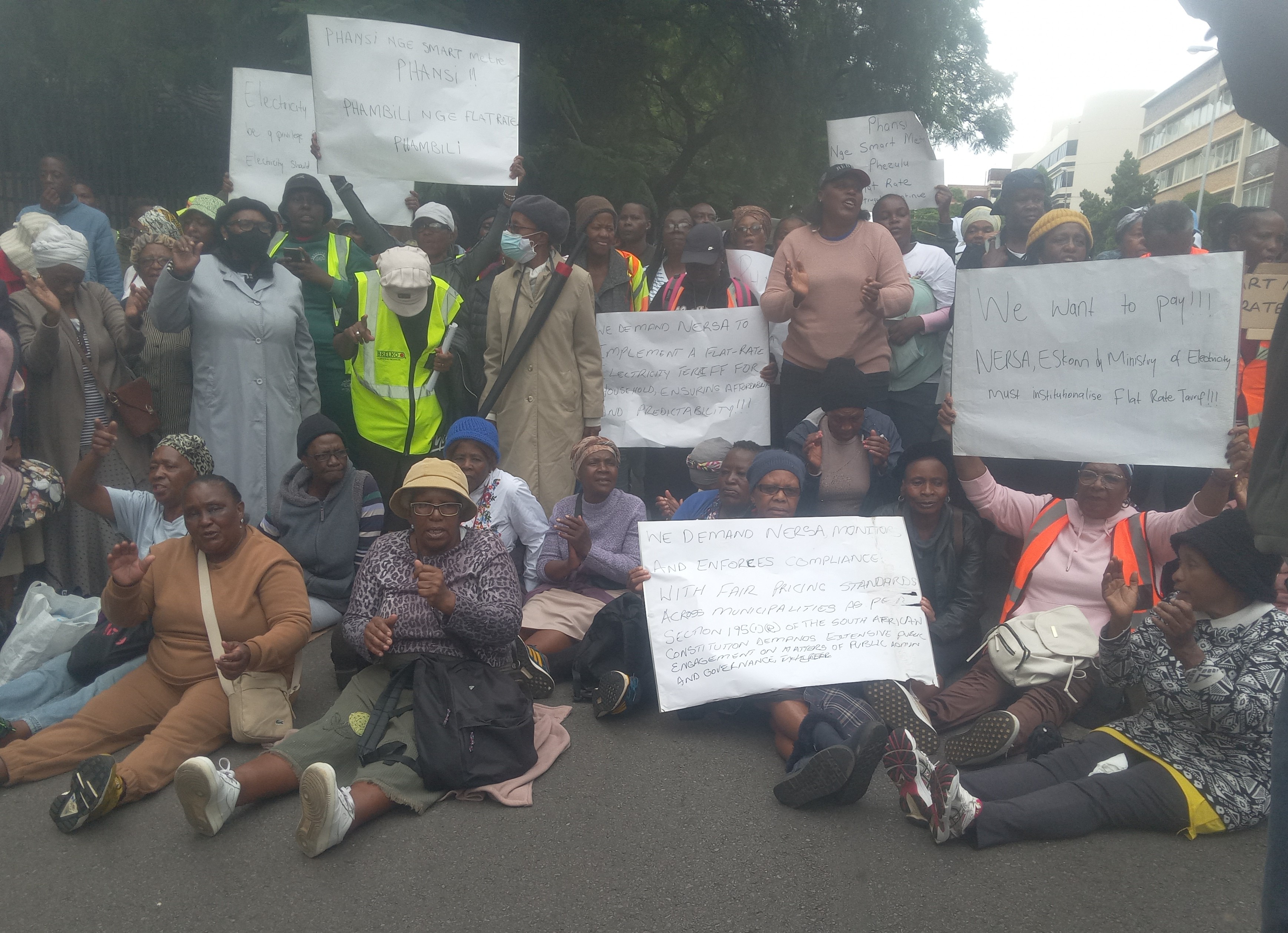
Mostly elderly residents from Soweto travelled to Pretoria on Monday to protest outside the office of the National Energy Regulator of South Africa. Photo: Warren Mabona
Hundreds of Soweto residents protested in the rain outside the offices of the National Energy Regulator of South Africa (NERSA) in Pretoria on Monday, demanding a flat rate electricity tariff of R350 for poor and working-class households. They said they cannot afford the current tariffs.
Protesters were led by members of the Diepkloof Workers, Elders and Youth Council. They want public hearings to be held in affected communities before a new tariff is charged.
Among their demands is for NERSA to instruct Eskom to suspend the installation of smart prepaid meters. Community leader Thabo Ngayo told protesters that Eskom started replacing the old electricity meters early last month. He said the power utility had started the project without consulting the community.

“If these meters are not suspended, there will be a lot of anarchy in Soweto. People are very angry,” warned Ngayo.
Ngayo said residents had marched to Eskom’s Soweto offices and handed over a memorandum on 13 March, but officials told them to approach NERSA.
Pensioner Ramolefe Mokwena told GroundUp that he spends R1,200 of his R2,300 a month on electricity every month. “My two children are at university, and I can’t buy enough food for them. It is painful to be unable to buy food for your children.”
“I’m begging you to feel sorry for us,” Motshidisi Maputle, 72, told the NERSA official who came out to accept the memorandum of demands. “I am very sick and weak. I need affordable electricity.”
Tshepiso Wesson said she is unemployed and survives on the R370 social relief of distress grant. “I cannot afford electricity on these new meters,” she said.
The protesters gave NERSA seven working days to respond. The memorandum was accepted by NERSA’s head of communications, Charles Hlebela, who promised to respond.
Support independent journalism
Donate using Payfast

Don't miss out on the latest news
We respect your privacy, and promise we won't spam you.
Letters
Dear Editor
The rising cost of living has already placed an unbearable strain on the working class, with many households surviving hand-to-mouth. Our elderly citizens, who should be living with dignity, are instead struggling to make ends meet on modest social grants that barely cover necessities.
In this context, it is deeply concerning that NERSA continues to approve significant electricity tariff increases. These decisions seem disconnected from the lived realities of ordinary South Africans. With petrol prices also on the rise, the financial pressure on households is intensifying from all directions.
Electricity, which is a basic need, is fast becoming an unaffordable luxury for many. When price hikes outpace inflation, they do more than inconvenience people — they push vulnerable communities further into hardship. If this trend continues, we risk regressing to a point where families are forced to rely on candles and other unsafe alternatives just to cope.
There is an urgent need for greater consideration of the socio-economic impact of these decisions. The burden placed on citizens is simply unsustainable, and meaningful intervention is required to protect the most vulnerable.
Dear Editor
While I understand their despair and angst, the demand for a "flat rate" simply highlights the lack of understanding of our current reality and level of mind control resulting from years of political lies and broken promises.
Their "rights" apply to the right not to be denied access to electricity, not the right to have others pay for it on their behalf.
You get what you vote for. Life's decisions carry consequences.
Yes, I say, give them cheaper electricity, but not on a flat rate. A lower rate, on prepaid, directly from Eskom - not from the municipality, which steals and wastes that money but never pays Eskom.
Time to change this culture of non-payment and special "rights".
© 2026 GroundUp. This article is licensed under a Creative Commons Attribution-NoDerivatives 4.0 International License.
You may republish this article, so long as you credit the authors and GroundUp, and do not change the text. Please include a link back to the original article.
We put an invisible pixel in the article so that we can count traffic to republishers. All analytics tools are solely on our servers. We do not give our logs to any third party. Logs are deleted after two weeks. We do not use any IP address identifying information except to count regional traffic. We are solely interested in counting hits, not tracking users. If you republish, please do not delete the invisible pixel.