
I tried to buy a matric certificate on Facebook: here’s what happened
Facebook is full of adverts for fake matric certificates
 Add GroundUp on Google
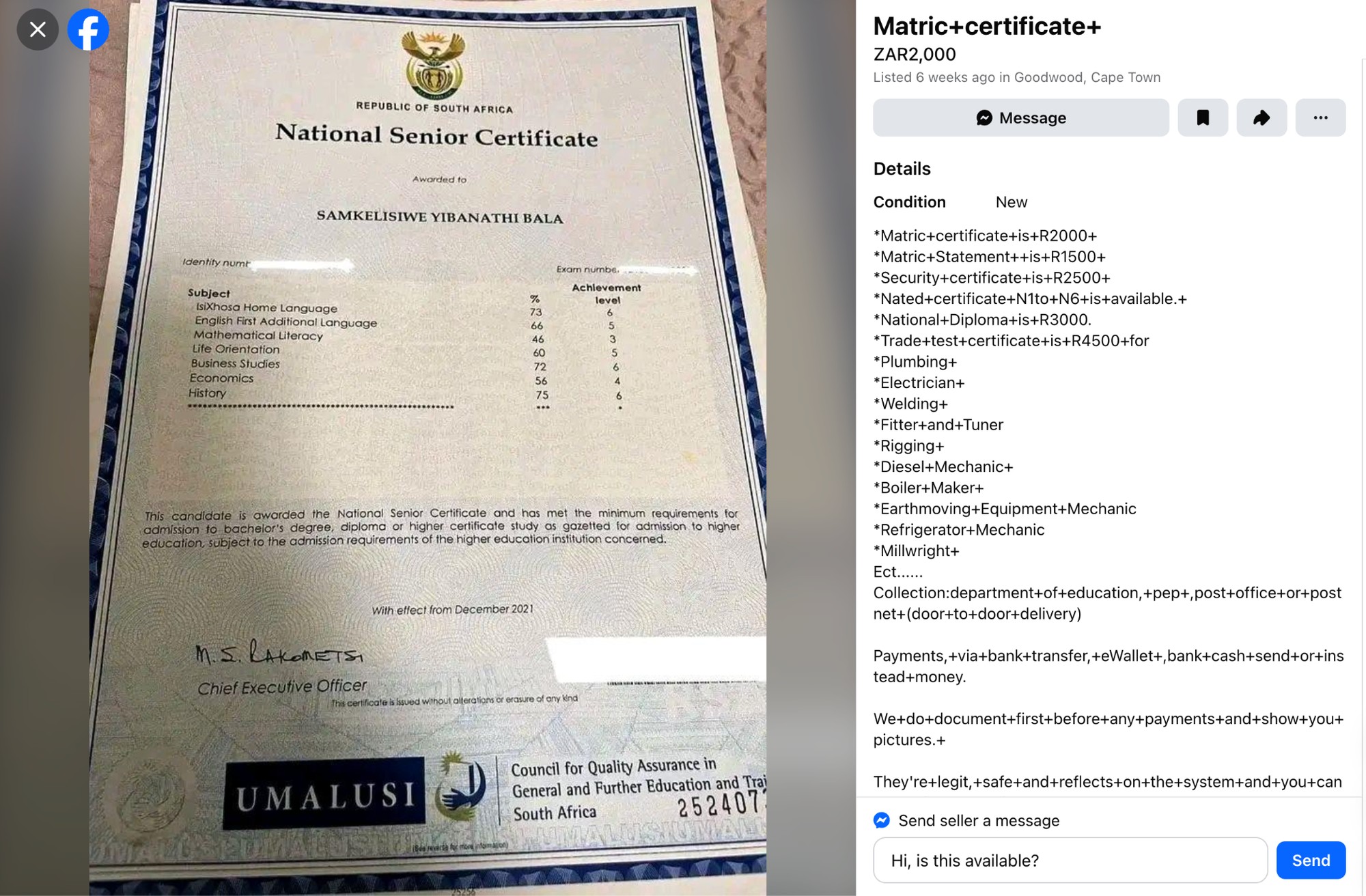
A Facebook Marketplace listing for various fake certificates.
- Dozens of advertisements on Facebook offer a registered matric certificate for a fee. The advertisers claim to work for Umalusi and say they can register the certificate with the Department of Basic Education.
- But all the certificates are fake.
- Facebook’s policy bans the sale of educational documents and professional certificates. But this does not appear to apply to advertising on Facebook.
- Though we reported all the scams we found, none of them has been taken down.
Dozens of advertisements on Facebook and TikTok promise South Africans a registered matric certificate for a fee, usually between R1,500 and R5,000. They are all fake.
Digging through the Facebook ad library, I found more than 30 active adverts from people claiming they can create a matric certificate with any subjects and any results you want. Each one of these scammers claims that the certificate is real, and that once you’ve paid, they will register it with the Department of Basic Education, as well as Umalusi. All of them claim to work for Umalusi and use pictures of Umalusi officials as their profile pictures on WhatsApp.
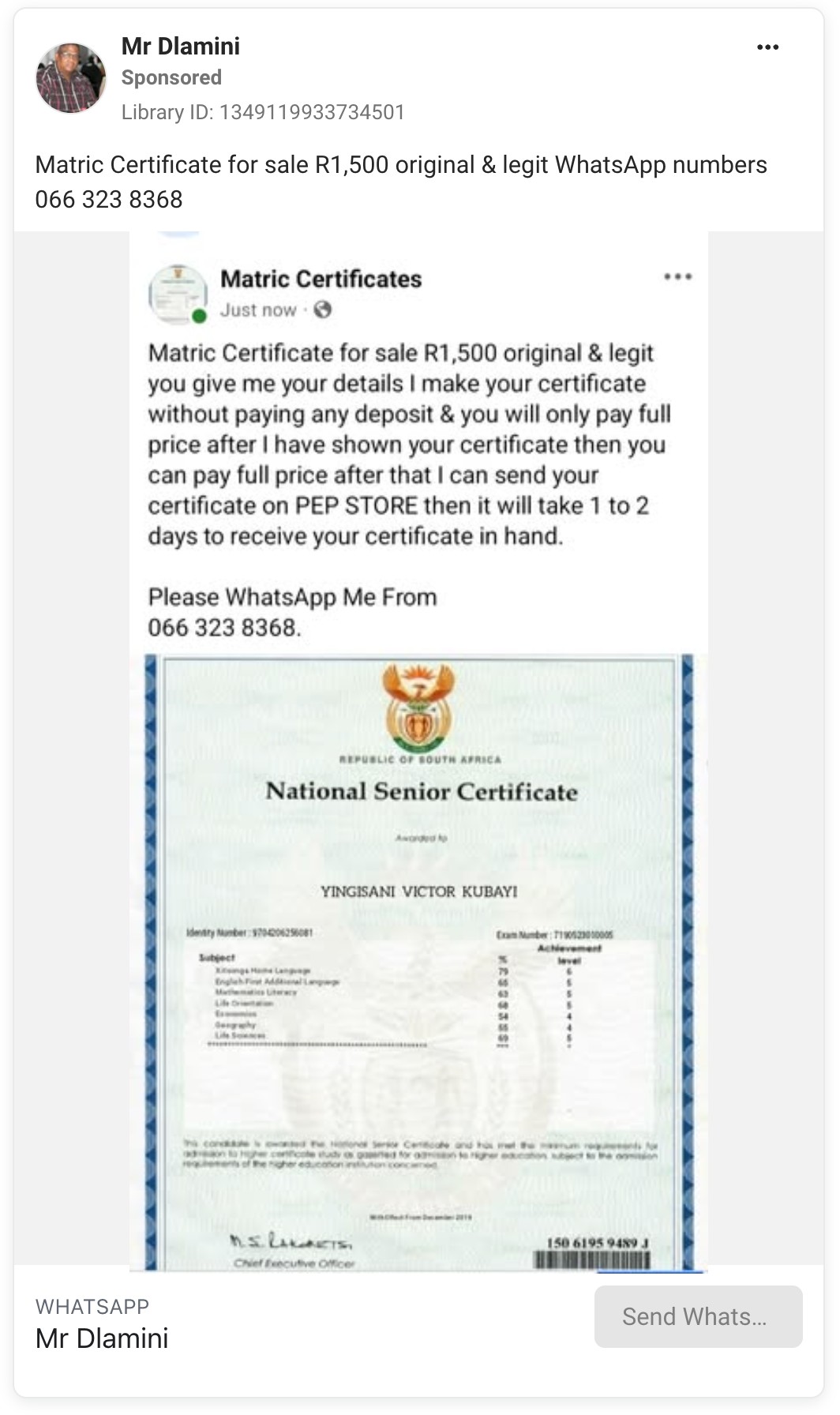
One of the advertisements targeting Facebook users.
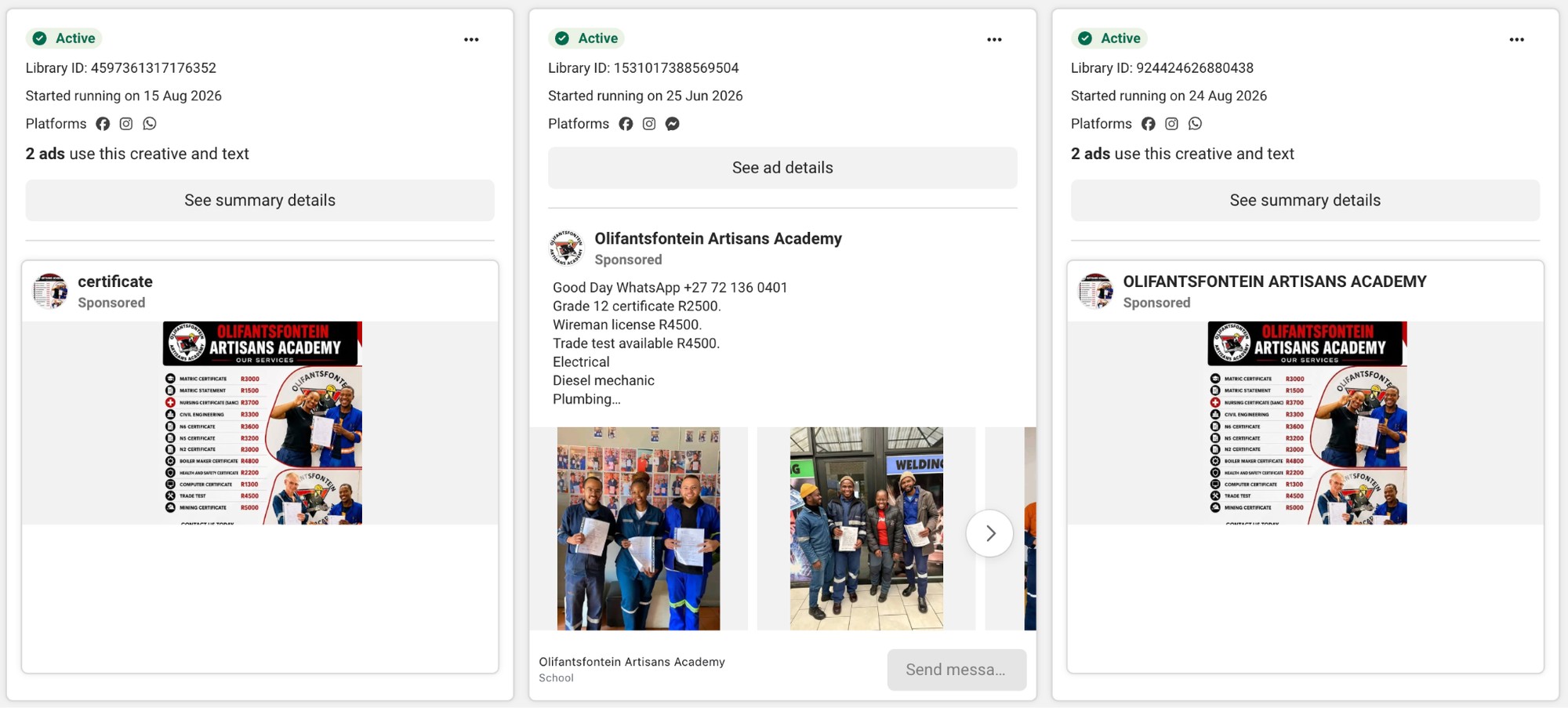
These adverts get thousands of impressions (views) each. Some use names like “Mr Ngwenya”, “Mr Ngele”, or “Mr Dlamini”. Some impersonate real businesses, including a trade test centre called “Olifantsfontein Artisans Academy”.
I contacted three sellers on WhatsApp, pretending to be a guy called Jason, looking for a matric certificate for my cousin, as he has a job interview soon for which he needs a certificate.
Scammer 1: Mr Dlamini doesn’t know what he is doing
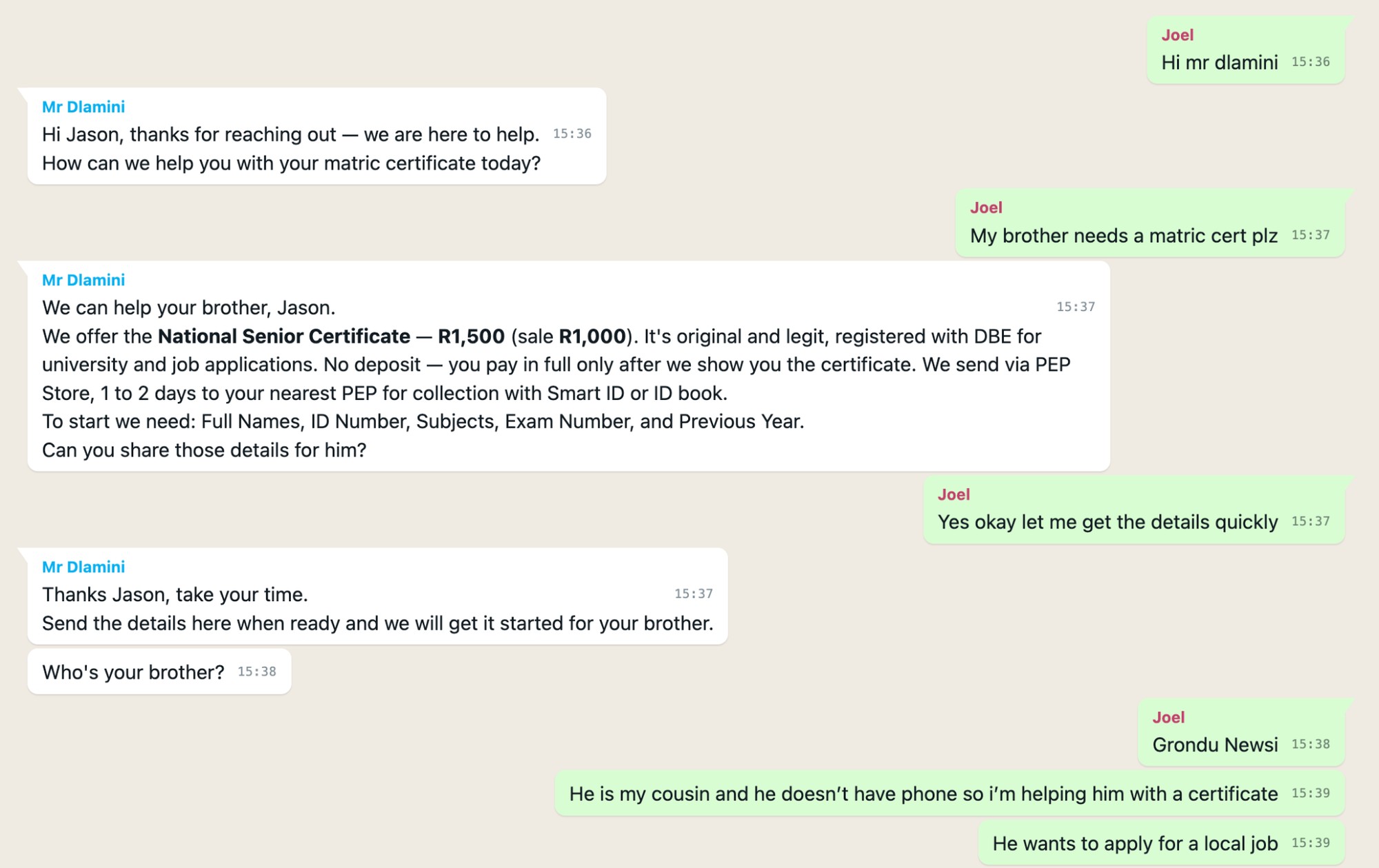
My first attempt at obtaining a certificate for my cousin was with Mr Dlamini.
In his advertisement, he had a very low price of R1,500, and said that I only had to pay once I’d seen the certificate. In my messages with him, I found out that there was a sale. The certificates were going for just R1,000.
After some back and forth, we settled on what I wanted on the certificate: my cousin’s name, Groundu Newsi, his ID number, and his subjects and marks (Groundu simply wanted a Bachelor’s pass).
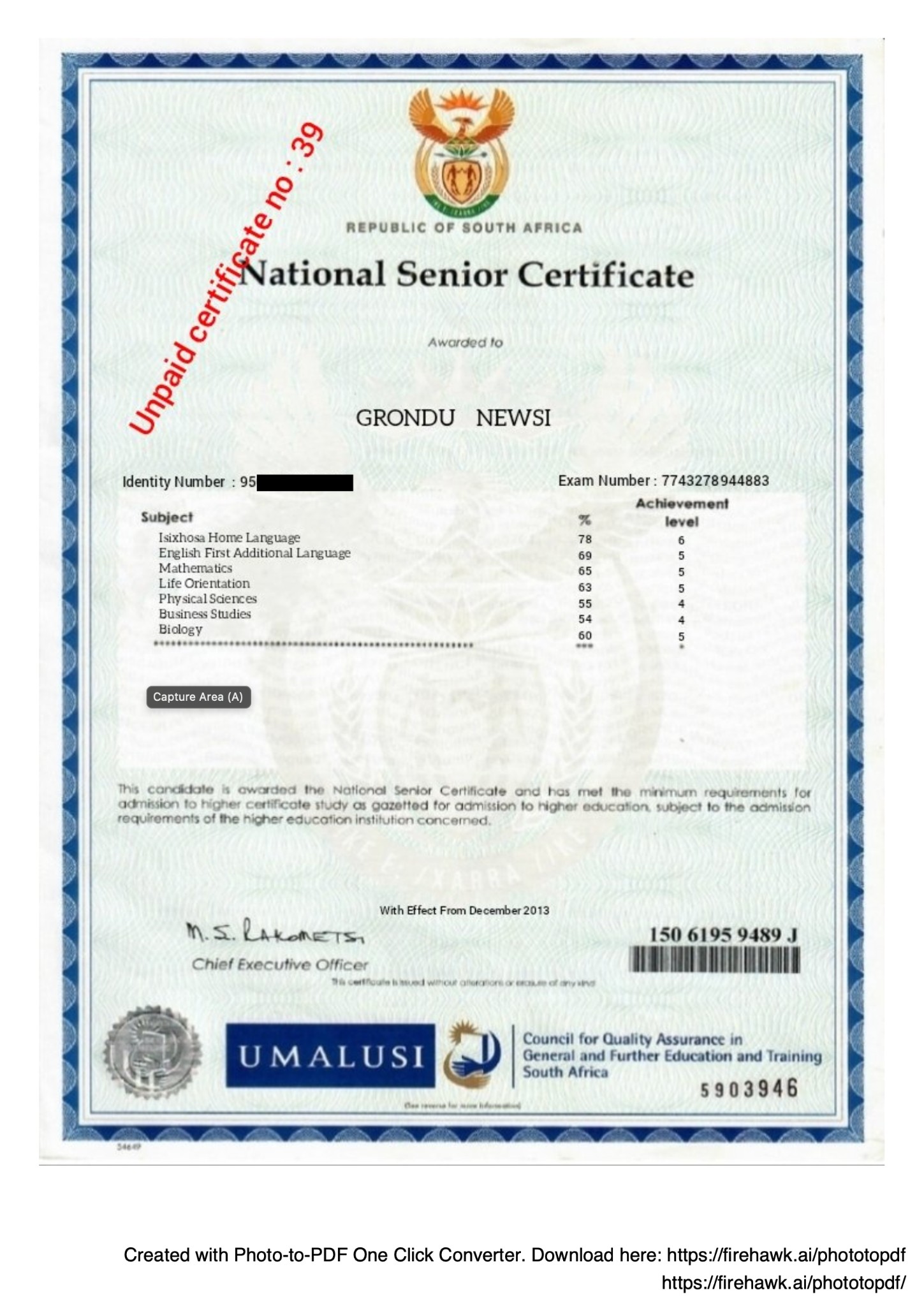
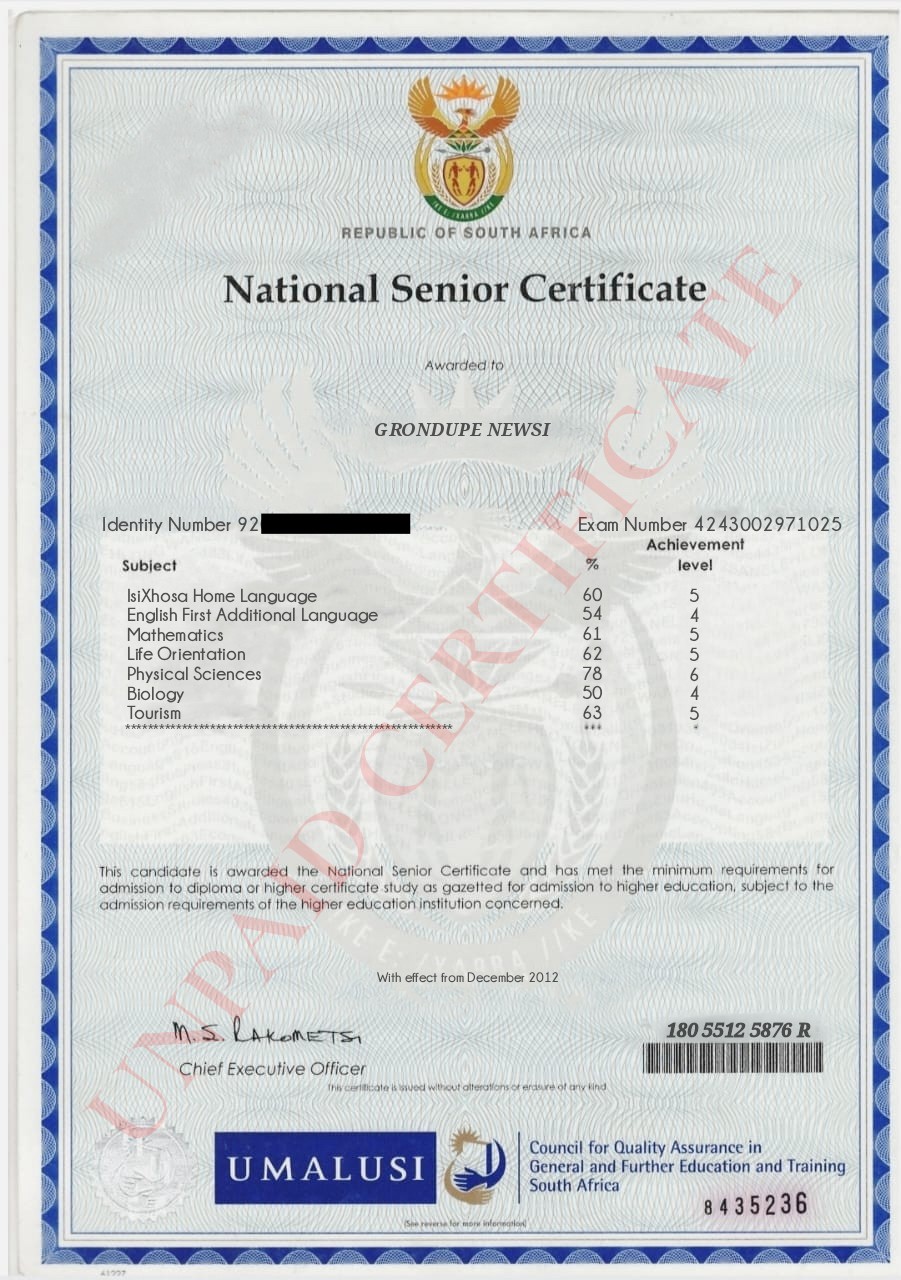
The certificate that Mr Dlamini sent me (with the ID blurred by us)
The certificate I got from Mr Dlamini was full of spelling mistakes, different fonts, blurriness and obvious cutting and pasting. Mr Dlamini, I have a few issues. The capitalisation of isiXhosa is wrong. And Biology is no longer a matric subject; it’s called Life Sciences now. Pretty poor fake, but I guess you get what you pay for. Luckily, I didn’t pay.
But I did ask him for his banking details. Initially, he insisted on Cash Send (the preferred choice by scammers, for its pseudonymity), but after some persistence on my part, I got his banking details.
It turns out Mr Dlamini’s bank account does not belong to Mr Dlamini, but rather to a “K Semetjane” account with GoTyme. His phone number also turned up in another scam, this one targeting people looking for RDP houses, under yet another name.
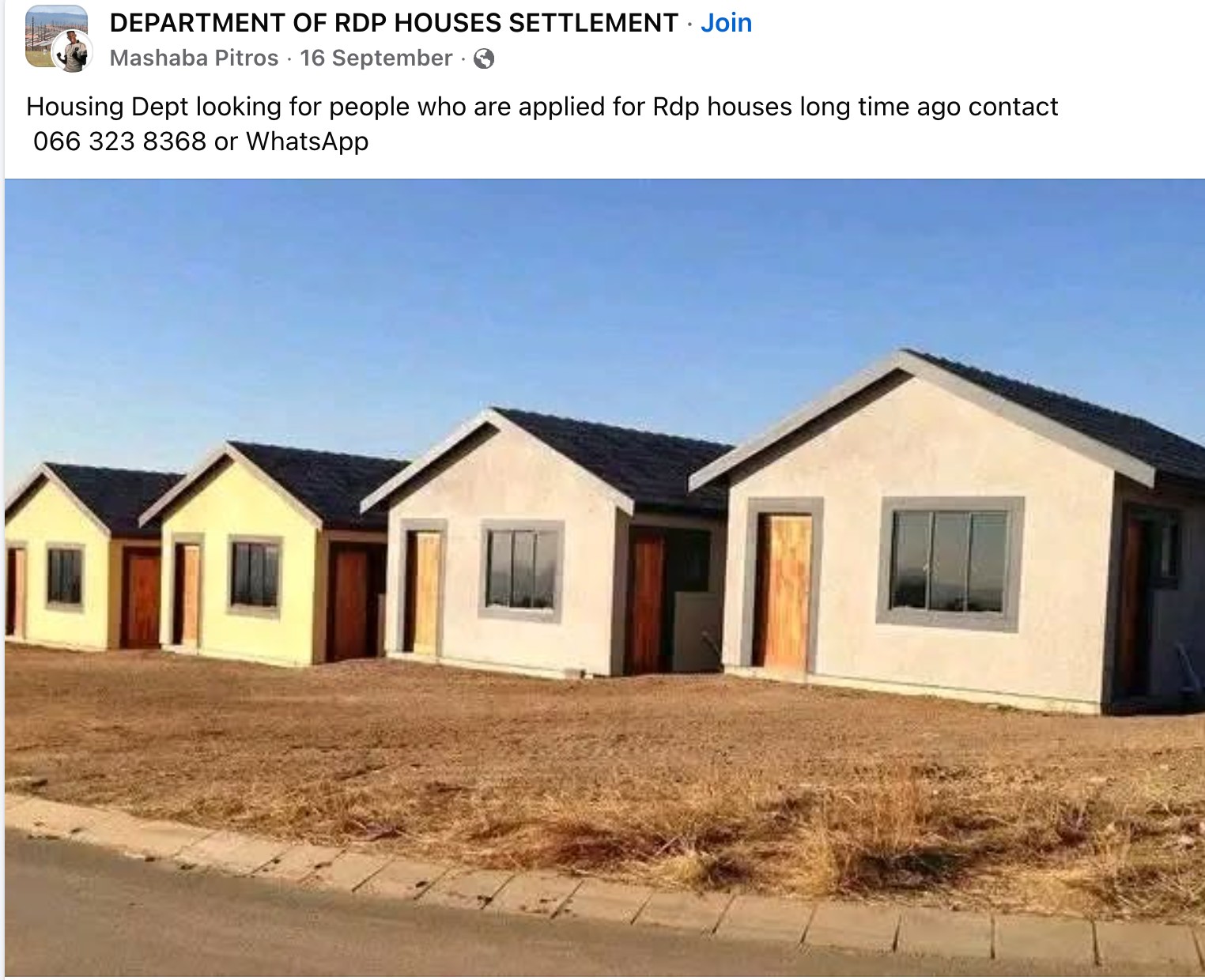
“Mr Dlamini’s” phone number is being used for another scam by “Mashaba Pitros”. None of these matches the name of the bank account.
Scammer 2: Tshabalala Certification Services, and AI slop
Unimpressed with the first certificate, I continued on my search. I found an advertisement by an account called “Matric Certificate”. The advertisement was an AI-generated video, which started off with: “remember this, God made you different, so don’t mess that up by trying to be like everyone else”.
Maybe they meant I should buy my matric certificate rather than get it through school like everyone else.
I WhatsApped the number on my screen, and I was greeted by Tshabalala Certification Services’ bot. I asked for a Bachelor’s Certificate, and was told to provide R3,500, and all the relevant details. Wow - a R2,500 increase from Mr Dlamini. I hoped that this one would be good.
Once again, I provided all the relevant details for the certificate.
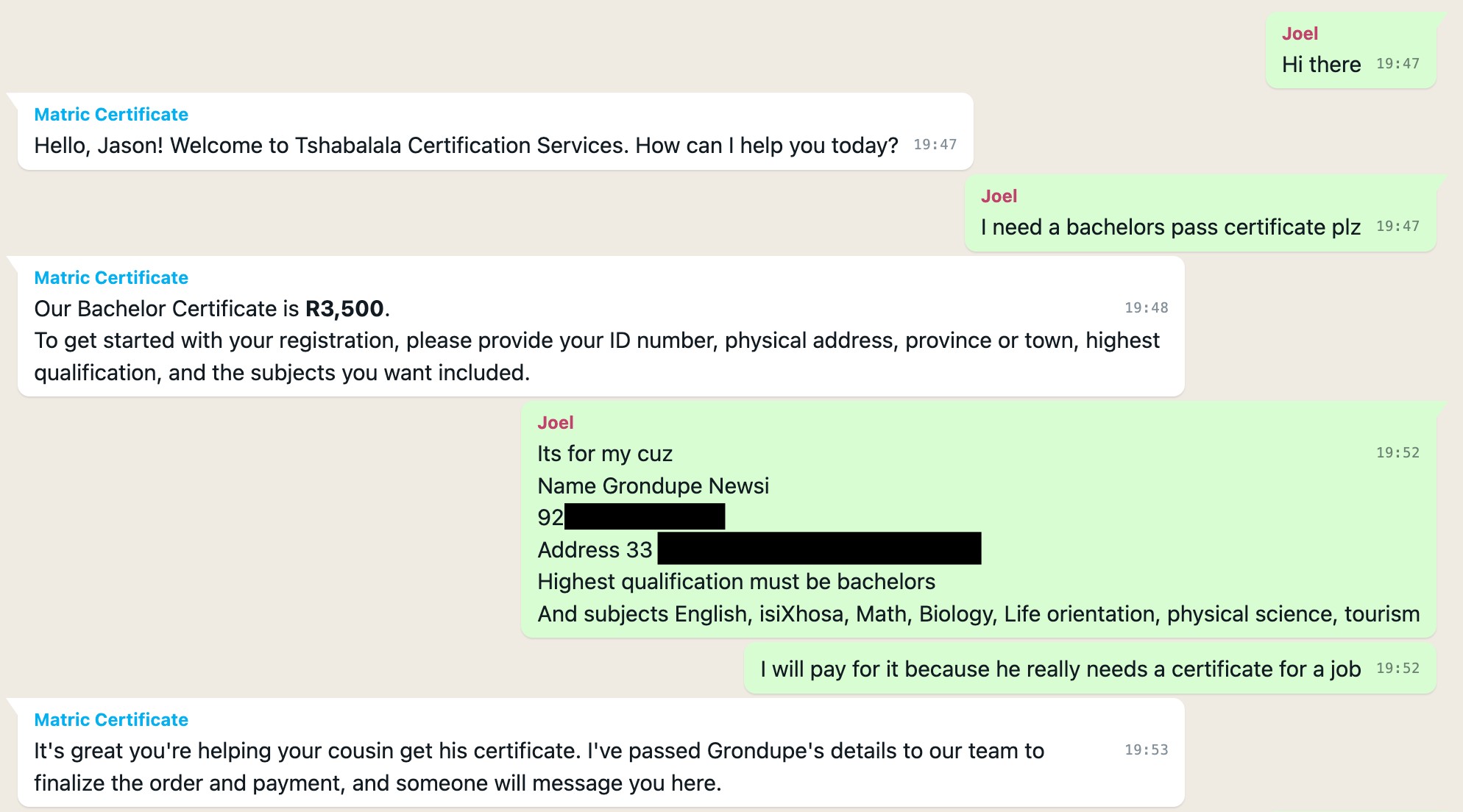
The scammer then tried to call me to finalise all the details. Mr Dlamini had also tried this. But I lied to both, telling them that my microphone was broken (Dlamini wanted proof, so I stuffed my mouth with a sock and recorded a muffled voice note). I assume that the scammers do this because they do not want the exchange to happen over text and in writing.
Tshabalala said that in order to start with the registration process, I had to pay a R500 deposit, and the remaining R3,000 after seeing the certificate. I pleaded, and eventually the automated robot agreed to share the certificate with me, but with a watermark over it. But then, a human stepped in and told me the R500 was non-negotiable. I continued to plead, but no luck.
I did, however, manage to get Tshabalala Certification Services to send sample pictures of their work. The certificates are significantly better than Mr Dlamini’s, but they have clearly been created using AI. In one image, the person’s thumb bends in an alien-like manner, and the characters on the keyboard are glitching. The scammer is using OpenAI’s models to create and/or edit the images and certificates.
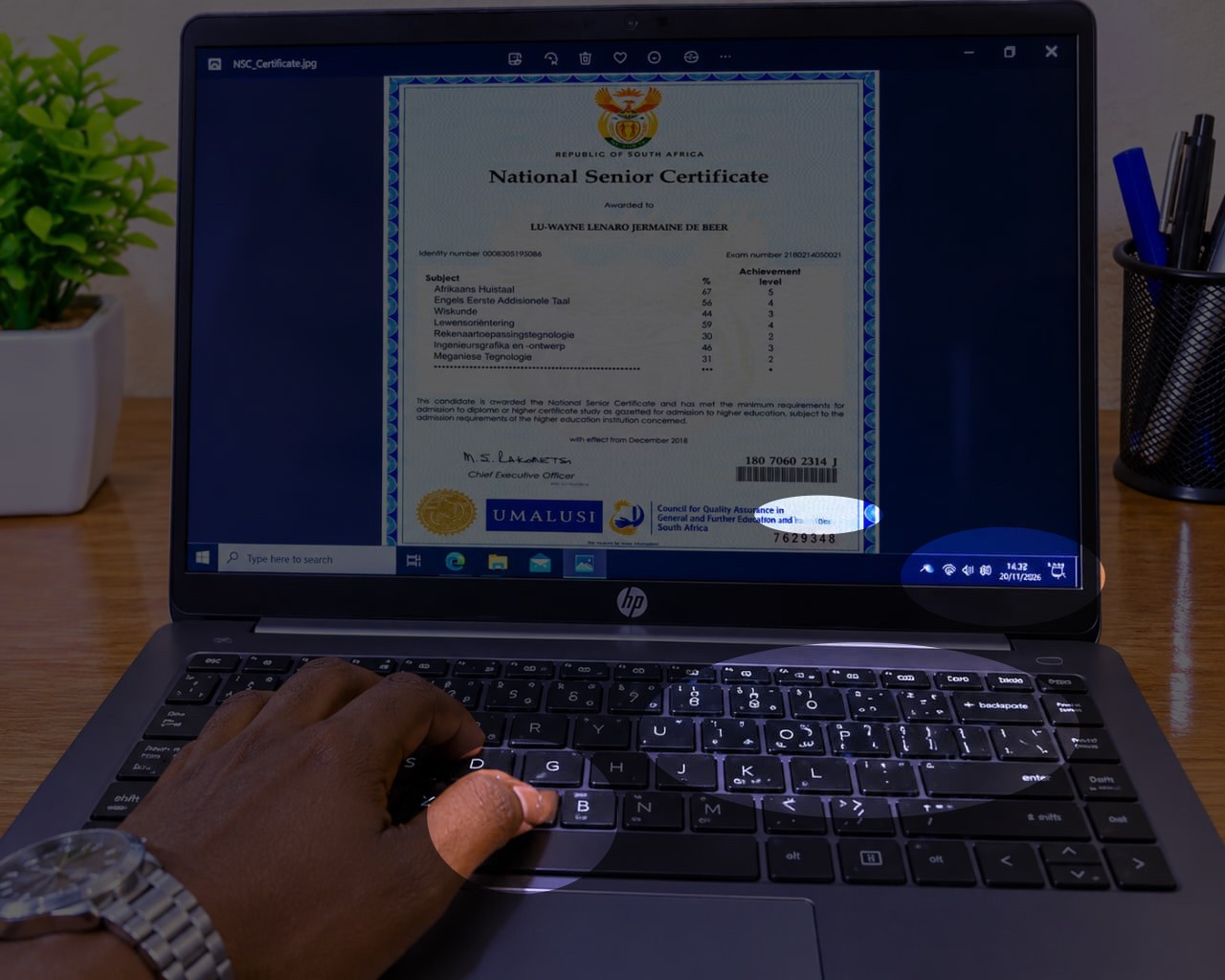
An image shared by the fraudster, with AI indicators highlighted by me.
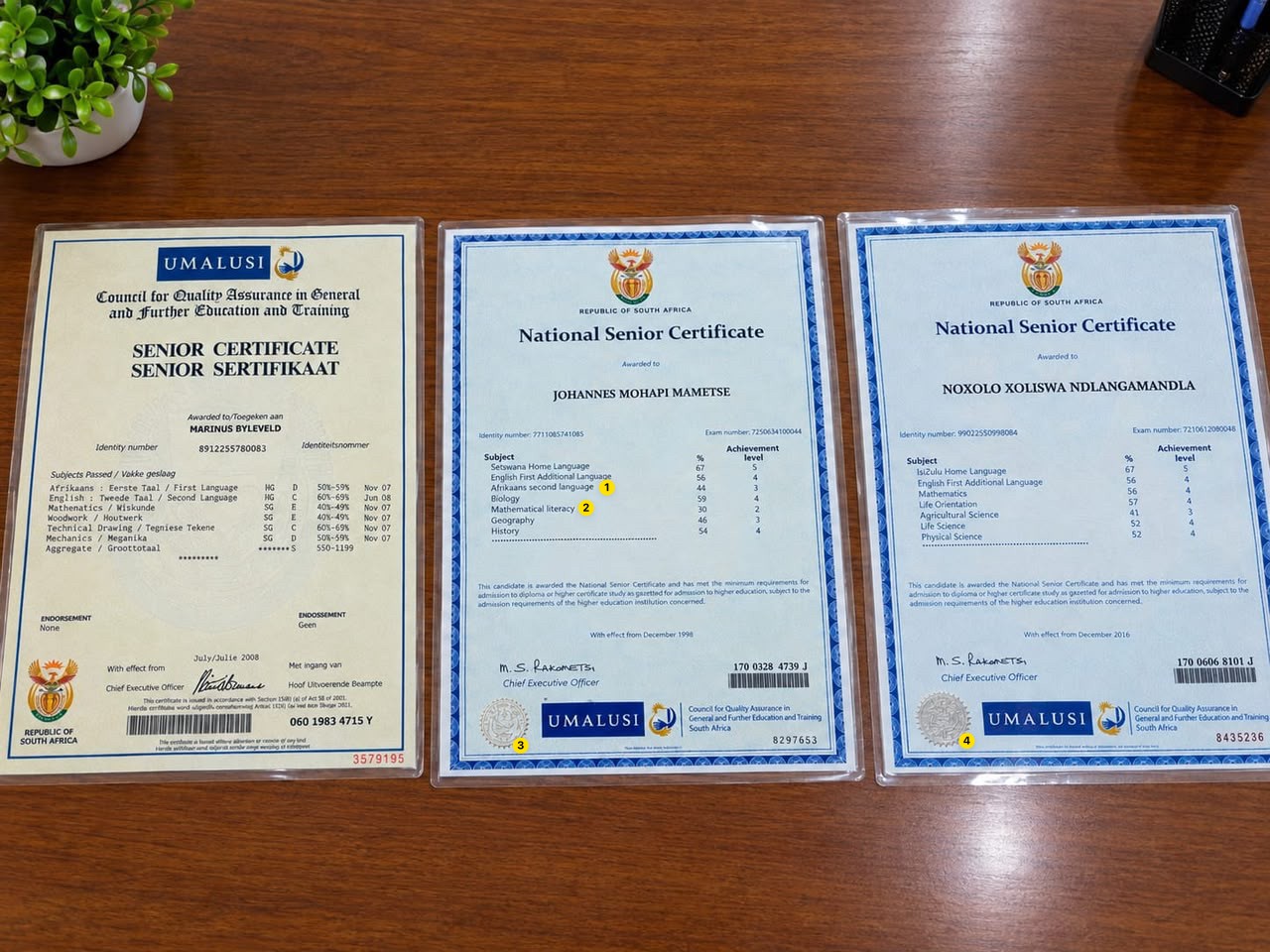
I have numbered some of the AI indicators in this image shared by the fraudster.
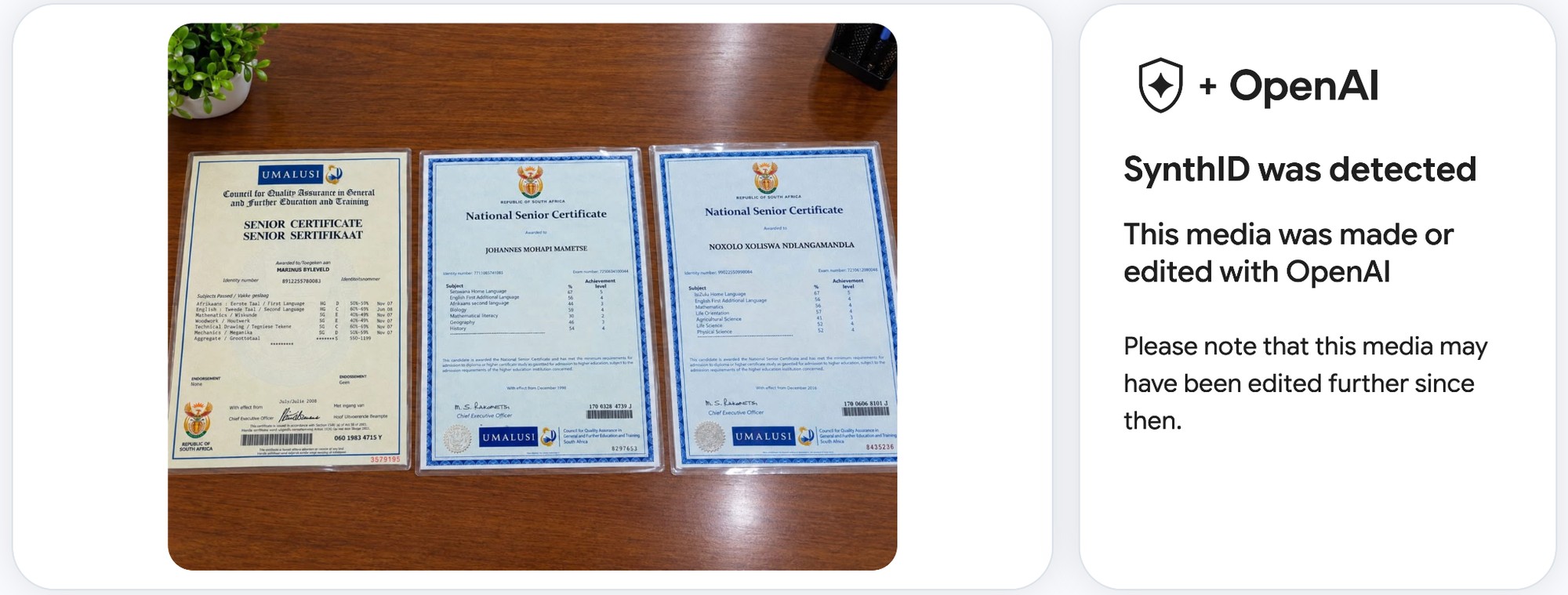
An AI watermark was discovered in all of the images shared by the fraudster.
Scammer 3: Facebook Marketplace
I found the third scammer through a Facebook Marketplace listing. Again, I made contact on WhatsApp and asked for a matric certificate and a statement of results for my cousin. The scammer insisted on a deposit before providing a certificate, but I pleaded and eventually got my way.
Another poor fake. The exam number is too long, the fonts are mismatched, and there is strange blurriness in the background.
The fake National Senior Certificate provided to me by Scammer 3
Impersonating a trade test centre
A handful of the advertisements are impersonating a real trade test centre, Olifantsfontein Artisans Academy. This has led the academy to put up notices across their social media and their website warning of fraud, and to offer a reward up to R10,000 for reporting such fraud to them.
Administrator Madri Hitge said the academy had reported the problem to the Construction Education and Training Authority and to the National Artisan Moderation Body and had also opened a case with the police. “We continue to report it on Facebook,” she said. “As we report, they jump up again.”
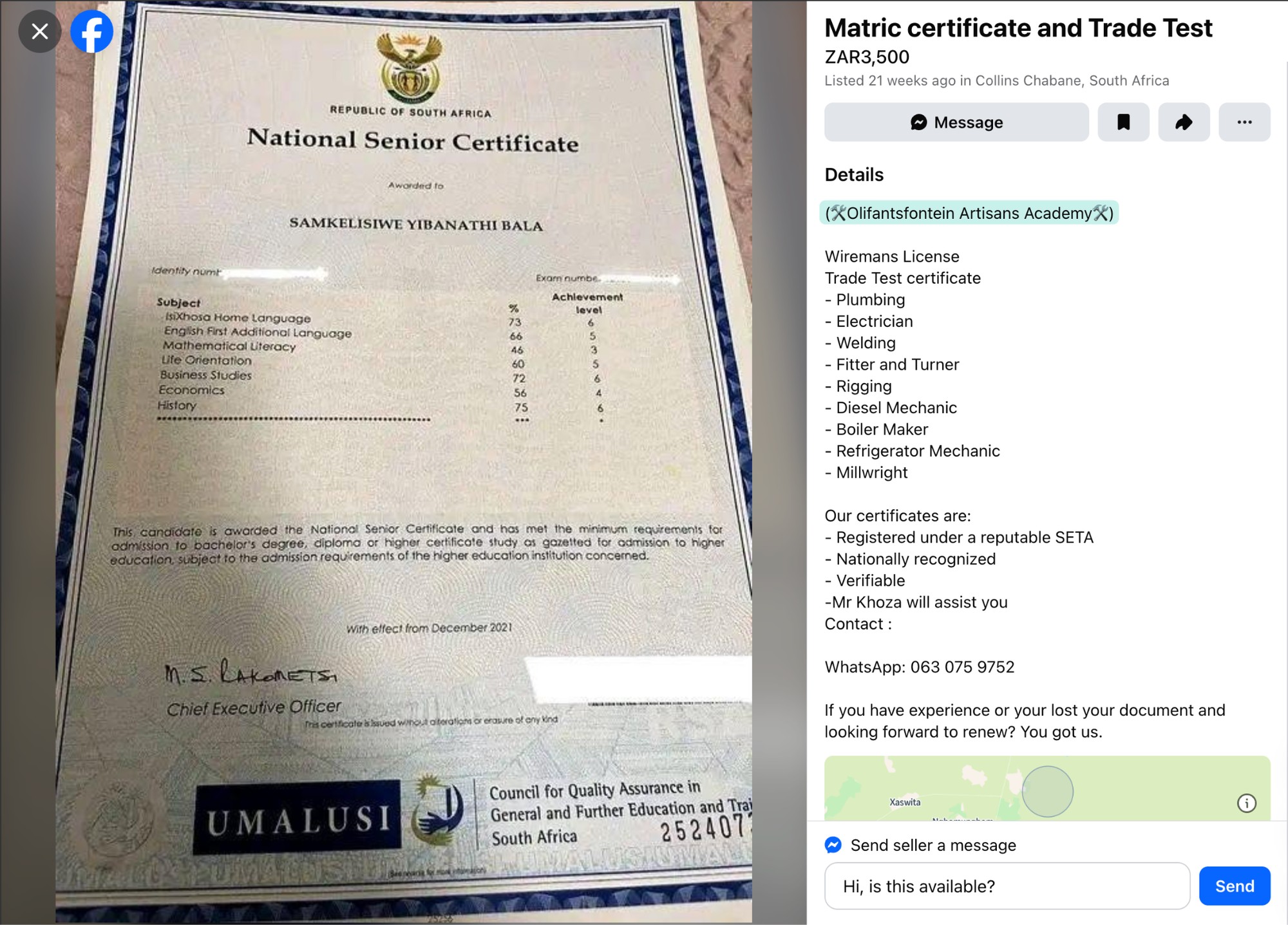
A Facebook Marketplace listing impersonating Olifantsfontein Artisans Academy
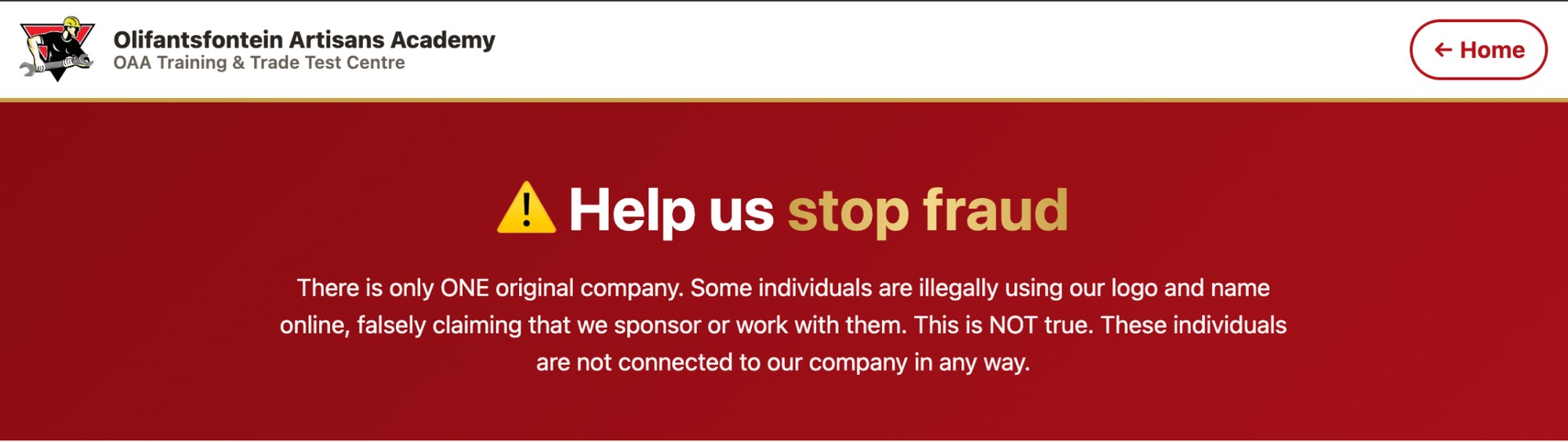
A notice shared by Olifantsfontein Artisans Academy on their website
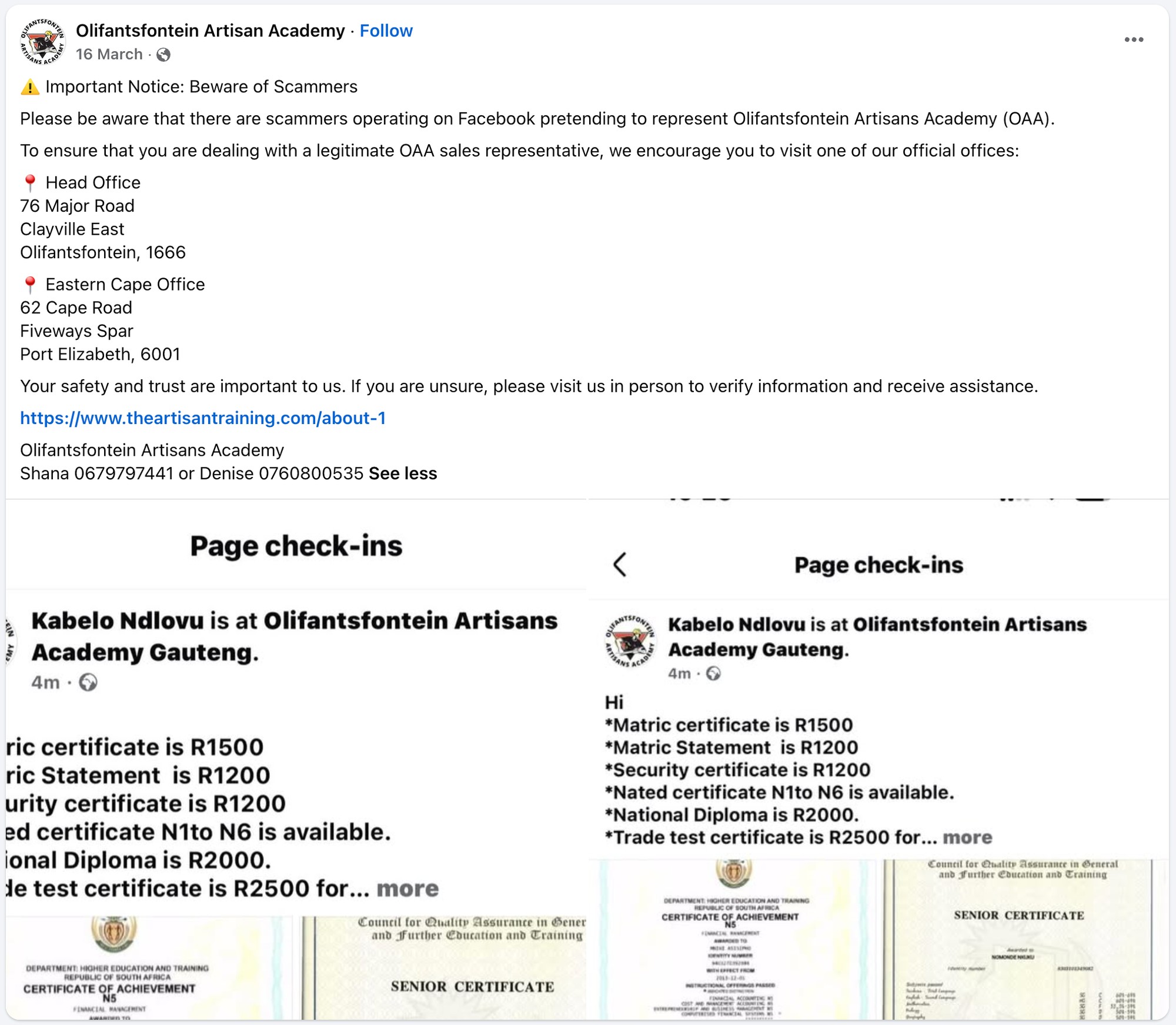
An official notice on the official Facebook page for the academy
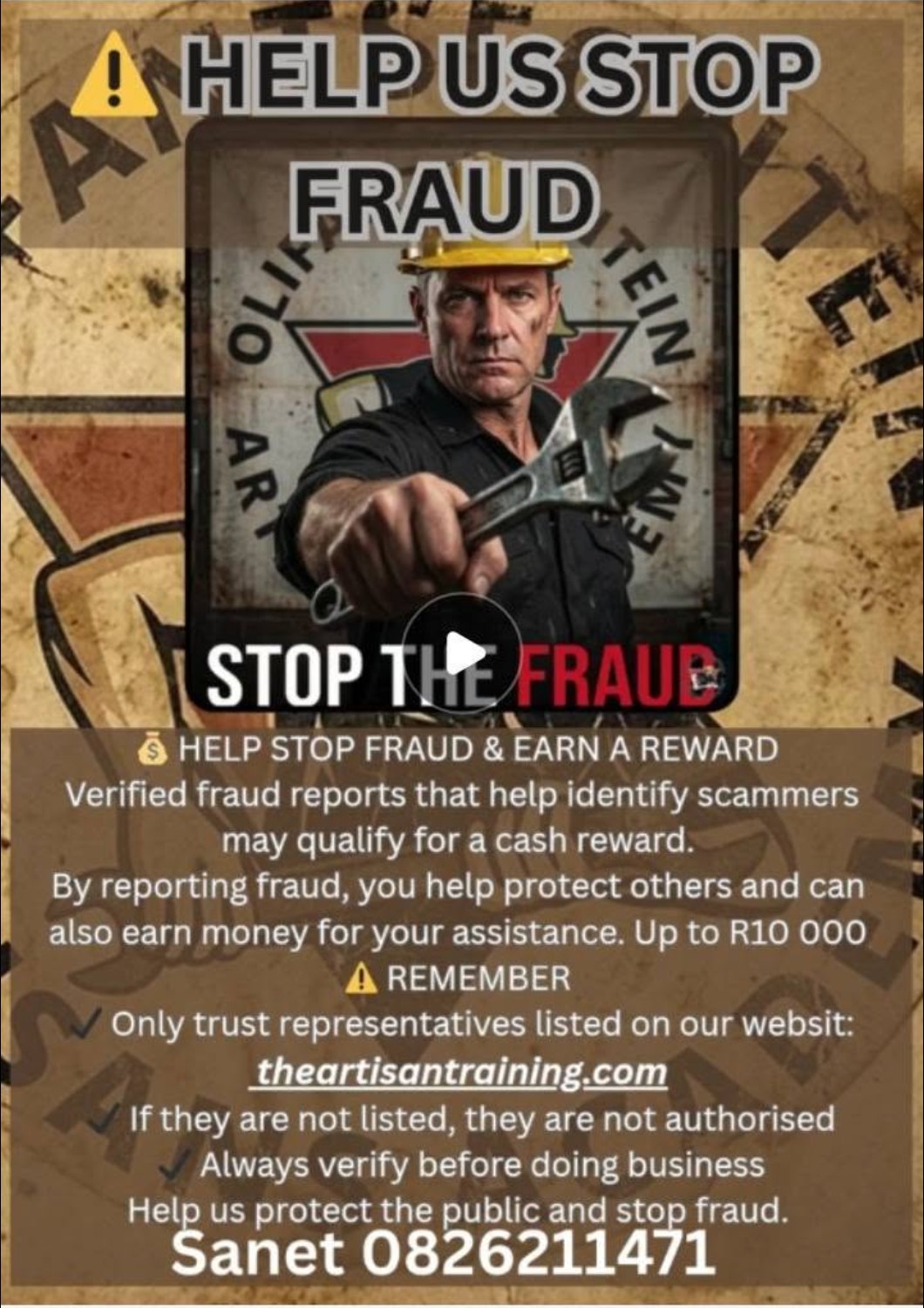
The academy is offering rewards of up to R10 000 for information on the scammers
Facebook’s hypocrisy
If you search Facebook for “matric certificate for sale” or “buy certificate”, you will immediately see a Facebook notice saying the search terms violate its policies, specifically its policy on prohibited documents and financial services. That policy bans “Content that facilitates or offers the solicitation, creation, sale, purchase or trade of the following: […] Educational documents and professional certificates”.
However, this policy does not seem to apply to Facebook’s advertisements. It seems Facebook will happily take money from these scammers and push their offers to users of the platform.
I found 30 active advertisements across Meta’s platforms for matric and other certificates. I reported all of them to Facebook. Not one has been removed yet.
GroundUp contacted Facebook’s Global Press Office for comment but no response had been received by the time of publication.
Facebook adverts are also being used to hijack SASSA grants, and all these scams will ramp up as Black Friday approaches.
Be wary of adverts on and off Facebook. And do not buy a matric certificate. It is illegal, and it is easy for an employer to check a certificate with Umalusi.
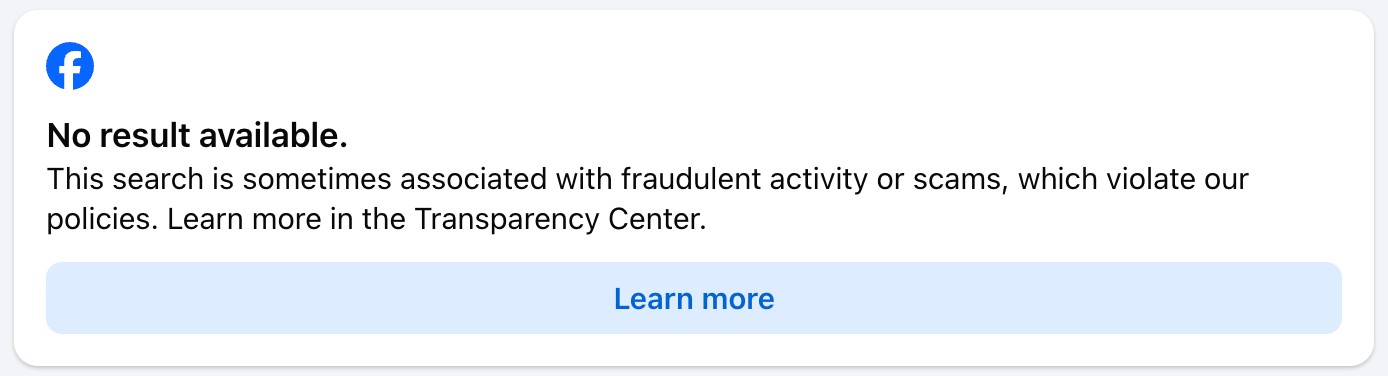
What you see when you try to search for anything to do with the purchasing of a certificate
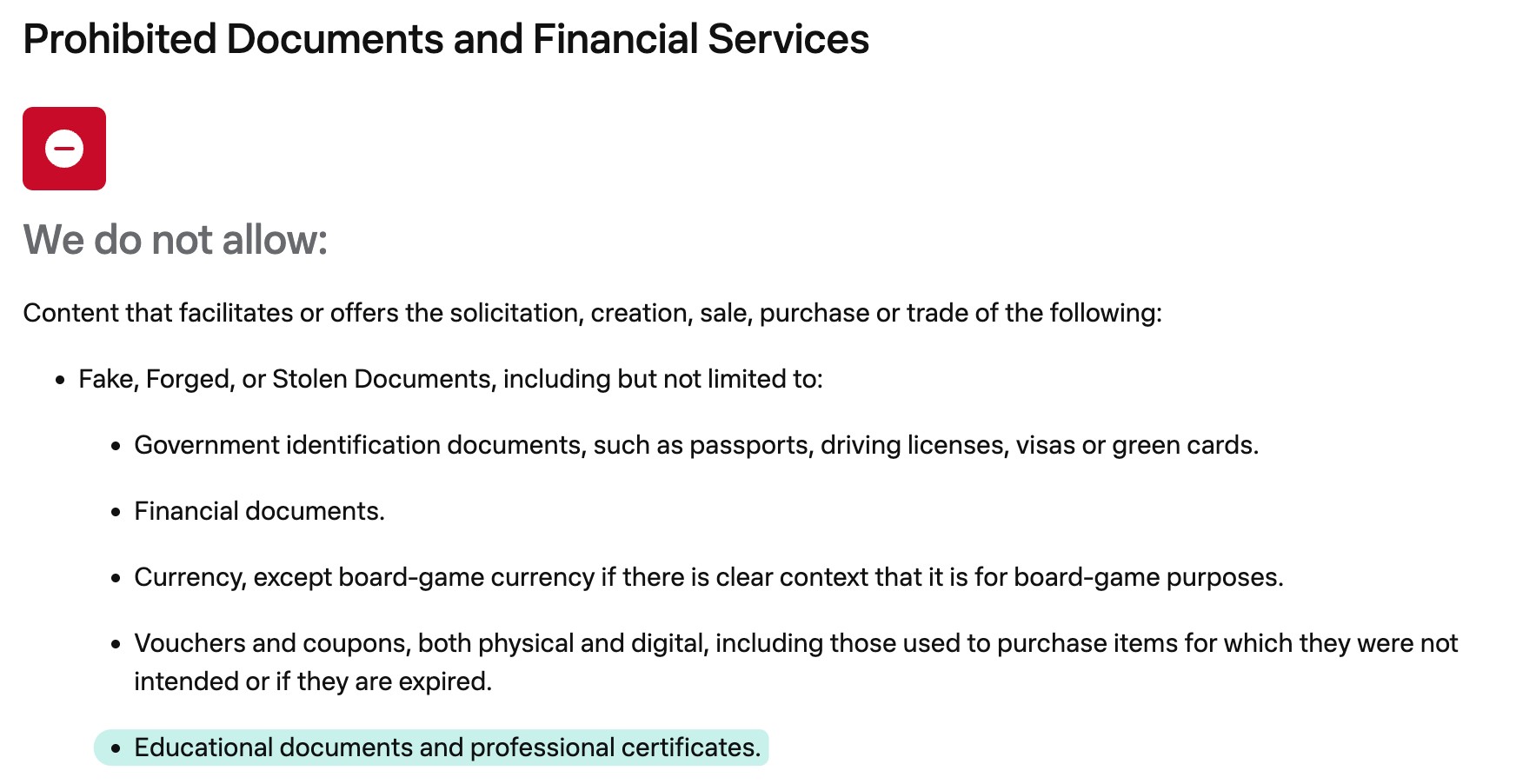
Meta’s policy regarding prohibited documents and financial services
Support independent journalism
Donate using Payfast

Don't miss out on the latest news
We respect your privacy, and promise we won't spam you.
© 2026 GroundUp. This article is published under the GroundUp Republication Licence Version 1.0. Email [email protected] to request permission to republish.