
Johannesburg: Where water runs in the streets, but not in the taps
Nearly half the city’s water is lost to leaks
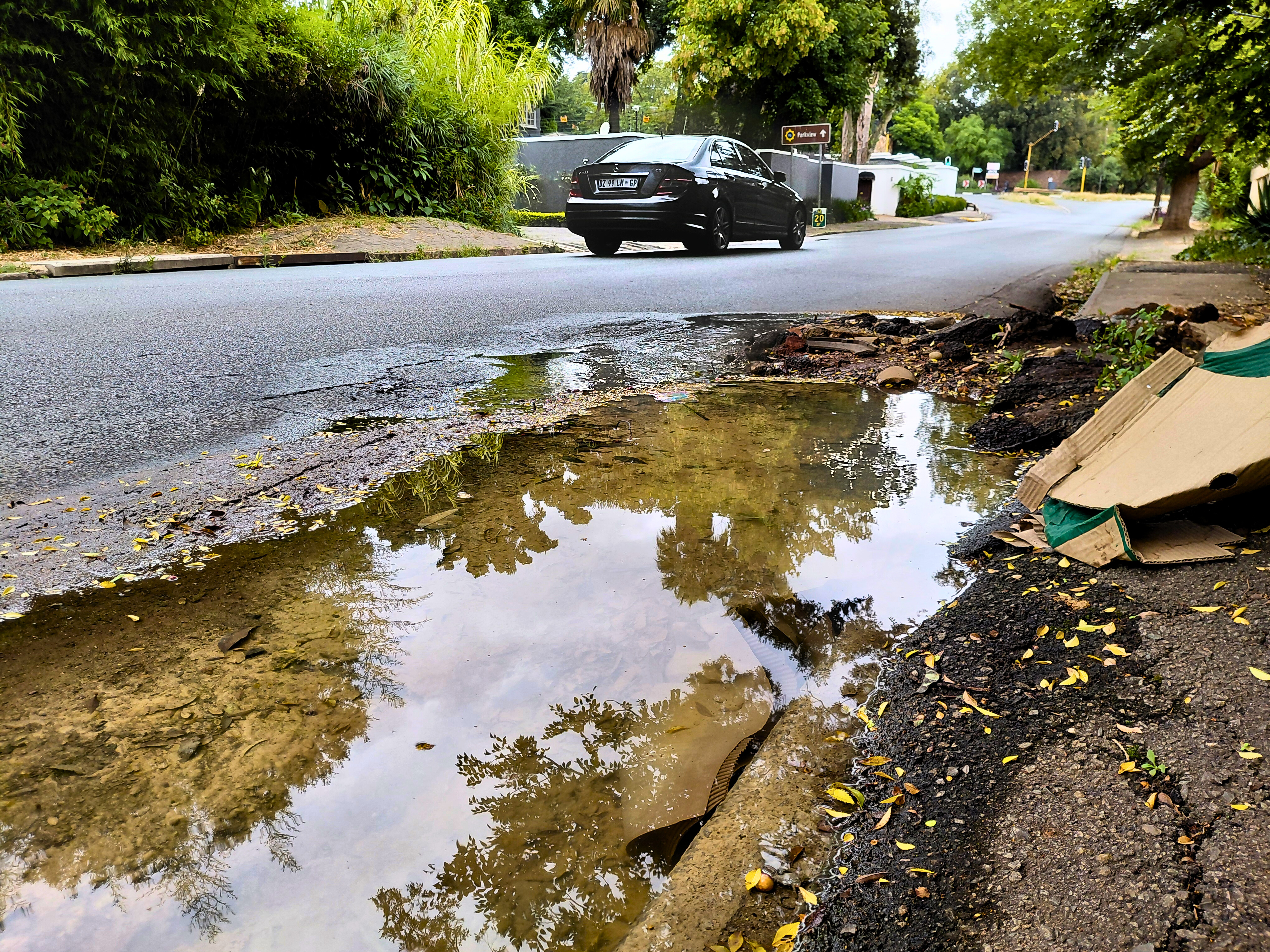
Water from a leaking pipe pools on a street in Johannesburg. Photo: Seth Thorne
- More than 48% of Johannesburg’s water is lost to leaks, bursts and illegal connections.
- Johannesburg will need R64-billion over the next ten years to fix its water infrastructure and stop leaks and bursts.
- Minister of Finance Enoch Godongwana announced on Wednesday that R27.7-billion has been allocated to Johannesburg Water over the next three years.
Families across Johannesburg, from Brixton to Westbury, Melville, Coronationville and Midrand, having faced dry taps for weeks, are reeling from the impact of an ailing water distribution network.
Nearly half of Johannesburg’s water is lost, mainly because of old pipes and other infrastructure.
In his Wednesday budget speech, Finance Minister Enoch Godongwana noted that R64-billion would be needed to fix water supply problems in the city.

He warned that revenue collected for a specific purpose had to be used for that purpose.
“In reality, this principle is consistently flouted. For instance, Johannesburg’s water revenue is R11.9 billion, but only R1.3 billion is allocated to Joburg Water for capital expenditure,” he said.
He said R27.7-billion had been allocated over the next three years to a reform in the country’s metros aimed at matching revenue collection to reinvestment in the same service, something activists and engineers have been urging for years.
Failure to meet targets would result in budget cuts to the metros, Godongwana warned.
A Brixton doctor, who did not want to share his name, told GroundUp he had not had a drop of water in his consulting rooms for weeks. And no City of Johannesburg water tankers had come.
“I’ve been here for decades. I called and pleaded with the City to bring tankers, but nothing. We all had to buy and carry the water to work, while giving to many in the area without,” said the doctor.
Water has been restored in his building, but he says that many patients are complaining that they are getting very little water and of poor quality.
“We did not have any water for 25 days,” said Pathie Ncube, a barista at Topdose Cafe.
“It is frustrating because everywhere you look, there are leaks that have been going on for ages. They know about it. It is as if they are waiting for a major burst to act,” said Ncube.
Leaks
According to the Gauteng Water Security Dashboard, over 48% of Johannesburg’s water is classified as lost to leaks, bursts and illegal connections (non-revenue water) against a World Bank best practice benchmark of 25%.
National Treasury told Parliament in late 2025 that 72% of these losses are physical, “attributable to minimal investment in infrastructure”.
Between 1 July and November 2025, Johannesburg recorded 20,915 leaks, according to the Gauteng Water Security Dashboard.
Yet, in 2023/24, Johannesburg Water replaced only 17km of water pipes in its 12,364km distribution network, much of which is over 80 years old.
WaterCAN communications manager Jonathan Erasmus said the network had “been pushed beyond its limits”.
“Prolonged outages, collapsing pressure, and unpredictable supply have become normalised across the city.”
“Despite repeated warnings from civil society, engineers, and residents, corrective action has been slow, fragmented, and opaque.”
Water management expert Professor Anthony Turton said the collapse has been driven by years of politicised decision-making, skills losses, and corruption.
While additional water supplied by Rand Water, granted by the national government, offers short-term relief, Turton warned that it does not address the underlying system constraints.
He described it as pouring water into a leaking bucket
Johannesburg Water’s Turnaround Strategy
Johannesburg Water spokesperson Nombuso Shabalala said it has implemented a water demand and conservation strategy focused on leak detection, pressure management, pipeline replacement, reservoir repairs and curbing illegal connections to reduce water losses and improve response times.
Shabalala said the utility’s ten-year Turnaround Strategy 2024 is aimed at strengthening financial sustainability and governance while directing revenue towards critical infrastructure upgrades.
The strategy notes that R64-billion is required over the next ten years.
The plan promises upgrades to pipelines and reservoirs, network maintenance, wastewater treatment improvements and expanded storage capacity.
In the interim, Shabalala said the utility is “filling critical technical posts and appointing additional artisans to improve response times to leaks and bursts”, as well as bringing in emergency contractors to help clear the service delivery backlog.
“These interventions are part of a broader commitment to improve system efficiency and ensure a more reliable water supply for all residents,” said Shabalala.
Support independent journalism
Donate using Payfast

Don't miss out on the latest news
We respect your privacy, and promise we won't spam you.
Next: Clothing company implicated in sweatshop scandal cries foul
Previous: In photos: How Cape Town is converting waste into electricity
© 2026 GroundUp. This article is licensed under a Creative Commons Attribution-NoDerivatives 4.0 International License.
You may republish this article, so long as you credit the authors and GroundUp, and do not change the text. Please include a link back to the original article.
We put an invisible pixel in the article so that we can count traffic to republishers. All analytics tools are solely on our servers. We do not give our logs to any third party. Logs are deleted after two weeks. We do not use any IP address identifying information except to count regional traffic. We are solely interested in counting hits, not tracking users. If you republish, please do not delete the invisible pixel.