
Judge gets tough on incompetent lawyers
Divorce lawyer told to pay costs on punitive scale. Liquidation lawyers told to refund fees.
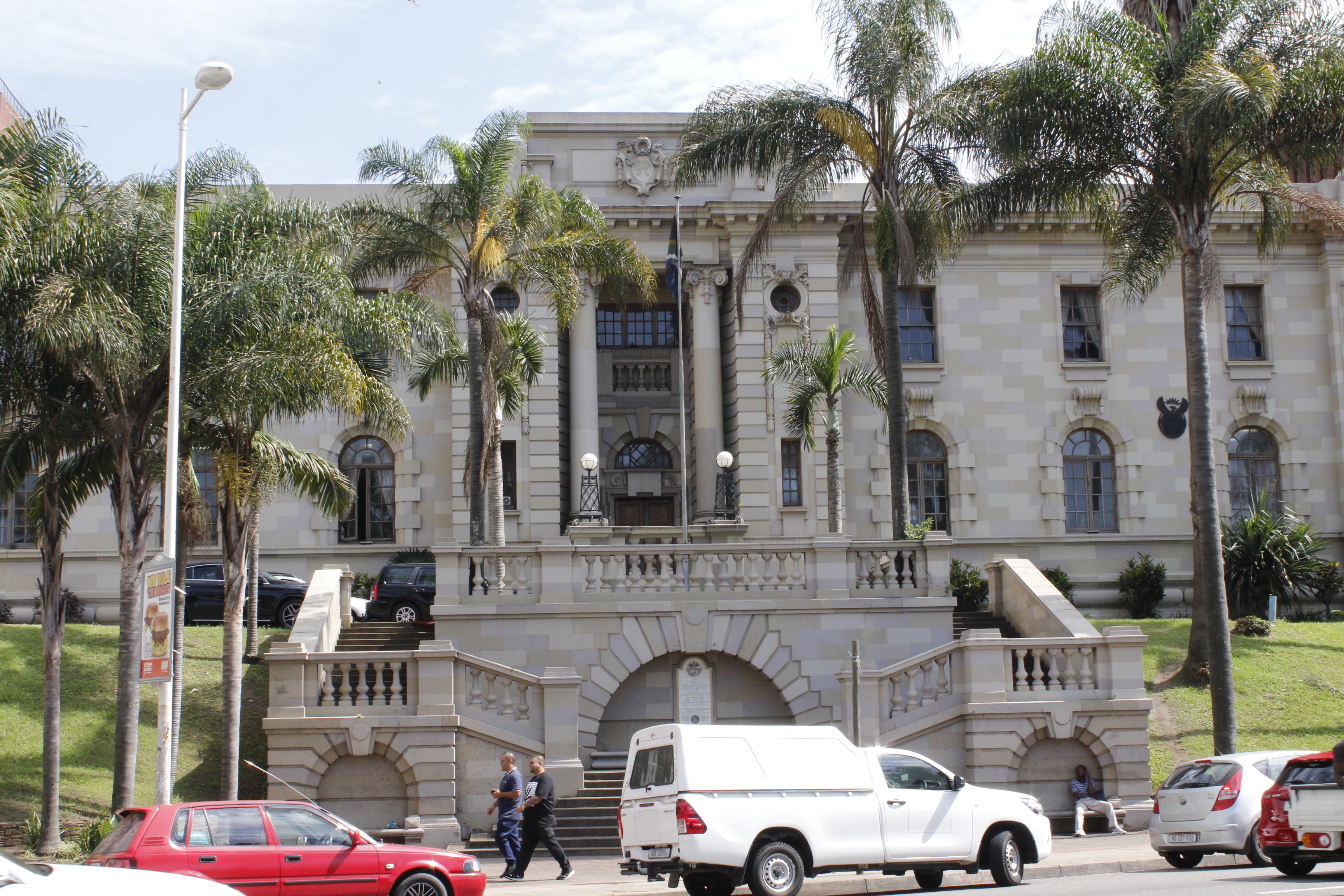
High court in Durban. Archive photo: Nomfundo Xolo
- A lawyer set down an opposed divorce matter on the unopposed roll.
- Judge Rob Mossop was furious and ordered her to personally pay the cost of the application on a punitive scale. Her conduct must be reported to the Legal Practice Council, he said.
- In another matter, lawyers representing sides in a liquidation matter failed to notice that the company had ceased to exist in 2011.
- Mossop, in a scathing ruling, ordered the lawyers to refund their fees.
Lawyers appearing before KwaZulu-Natal High Court Judge Rob Mossop have been cautioned to get their legal ducks in a row - or face the consequences.
In two separate rulings handed down on one day this week, he ordered one attorney, handling a divorce matter, to personally pay the costs of the application on a punitive scale, and he referred her conduct to the Legal Practice Council.
In the other, a liquidation matter, he barred the lawyers on both sides from claiming any fees from their respective clients and ordered that they refund anything already paid.
Lawyer tried to “steal a march” on her client’s husband
The divorce issue came before Judge Mossop in an application to rescind a decree of divorce.
A different judge had granted the divorce order in December 2025, in an application moved by the wife’s attorney as unopposed, even though the matter was opposed by the husband.
The husband was “outraged” when he learnt about this only when the divorce order was served on him in January this year.
He and his attorney said he had opposed the application and had served papers on his wife’s attorney, Aphsana Yusuph, and with the court.
Judge Mossop, faced with an urgent rescission application from the husband, sought clarity from Yusuph as to what had transpired.
He also called for the divorce file, but was “inexplicably” told that “it was missing”.
In her affidavit, Yusuph said the opposing documents had not been in the court file, and thus the rules of court had not been complied with.
“I am astonished at the attitude adopted by Ms Yusuph. Her understanding of what the law requires is at complete variance with what I understand its demands to be,” said Mossop.
“She appears to try and explain her conduct by reference to the state of the court file: the documents were allegedly not in it, so it was entirely permissible for her to set the matter down on the unopposed roll. There is not even a passing nod to the requirement that a legal practitioner is required to be entirely honest and candid with the court and not to deceive or mislead the court,” he said.
“A troubling aspect to this whole episode is Ms Yusuph’s apparent lack of responsibility towards the truth,” he said, noting that if documents were not in the court file, it was her duty to rectify the problem.
Instead, she had taken the opportunity to “steal a march” on her client’s husband.
Her conduct was contrary to the standards expected from those in the legal profession, Judge Mossop said, and for that reason, she must pay the costs of the rescission application personally on a punitive scale, and her conduct must also be brought to the attention of the Legal Practice Council.
Liquidating a company that hasn’t existed for 15 years
The next matter on the judge’s motion court roll was an ongoing dispute between two brothers-in-law, the one attempting to liquidate the company they both owned.
Krishna Naidoo had, in August 2024, secured a provisional order winding up Gayregina Investments CC, owned jointly by him and Govindsamy Naidoo.
Krishna Naidoo now wanted that order to be made final.
Judge Mossop said that, in order to track the history of the matter, which had been before the court since 2023 and had been on the roll at least nine times, he had to peruse “an appallingly maintained court file”.
“It is reasonably safe to conclude that a significant amount of court time has been consumed by this matter, and the court file would have been read by the presiding judge every time it appeared on the roll.”
“But had the applicant’s attorneys paused, and thoroughly researched the matter, it would have immediately become obvious that the application was moribund and could never, no matter how many adjournments were granted, have finally led to the liquidation,” he said.
This was because the company had been deregistered in February 2011, nearly 15 years ago, which effectively meant the company no longer existed.
A simple perusal of the Companies and Intellectual Property Commission (CPIC) records by attorneys on both sides, would have revealed this.
Judge Mossop said he had written to both legal representatives before the matter came before him in court, asking them to explain themselves and why they should not be ordered to personally pay the costs of the application, on a punitive scale.
He said both sides were at fault.
“It is a notorious fact that litigation in the High Court is expensive. In light of that, the least that clients can expect is that the attorney they have instructed properly and soberly considers the facts of the case, performs the necessary research where knowledge is lacking, knows and understands the law relating to the matter.”
Judge Mossop said even when he alerted the lawyers about the fundamental problem, Krishna Naidoo’s attorney, Bala Naidoo and Company, had remained intent on “seeking the necessary relief from the court”.
The conduct of Advocate Selvan Naidoo, a trust account advocate representing Govindsamy Naidoo was “scarcely better”.
“This matter has been poorly and slovenly handled from inception by both sides. This type of approach will no longer be tolerated. All of this has been to the financial detriment of the parties and to the detriment of the court, whose diminishing resources, already under severe strain, have been needlessly consumed,” the judge said.
He said the lawyers needed to bear the consequences of this, and they should not be entitled to benefit financially from what they had done, or failed to do.
He discharged the provisional liquidation order and barred Bala Naidoo and Company and Advocate Selvan Naidoo from deriving any fees in respect of the application. Any fees already paid must be refunded within 30 days.
Support independent journalism
Donate using Payfast

Don't miss out on the latest news
We respect your privacy, and promise we won't spam you.
Next: Gangsters shut down Khayelitsha clinic
Previous: Basic income grant policy will take another year at least
© 2026 GroundUp. This article is licensed under a Creative Commons Attribution-NoDerivatives 4.0 International License.
You may republish this article, so long as you credit the authors and GroundUp, and do not change the text. Please include a link back to the original article.
We put an invisible pixel in the article so that we can count traffic to republishers. All analytics tools are solely on our servers. We do not give our logs to any third party. Logs are deleted after two weeks. We do not use any IP address identifying information except to count regional traffic. We are solely interested in counting hits, not tracking users. If you republish, please do not delete the invisible pixel.