
Kimberley’s big hole of municipal failure
Sol Plaatje municipality’s speaker and municipal manager were recently appointed despite tainted records
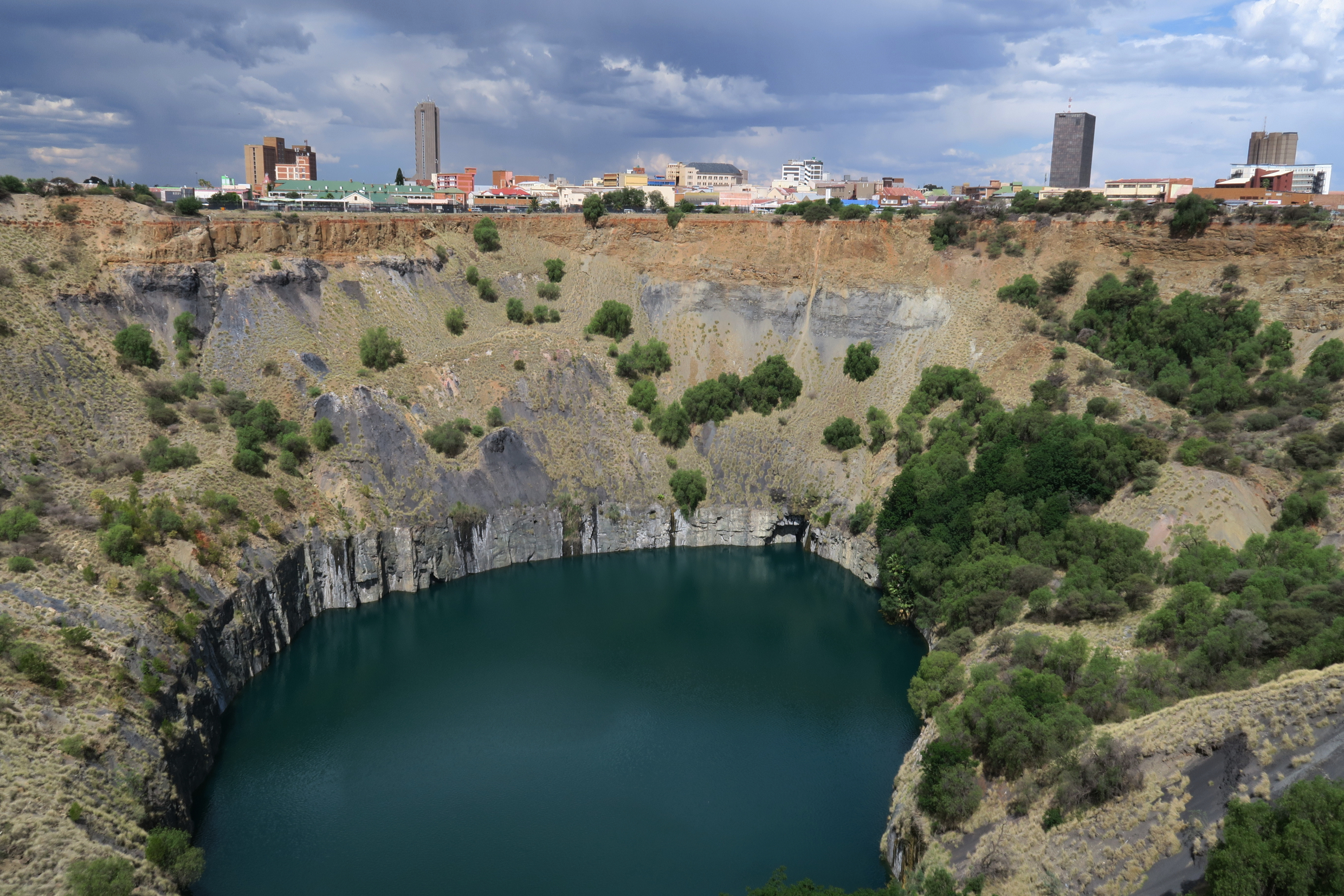
Kimberley was built on the wealth of diamond mining, as this big hole at its centre testifies, but municipal services in the town are poor. Photos: Steve Kretzmann
- Sol Plaatje Municipality, which runs Kimberley, loses hundreds of millions of rands worth of water and electricity yearly.
- The municipality’s last unqualified audit was in 2016/17, with the Auditor-General raising 11 qualifications in the latest audit, including fruitless and wasteful, and irregular expenditure of R105-million.
- The municipality recently appointed a new Speaker, Dipuo Peters, who was suspended by President Ramaphosa as a deputy minister for unethical conduct, and it appointed as acting municipal manager Busisiwe Mgaguli, who was convicted of fraud in 2013 and ordered to pay back over R780,000 this year.
Far from its diamond mining history making it a dazzling gem of the Northern Cape, Kimberley has sunk into a deep hole of debt and failing service delivery due to municipal mismanagement.
Previously, we reported how sewerage failures have resulted in widespread environmental pollution, the loss of potential jobs and revenue, and a threat to human health. But this is just one of the municipality’s failures. Finances, water supply, waste management, and community facilities are all collapsing. And in the past year, the council has made highly questionable appointments in the positions of Speaker and Municipal Manager.
Giving up on the ANC
Kimberley and a few small settlements, such as Ritchie and Platfontein, are run by the Sol Plaatje Local Municipality, which has been governed by an ANC majority for the past 30 years.
The ANC had 73% of the vote in the 2006 elections, but that decreased to just over 50% in the last municipal elections held in 2021. With 33 seats, the ANC has a one-seat majority in the 65-seat council. The DA, with 14 seats, is the official opposition.
The last time the Auditor-General (AG) gave the municipality an unqualified audit was for the 2016/17 financial year, but electricity losses through illegal and unmetered connections, water losses from leaks and unmetered connections, debt write-offs, and poor payment collection were flagged as matters of concern.
“Unqualified with matters” is the second-best audit opinion a municipality can obtain from the Auditor-General, and the municipality had these for three years running, picking itself up after a qualified audit opinion in 2013/14.
But in 2018, it slid back to a qualified audit, with the AG raising four qualifications. In the last available audit, for the 2023/24 financial year, the AG raised 11 qualifications, with the four qualifications from 2018 not only repeated, such as loss of water and electricity, but growing worse.
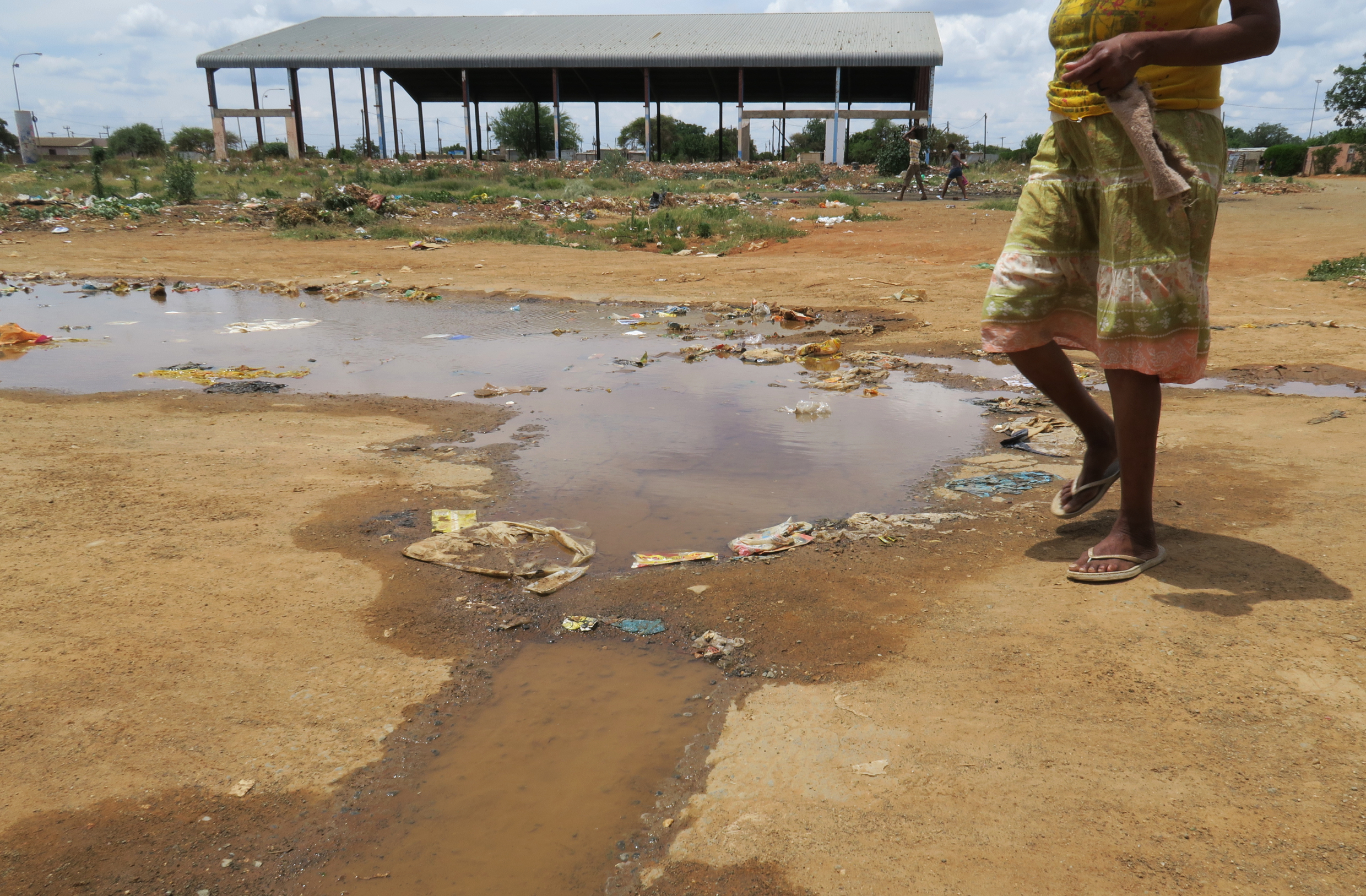
A water leak in Jupiter Street in the suburb of Roodepan, Kimberley. In the background is the remnant of a community hall which was stripped by thieves during the covid lockdowns and never repaired. A resident said the hall once had a kitchen and was a popular centre for weddings, anniversaries and other special occasions. A community hall in neighbouring Galeshewe was also stripped.
Financial woes
At the time of the 2016 local government elections, the AG said the municipality was losing over half of all the water it purified for consumption. It calculated that this cost the municipality R35-million that financial year.
The AG’s latest calculation (2023/24) put water losses at 66%, amounting to a financial loss of R85-million.
In the municipality’s 2024/25 financial statements (for which no AG report is yet available), water losses are listed as having risen to 67%, amounting to about R94-million in lost revenue.
The municipality also lost a quarter (24%) of the electricity it bought from Eskom in 2023/24, according to the AG, amounting to a financial loss of R192-million.
The municipality’s 2024/25 financial statements record an increased loss, now to 26%, amounting to R233-million in lost revenue.
According to the financial statements, 18 of its own councillors were in arrears on their municipal accounts, amounting to R1.25-million. Five of these councillors owed more than R100,000, with the FF+ councillor owing the most, at R198,000. The other top defaulters are ANC councillors, along with one from the Sol Plaatje Service Delivery Forum.
Additionally there was fruitless and wasteful expenditure of R27-million, unauthorised expenditure of R29-million, and irregular expenditure of R117-million.
In theory, if these losses were stemmed and arrears collected, the municipality has the potential to be R475-million the richer. This would bring it within sight of being self sufficient, as it spends R496-million more than it receives.
Perhaps the only reason it is not almost half a billion rand in the red annually is thanks to government grants and subsidies which amounted to R888-million during the 2024/25 financial year, making up 26% of its total income. Yet, R391-million of this grant money remained unspent at the end of its financial year.
How it spent R496-million of the grant money is an open question, which the municipality has not answered.
According to its financial statements, the municipality had a net debt of just more than R1-billion at the end of June.
It appears much of this was to Eskom, which has been instructed to write off R248-million, as part of national Treasury’s Eskom debt relief programme. The Diamond Fields Advertiser reported municipal spokesperson Thabo Mothibi as saying the write-off amounted to a third of the debt owed to Eskom.
The financial statements reflect R2.5-billion owed to the municipality by consumers, with the Department of Public Works being the top single defaulter with a debt of over R630-million.
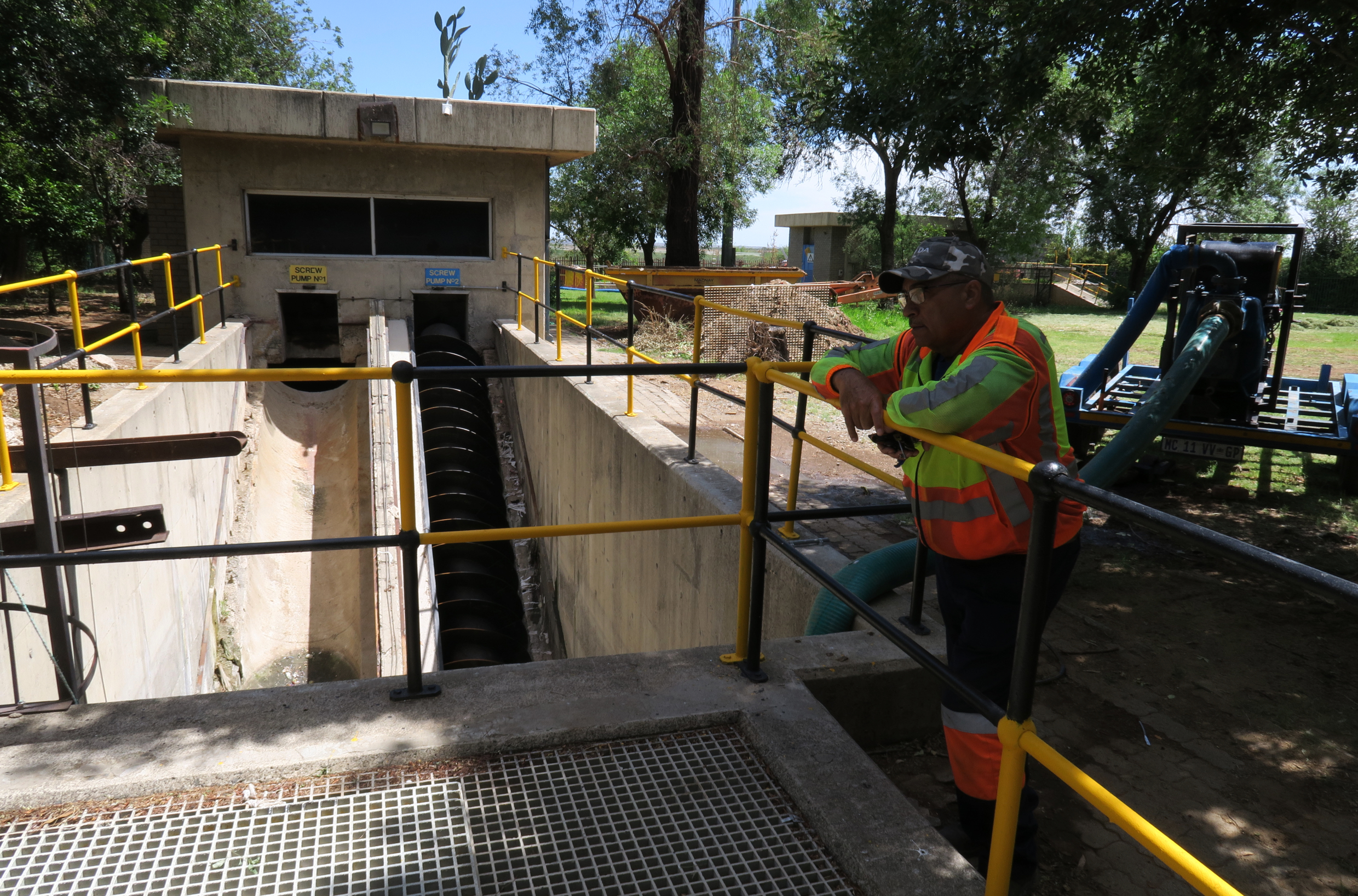
Councillor George Joseph inspects the Gogga sewage pump station.
Water and sewers
High Court Judge Almé Stanton recently ruled against the municipality in a case brought by Northern Cape ranchers seeking to order the municipality to submit a plan and budget to properly treat sewage released into the Kamfersdam from Kimberley’s main Homevale waste water treatment works.
Noting that the municipality said it needed R106-million to repair the facility, Judge Stanton said this was “absolutely astounding” in the light of the municipality receiving more than R1-billion from the Department of Water and Sanitation for water infrastructure refurbishment over the last and current financial years.
GroundUp visited the Homevale works and saw no sign of repair work.
Meanwhile, numerous sewage pump stations around Kimberley are broken, with local newspapers reporting that they have been in this state for years. The only activity we saw from the municipality was the installation of a sliding security gate at the Gogga sewage pump station in the suburb of Galeshewe.
Ward 14 Councillor George Joseph (DA) said “some work was done” on five pump stations in the suburb of Roodepan (where 19 families lost their houses to the 2021 flood of sewage), but it had not been completed “as per plans”.
The non-functioning Gogga station is causing ongoing pollution of vast stretches of veld to the west of Kimberley. The two screw pumps that lift water out of the sewage well to a higher chamber to be pumped to the treatment works are not operational. The municipality had a diesel-driven suction pump, but it ran out of diesel while GroundUp was on site. The well soon filled and overflowed into the surrounding veld.
Ward 24 Councillor Chris Whittaker (DA) said one pump station in his ward was “functional” but insufficient for current demand, and another station relied on an outsourced pump. The owner of that pump had removed it in the past when the municipality failed to pay.
The municipality’s water quality tests, submitted to the national department, show it mostly meets the minimum standards for drinking water, but taps frequently run dry.
Whittaker said councillors do not receive “anything resembling a monthly report on water outages”, but the main reservoir is turned off “almost on a weekly basis” in order to repair burst pipes. This leaves large sections of the town without water. Smaller sections of the town also run dry due to burst pipes.
“If I remember correctly”, the water treatment works was shut down once in the last month, said Whittaker, which led to a total water shutdown.
Answering questions from the Human Rights Commission during its recent inquiry into Northern Cape municipalities, Sol Plaatje executive director for infrastructure Walter Jood said the old asbestos pipes needed replacement. They had not been maintained due to a lack of budget.
However, he said, Treasury had granted a budget facility last year to address water infrastructure, and this was being done within a seven-year programme.
Jood told the commission in October that certain sewage pump stations, such as the one in Roodepan that had failed and led to 26 homes being flooded in 2021, had been fixed.
However, when GroundUp went to the pump station on 3 November, it appeared to be completely stripped and was certainly not operational.
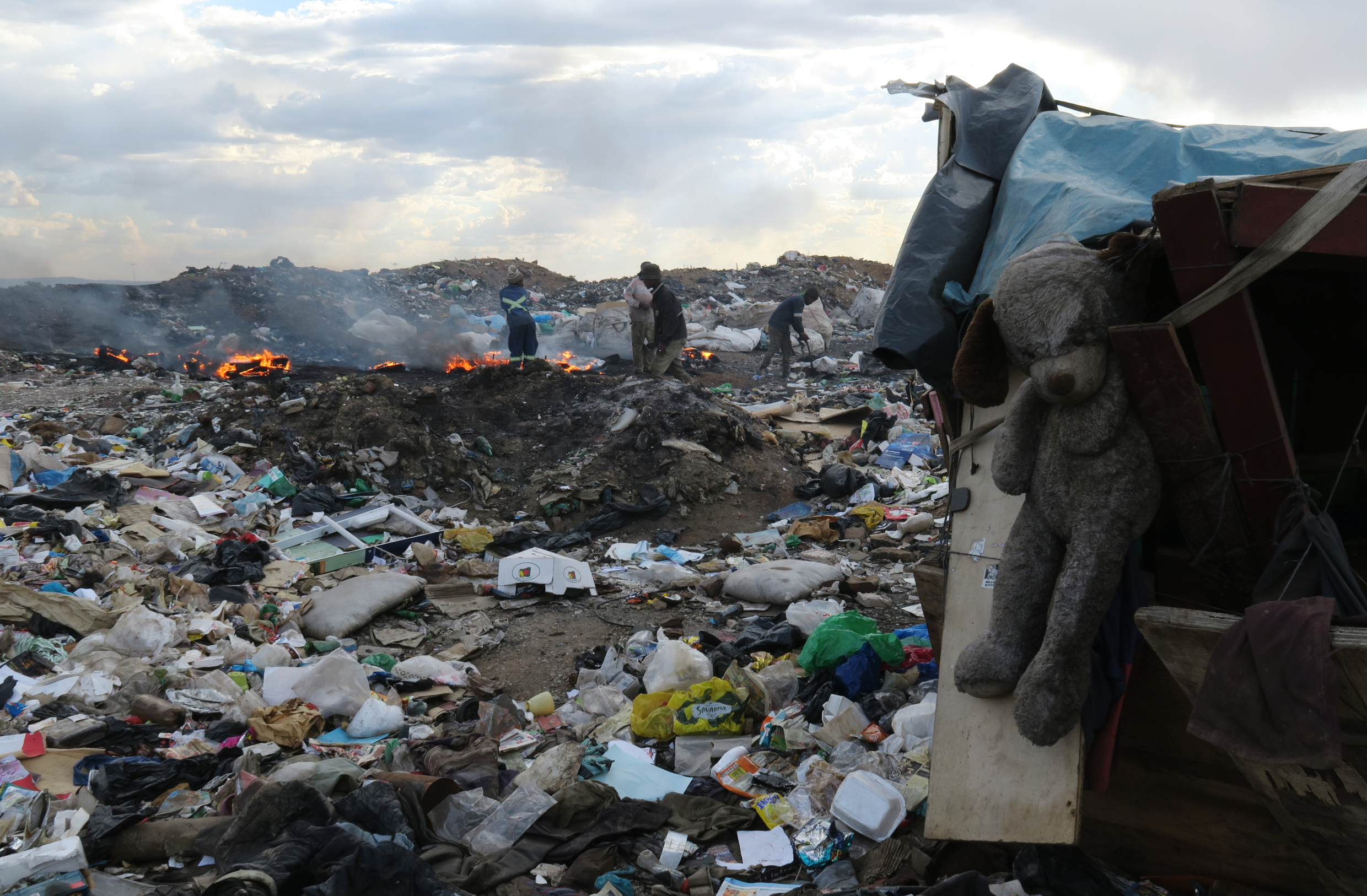
There are numerous makeshift huts used by scores of waste pickers who eke out a living on Kimberley’s landfill.
Landfill and waste management
In October 2017, it was reported that the municipality had spent R28-million to revamp Kimberley’s landfill.
When we visited last month, the weighbridge, listed in the reported upgrade, was unmanned. A security guard seated at an open boom gate did not look up from his phone as we drove over the bridge to the dump site, nor did he take note of any other vehicles entering or exiting. Most other items on the upgrade – toilets and showers, high mast lights, a garden refuse drop off point – were nowhere to be seen.
Scores of waste pickers were on the site in search of recyclable materials. Noxious plumes of thick, black smoke rose from several fires where waste pickers burned off rubber and plastic encasing any metal that can be sold for recycling. This included old tyres. Meanwhile, old fires continue to smoulder within the mountain of waste.
In its national audit of municipal landfills (which is supported by the Department of Forestry, Fisheries and the Environment), AfriForum scored Kimberley’s landfill as 54% compliant with national legislation. On the AfriForum scorecard, 80% is the minimum score necessary for compliance. The landfill last met minimum requirements in 2019, when it scored 82%.
The town and its surrounds are littered with rubbish, with illegal dumping taking place on almost any vacant plot or in the veld on the edges of town.
According to a 2023 review of the Integrated Development Plan for 2022 to 2027 (the 2023 review is the only one we could find on the municipality’s website), one in four households have no weekly refuse collection. This is even worse than it was in 2015, when it was one in five.
The development plan review states some newly developed areas are serviced “through communal waste collections”.
“Key challenges are the filling of vacant posts, shortage and breakdown of vehicles, the ageing of relevant infrastructure as well as littering and illegal dumping.”
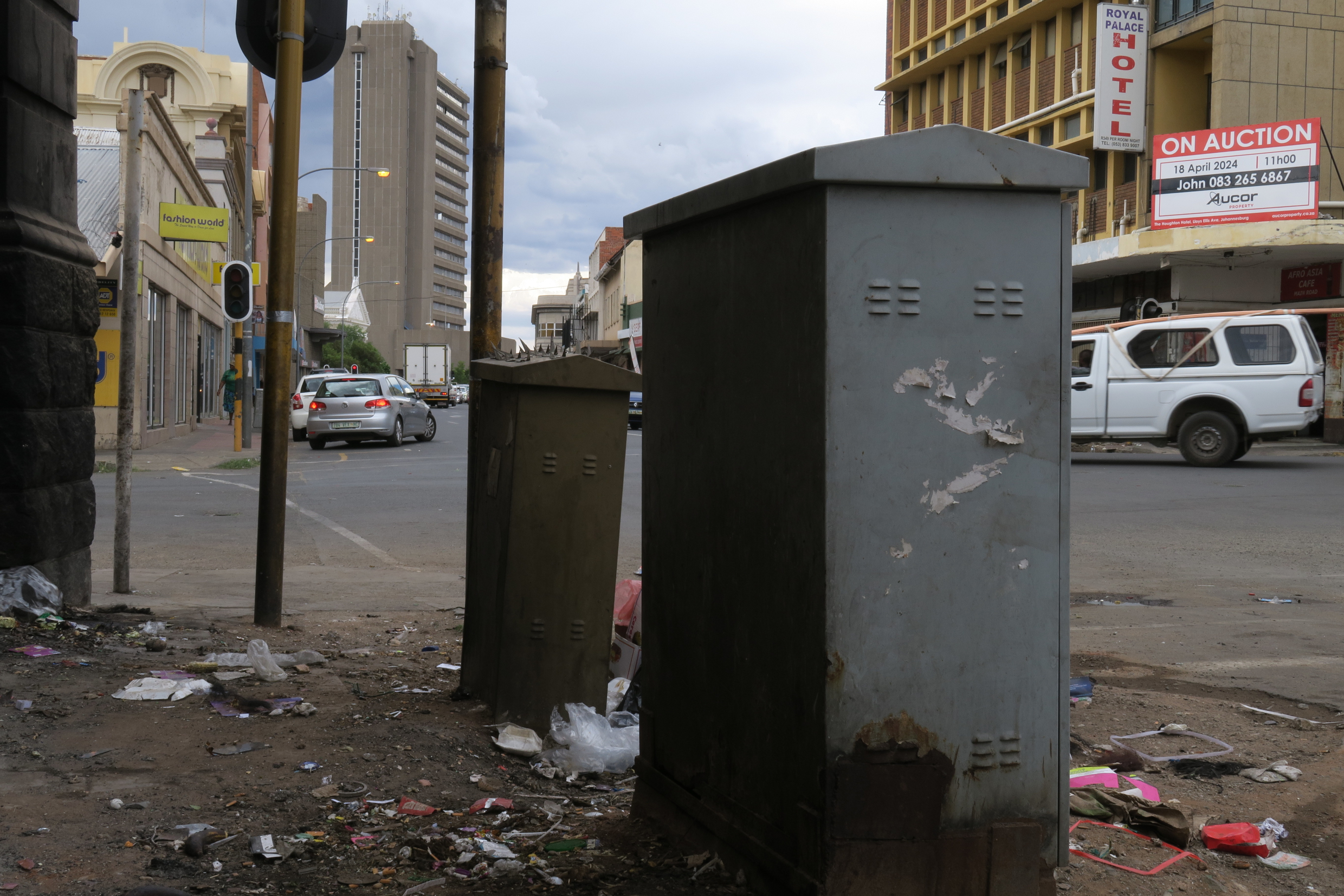
Litter and potholes are characteristic of downtown Kimberley, while vacant plots and the veld around the town is an extended illegal dump.
Tainted officials given the reins
Last year, Mayor Kagisho Sonyoni was reportedly shifted by the regional ANC to the district municipality and replaced by Barbara Bartlett. Speaker Nomazizi Shwababa was relieved of her position and made a mayco member. She was replaced by Dipuo Peters, who earlier that year was suspended as deputy minister of small business development by President Cyril Ramaphosa for unethical conduct during her tenure as transport minister.
Part of Peters’ actions as transport minister between 2013 and 2017 was to dismiss the PRASA board after the board uncovered R14-billion in irregular expenditure, using PRASA buses for ANC events without ensuring payment, and failing to appoint a CEO when required.
In September this year, municipal manager Thapelo Matlala was suspended amidst allegations of misconduct, maladministration and possible corruption, following an urgent motion submitted by the FF+.
Busisiwe Mgaguli became acting municipal manager, seconded from the provincial Department of Co-operative Governance, Human Settlements and Traditional Affairs. In 2013, Mgaguli was convicted of fraud for submitting false travel and subsistence allowance claims while she was employed by the Mpumalanga Department of Finance between 2011 and 2012. In March this year, the high court ordered her to pay back more than R780,000 to her former employer, after an application was successfully brought by the Asset Forfeiture Unit.
Given its bleak record governing Sol Plaatje, it is likely the ANC will lose its slim majority in the upcoming local government elections. A hung council is expected in 2027.
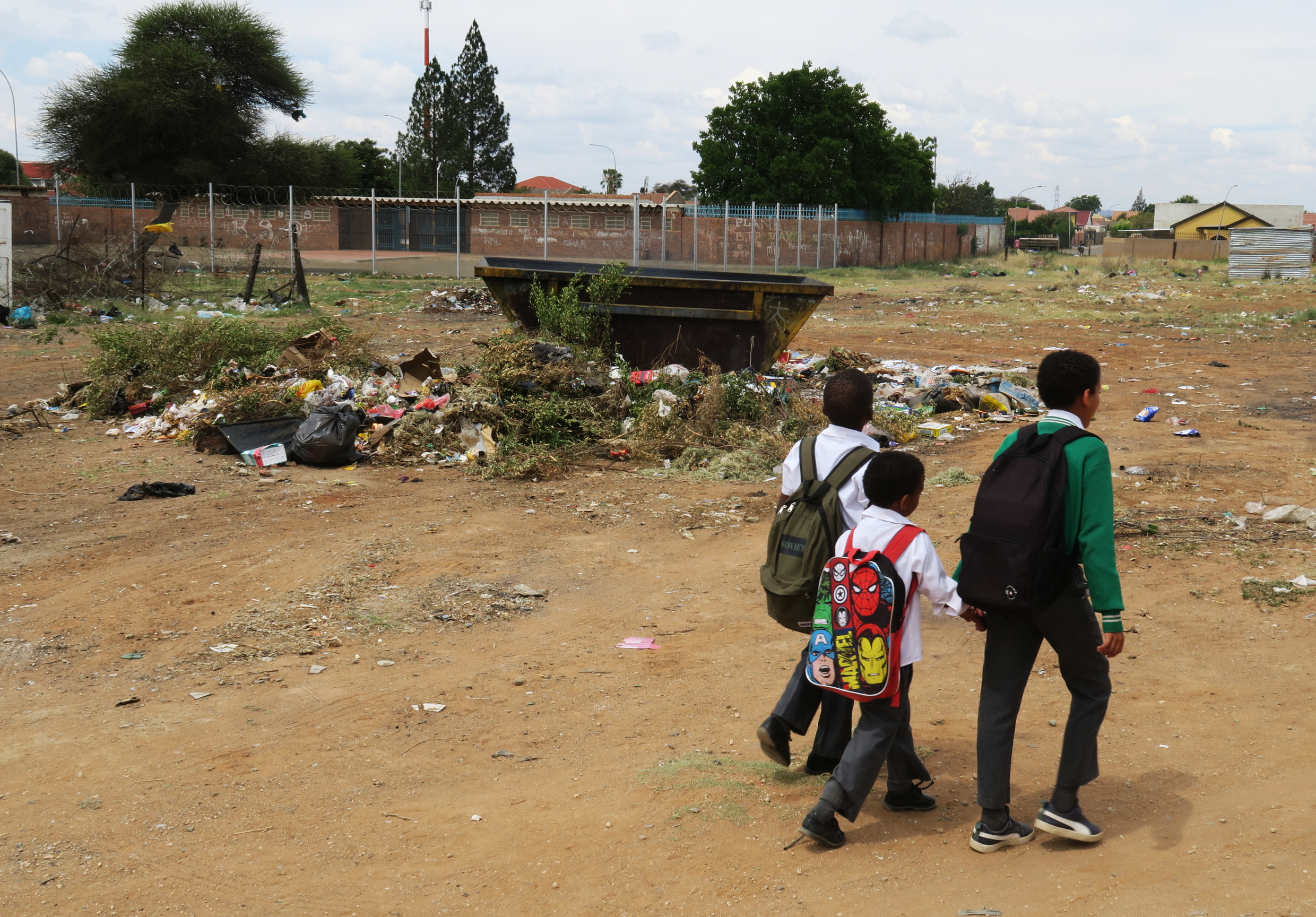
Children walk home from school past trash and a municipal swimming pool that has been closed for at least a year.
Support independent journalism
Donate using Payfast

Don't miss out on the latest news
We respect your privacy, and promise we won't spam you.
Next: Clinic staff are extorting immigrants to access life-saving medicines
Previous: After the shelter: Cape Town’s urgent need to house homeless people
© 2025 GroundUp. This article is licensed under a Creative Commons Attribution-NoDerivatives 4.0 International License.
You may republish this article, so long as you credit the authors and GroundUp, and do not change the text. Please include a link back to the original article.
We put an invisible pixel in the article so that we can count traffic to republishers. All analytics tools are solely on our servers. We do not give our logs to any third party. Logs are deleted after two weeks. We do not use any IP address identifying information except to count regional traffic. We are solely interested in counting hits, not tracking users. If you republish, please do not delete the invisible pixel.