
Municipality silent on why it can’t provide electricity
“We no longer care about bricks because we know they will take forever,” says Komani woman who has lived in shacks for 24 years
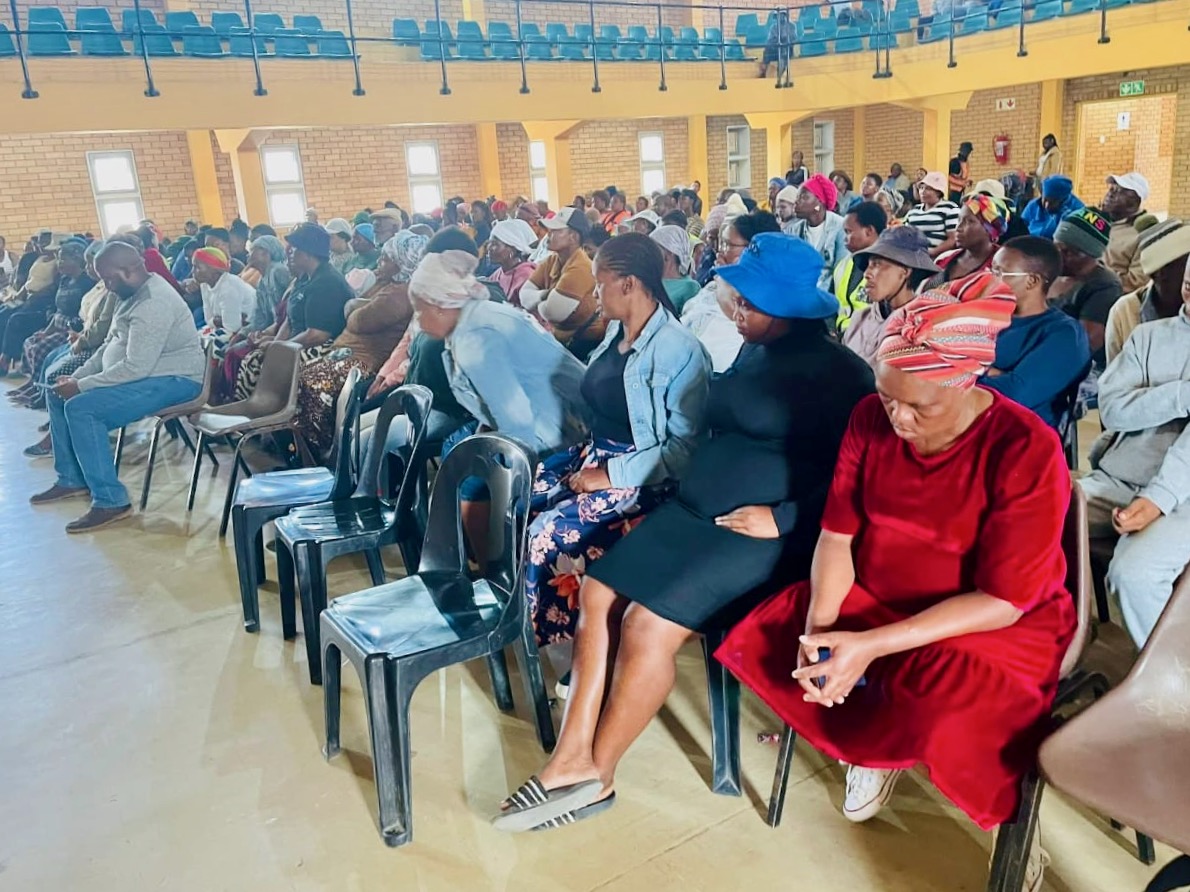
Residents of 11 informal settlements held a public meeting in Sikhweyiya community hall, Komani, last week. Photo: Nombulelo Damba-Hendrik
There are 11 informal settlements in Mlungisi township in Komani, Eastern Cape. None have electricity. The oldest, Kwanca, was formed in the 1990s. The newest, eMabhangalweni, has about 500 households, while Marikana informal settlement has about 1,000 shacks, only three taps, and no toilets.
After protests last month, about 200 residents from all 11 settlements held a public meeting at the Sikhweyiya community hall last week. They expected a written response from the municipality to their memorandum of demands, which included a clear plan and timeline for electrification. They also want serviced stands with water and toilets while they wait for RDP houses.
But officials from the Enoch Mgijima Local Municipality did not arrive. Residents sang and waited. Around 11:30am, they went to look for municipal human settlements head Ongama Adonisi.
Community leader Baxolele Bango said it was disappointing that the officials residents most wanted to see had not come. He said Mayor Madoda Papiyana should apologise for the municipality’s failure to provide basic services.
Lelethu Faku lost her home in the 2023 floods. She said that after the municipality placed flood victims in emergency accommodation, no officials had came to check on them. “Houses are leaking, walls are broken, including the floors,” she said.
Monica Fula, now in her 50s, said she had been living without services for 24 years. “I left Joe Slovo due to a lack of services, but in Marikana things are worse. There’s nothing. What we want now is serviced sites. We no longer care about bricks because we know they will take forever.”
Ward committee member Silvia Mabhuvu, from Cemetery informal settlement, said: “At home we are ten people sharing a three-room shack. Old people are dying while they wait for houses.”
She said that when she takes the ward committee’s list of people awaiting houses to the municipality for verification, “we are always told there are network issues”.
“We don’t even know if we appear on a database or not,” she said.
Adonisi said the New Rathwick housing project, which will build 3,000 houses, will start in March. Priority would be given to “child-headed households, military veterans and backyard dwellers”.
He advised residents to work with their ward councillors, but he was shouted down by people saying their councillors had failed them.
Municipal spokesperson Lonwabo Kowa has not yet responded to our questions.
Support independent journalism
Donate using Payfast

Don't miss out on the latest news
We respect your privacy, and promise we won't spam you.
Next: Thousands of families live on railway reserves without water, electricity or rubbish collection
Previous: After years of sewage flooding their land, Joburg residents start rates revolt
© 2025 GroundUp. This article is licensed under a Creative Commons Attribution-NoDerivatives 4.0 International License.
You may republish this article, so long as you credit the authors and GroundUp, and do not change the text. Please include a link back to the original article.
We put an invisible pixel in the article so that we can count traffic to republishers. All analytics tools are solely on our servers. We do not give our logs to any third party. Logs are deleted after two weeks. We do not use any IP address identifying information except to count regional traffic. We are solely interested in counting hits, not tracking users. If you republish, please do not delete the invisible pixel.