
Limpopo village without water after heavy floods wash away pipes
Residents have struggled to access water for almost two months
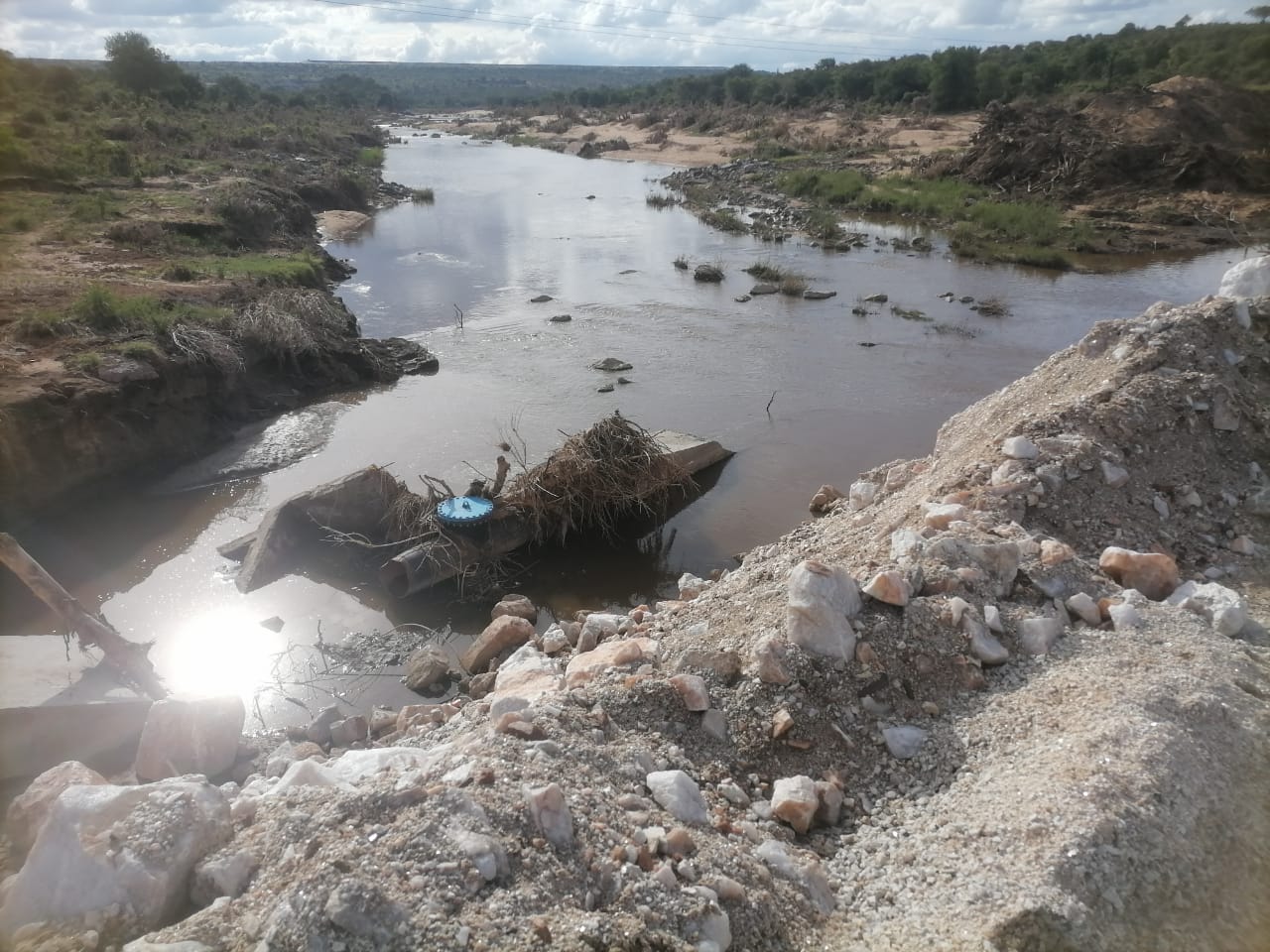
This pipe, which crosses the Selati River, supplies water to Ba-Phalaborwa town, but it was severely damaged by heavy floods in January. Photo: Bernard Chiguvare
Heavy flooding in January has left hundreds of people in Boelang village, about 15km southwest of Ba-Phalaborwa in Limpopo, without municipal water for almost two months. Ba-Phalaborwa itself is on a “water-shedding” schedule, receiving water every two days.
The floods damaged the two main pipelines supplying the area, according to Mopani District Municipality spokesperson Odas Ngobeni. A pump station has also failed.
A service provider has been appointed to repair the pipelines and pump, Ngobeni said in a statement. He did not say when the repairs would be completed.
Boelang resident Cath Abrams said she has arranged with her employer in Ba-Phalaborwa to fill containers with between 70 and 80 litres of water to take home.
She said the community has a borehole where residents queue to collect untreated water. She uses it for washing clothes and flushing the toilet.

Water tankers provided by the Ba-Phalaborwa Local Municipality are unreliable, she said.
“It is very frustrating. Some residents wait for the tanker to come to their road, but it never arrives because of the state of the roads,” she said.
Municipality spokesperson Jonas Mahesu did not respond to calls or messages.
A 53-year-old woman, who asked not to be named, said she is worried about whether her cats, chickens and dogs will have enough water. She has also been unable to water the vegetables in her garden.
She brings drinking water from the house in Ba-Phalaborwa where she works as a domestic worker.
A 66-year-old man, who also asked not to be named, said he delivers containers of water for free twice a week to vulnerable residents who cannot wait by the roadside for water trucks. He collects the water from residents who have boreholes.
“I realised that some families have no transport to fetch water from far places, and some elderly people can no longer carry buckets of water,” he said.
Support independent journalism
Donate using Payfast

Don't miss out on the latest news
We respect your privacy, and promise we won't spam you.
Next: Volunteers turn derelict historic building into a thriving community centre
Previous: Work on Eastern Cape clinic stalled because health department didn’t pay the builder
© 2026 GroundUp. This article is licensed under a Creative Commons Attribution-NoDerivatives 4.0 International License.
You may republish this article, so long as you credit the authors and GroundUp, and do not change the text. Please include a link back to the original article.
We put an invisible pixel in the article so that we can count traffic to republishers. All analytics tools are solely on our servers. We do not give our logs to any third party. Logs are deleted after two weeks. We do not use any IP address identifying information except to count regional traffic. We are solely interested in counting hits, not tracking users. If you republish, please do not delete the invisible pixel.