
Fire victims stuck as housing plans fall through
Families in Doornbach settlement in Cape Town are still waiting for emergency housing, six weeks after the fire
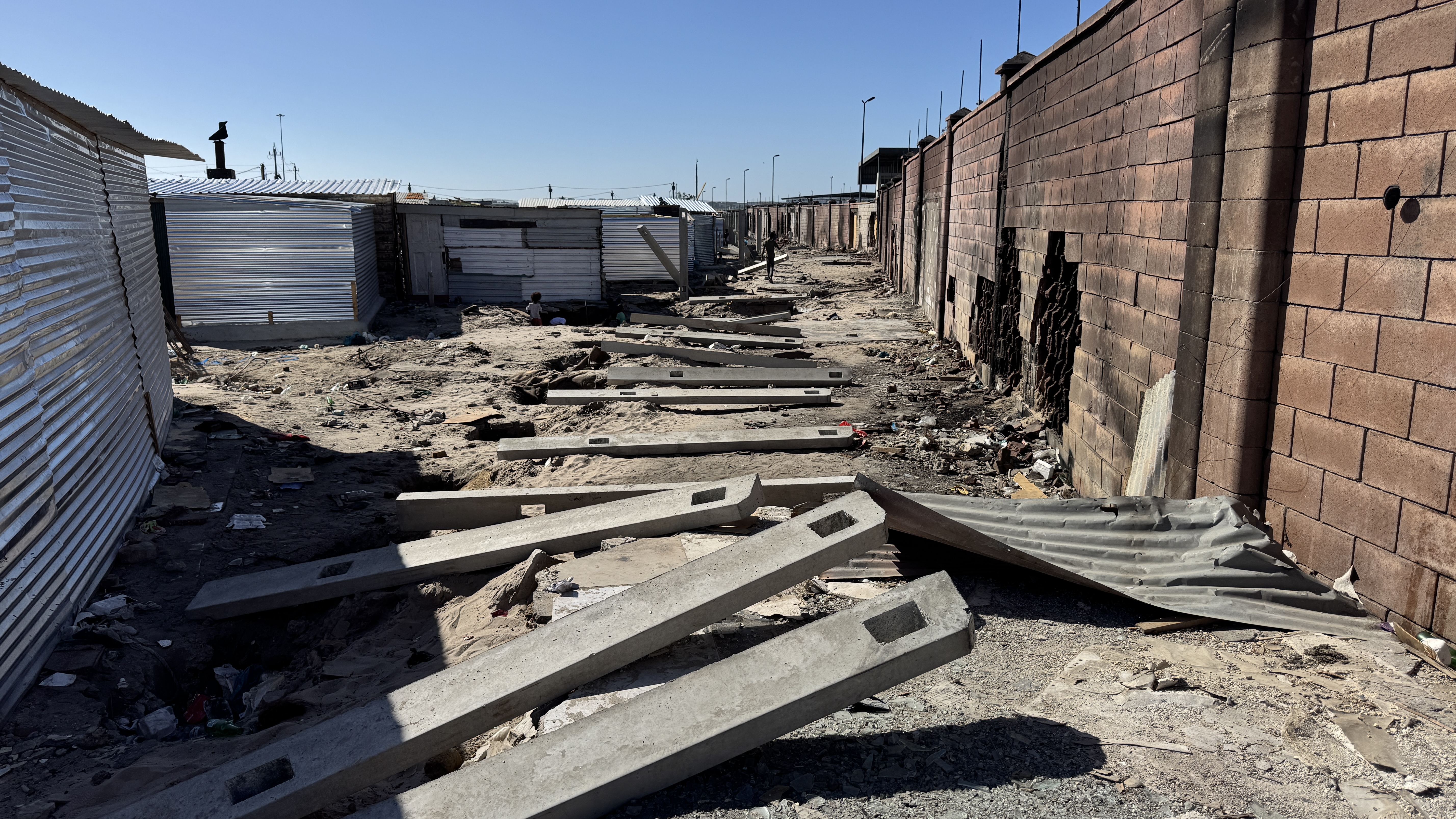
Families whose homes had been built against the MyCiTi bus depot boundary wall have not been allowed to rebuild after the fire at Doornbach informal settlement over six weeks ago. Photo: Peter Luhanga
- Victims of the massive fire in Doornbach informal settlement in Cape Town are still waiting to hear if they will be rehoused.
- About 28 families have been prevented from rebuilding their homes against a MyCiTi bus depot boundary wall because it is unsafe.
- A plan to house them temporarily in hotels fell through.
- The City of Cape Town has identified vacant land in Dunoon, but residents say it is not suitable.
Families whose homes were gutted in a fire at Doornbach informal settlement over six weeks ago say they have been living in limbo while waiting for emergency housing.
About 2,600 people lost all their belongings in the fire, on 9 January.
Many have since rebuilt their homes but about 28 families have been prevented from rebuilding on land next to the MyCiTi depot because the boundary wall has been declared structurally unsafe.
In January, Tsekiso Machike, spokesperson for the Human Settlements minister, said the families would be relocated. He said the department would fund emergency accommodation at R450 per person per night for 30 days.
Machike said two hotels had been secured, and the City of Cape Town had been asked to arrange transport. But no transport was arranged and the booking was eventually cancelled on 11 February, he said.
Machike said the emergency housing plan had been “reactivated” on 15 February, with another request for the City to help with transport and meals for the group. But residents had refused to go.
Machike said responsibility would now be passed to the City to provide accommodation for the affected households.
Asked why the department had chosen hotel accommodation instead of securing land for permanent resettlement, Machike said providing Temporary Emergency Accommodation for disaster victims was within the department’s mandate. But long-term resettlement and land acquisition, he said, was the responsibility of the province and the municipality through the Informal Settlements Upgrading Partnership Grant.
In response, mayoral committee member for human settlements Carl Pophaim said the Temporary Emergency Accommodation policy did not assign transport responsibilities to the municipality.
Pophaim said a six-metre buffer was needed between the bus depot wall and any housing.
He said vacant land had been identified in Dunoon and the affected Doornbach families would be prioritised for relocation.
On Monday, subcouncil 1 manager Roxanne Moses visited the proposed housing site with the families. Simon Hili, who had been living in Doornbach for 26 years, was among those who visited the site. He said residents had rejected the site, though the City stated it would provide water, toilets and electricity.
Hili said if the Doornbach residents moved in there would be tension with residents of the neighbouring Zwezwe settlement who lack municipal services. “They [the City] will leave us there to fight,” said Hili.
Meanwhile families say they have had to find alternative housing.
Nolubabalo Mgwedlanyana, a mother of four, said her family was forced to split up after the fire. She now rents a single-room shack in Thembeni informal settlement with her husband and their four-month-old, while her older children have been sent to live with relatives. The family survives on two child support grants, using the money to cover the R800 monthly rent.
Support independent journalism
Donate using Payfast

Don't miss out on the latest news
We respect your privacy, and promise we won't spam you.
© 2026 GroundUp. This article is licensed under a Creative Commons Attribution-NoDerivatives 4.0 International License.
You may republish this article, so long as you credit the authors and GroundUp, and do not change the text. Please include a link back to the original article.
We put an invisible pixel in the article so that we can count traffic to republishers. All analytics tools are solely on our servers. We do not give our logs to any third party. Logs are deleted after two weeks. We do not use any IP address identifying information except to count regional traffic. We are solely interested in counting hits, not tracking users. If you republish, please do not delete the invisible pixel.