
Oil search won’t harm fishing, court told
Fishers and environmental groups are challenging permission to do seismic surveys off the West Coast
 Add GroundUp on Google
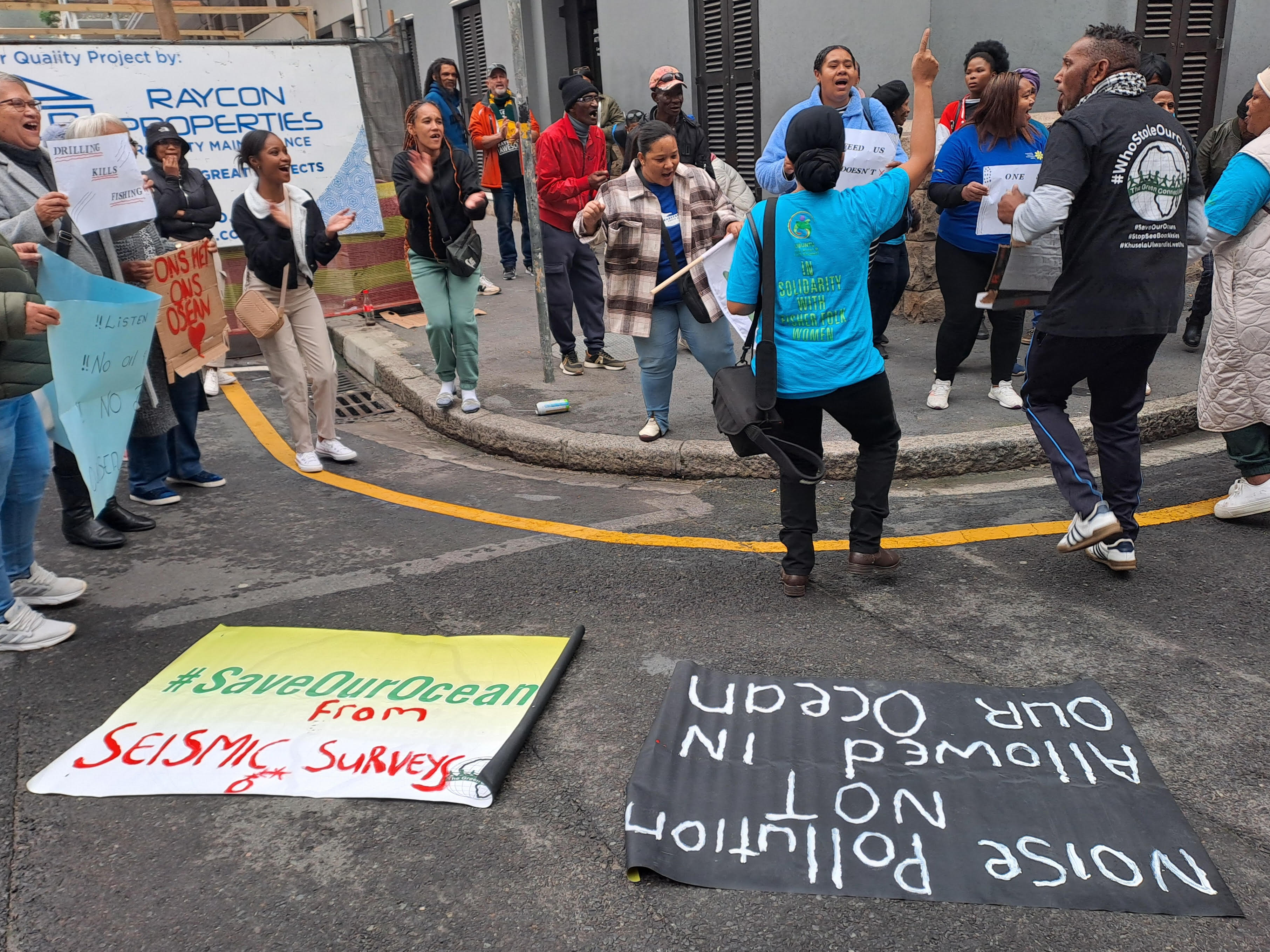
Fishers picketed on Monday outside the court where the case on seismic surveys off the West Coast is being heard. Photo: Liezl Human
- The planned seismic surveys off the West Coast are too far offshore to affect fishing, the company authorised to conduct the surveys told the Western Cape High Court on Tuesday.
- The company, TGS Geophysical Company, says any harm to marine life will be minimised.
- The government has authorised the surveys, but this is being challenged in court by the Aukotowa small-scale fishing cooperative, the Green Connection, and Natural Justice.
Seismic surveys off the West Coast will not affect fishing, and harm to marine life will be minimised, the company authorised to conduct the survey in the Orange Basin told the Western High Court on Tuesday.
The Aukotowa small-scale fishing cooperative based in Port Nolloth, the Green Connection, and Natural Justice went to court to set aside the authorisation granted by the Minister of Forestry, Fisheries, and the Environment (DFFE), the director-general of the Department of Mineral and Petroleum Resources (DMPR) and the Minister of Mineral and Petroleum Resources to TGS Geophysical Company to do seismic surveys.
The applicants argued on Monday that the DMPR and DFFE had not properly considered the marine impact of seismic surveys.

In their court papers, they said that a “cautious approach” had to be taken because of “significant gaps in knowledge relating to the impacts and risks of seismic blasting on marine life”.
“Part of the uncertainty is that we don’t know what the long-term impacts are,” said Liz McDaid, strategic lead at The Green Connection. She said the seismic surveys could potentially affect “future generations of fish and therefore the livelihoods of fishers”.
On Tuesday, advocate Andrew Breitenbach, representing TGS, argued that the company’s Basic Assessment Report acknowledged “various information gaps” on the impacts on marine life, and would assume the “worst-case scenario” where there is “lack of full scientific certainty” and adopt “mitigating measures” where necessary. Mitigating measures include stopping seismic activity when detecting marine animals like penguins or avoiding sensitive areas such as feeding areas.
Breitenbach said the “impacts of the survey will be very limited and localised”. He said the survey would be so far offshore (about 120km offshore of St Helena Bay and 230km offshore of Hondeklip Bay) that it would have no impact on fishers.
He said TGS’s environmental assessments had been compiled by scientists with “comprehensive” scientific knowledge. In their court papers TGS said the reports demonstrated that “while survey activities will result in some impacts that could be categorised from low to medium, the adverse impacts can be mitigated to reasonable and appropriate levels”.
The science on the impacts of seismic surveys on marine life is inconclusive.
In a statement released in 2022, in a court case challenging seismic surveys by Shell off the Wild Coast, the South African Scientific Advisory Group on Emergencies acknowledged the “lack of full scientific certainty” on the impact of seismic activity. “Given a relative dearth of evidence on the impact of seismic surveys on marine life in South African waters, coupled with the uncertainties about the harm that may be suffered if Shell’s survey is permitted to resume…a precautionary approach is warranted.”
Similarly, a 2023 review in Frontiers in Marine Science of 31 studies found “extensive variability” in the effects of seismic activity. “Knowledge gaps still exist due to scarce information available on species distribution, the use of habitats, and the lack of standardized measurements,” the authors said.
Judgment in the case was reserved by Judge Judith Cloete.
Support independent journalism
Donate using Payfast

Don't miss out on the latest news
We respect your privacy, and promise we won't spam you.
Next: Lottery Olympics scammers must pay back the money
Previous: Khayelitsha clinic struggles to meet the needs of growing population
Letters
Dear Editor
It is unfortunate that in South Africa oil and gas exploration initiatives are taken to court on a continuous basis, often without reasonable justification.
Importing oil and gas at billions of rands per year is hardly less damaging to the environment, while the cost in terms of lost employment opportunities, economic growth and industrialisation that will result from growth in the local oil and gas industry are huge. It simply does not make sense not to speed up local exploration and production.
Offshore drilling was allowed in Mozambique, Namibia, Norway, the UK, the Gulf of Mexico and SAUDI Arabia, to name a few countries, with huge economic benefit. Why should it be different for South Africa?
South Africa needs increased energy security. This is particularly true against the background of current geopolitical uncertainties and their effect on oil prices. Energy poverty is a reality in Africa, where an estimated 600 million people are without electricity. Scientists tell us that Africa, unlike most other countries, will be experiencing significant population growth into the future. This no doubt will create an increasing demand for energy.
The European Union has declared gas a transition fuel for the energy transition. In Africa, gas is and will be a much-needed enabling fuel well into the future.
We need jobs and industrialisation opportunities. The South African Oil and Gas Alliance (SAOGA) has been instrumental in partnering with the training institutions and industry to develop thousands of youths in anticipation of a growing oil and gas industry. We found that 96% of the youth developed were employed in a pre-COVID survey conducted. A sustained oil and gas industry is a game changer for unemployment.
© 2026 GroundUp. This article is published under the GroundUp Republication Licence Version 1.0. Email [email protected] to request permission to republish.