
Parliament to consider impeaching Judge Nana Makhubele
Makhubele was found guilty of gross misconduct by the Judicial Service Commission
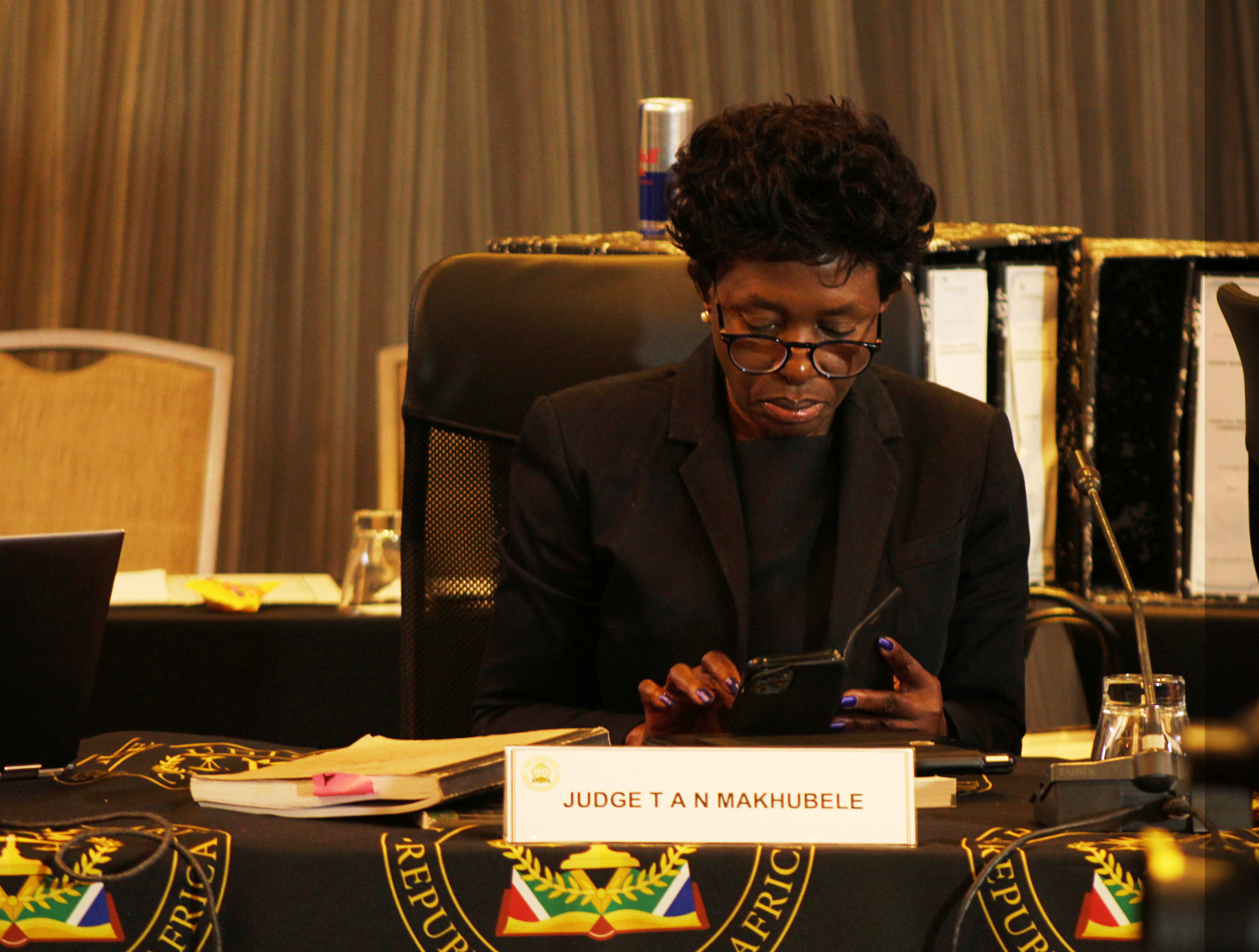
Judge Nana Makhubele during a hearing of the Judicial Conduct Committee tribunal in May 2023. Archive photo: Masego Mafata
Parliament has taken the first step to impeach Judge Nana Makhubele, who was found guilty on two charges of gross misconduct by the Judicial Service Commission (JSC) earlier this year.
The Speaker of the National Assembly, Thoko Didiza, has referred the gross misconduct findings to the Portfolio Committee on Justice and Constitutional Development. If the committee agrees with the findings, the matter will be referred to the National Assembly to vote on whether to impeach Makhubele.
The JSC’s investigation stemmed from a complaint by civil society organisation #UniteBehind in 2019. That complaint had two parts. First, it said Makhubele “undermined the independence of the judiciary” by sitting as a judge while also serving and receiving remuneration as chair of the Passenger Rail Agency of South Africa (PRASA) interim board. The second complaint related to Makhubele’s conduct and involvement in corruption while she was chair of the PRASA board.
The JSC found that “the evidence on which Judge Makhubele was found guilty clearly establishes gross misconduct in the form of dishonesty”.
Chief Justice Mandisa Maya recommended to Didiza that Makhubele be referred to the National Assembly for impeachment. According to parliamentary spokesperson Moloto Mothapo, “the Speaker tabled the Chief Justice’s letter on 26 August 2025 and referred the JSC’s finding to the Portfolio Committee on Justice and Constitutional Development for consideration and report”.
The portfolio committee is now considering the JSC’s findings in line with section 177 of the Constitution. “Should the Committee find that Judge Makhubele is indeed guilty of gross misconduct, the matter will be submitted to the National Assembly for a vote,” said Mothapo.
According to Section 177 of the Constitution, “the National Assembly calls for that judge to be removed, by a resolution adopted with a supporting vote of at least two thirds of its members” (267 votes in this case). If the resolution is adopted, the President will act to remove the judge from office.
“Given the constitutional and procedural requirements, no specific timeframe can be confirmed at this stage. However, Parliament remains committed to ensuring the process is conducted diligently, fairly and within the parameters of the Constitution and the rules of Parliament,” said Mothapo.
Support independent journalism
Donate using Payfast

Don't miss out on the latest news
We respect your privacy, and promise we won't spam you.
Next: Transgender prisoner wins right to hormone therapy
Previous: Open air cinema brings joy to Manenberg’s children
Letters
Dear Editor
The recent outcome in the case of Judge Nana Makhubele marks a defining moment for constitutional accountability and the restoration of public confidence in the South African judiciary. It affirms that no individual, regardless of rank or robe, stands above the ethical and constitutional standards that underpin judicial office. This decision arrives at a time when the nation watches closely the ongoing investigations by the Madlanga Commission of Inquiry into allegations of corruption within the judiciary, and it signals that integrity, transparency, and ethical conduct remain non-negotiable pillars of judicial service.
The success of this accountability process underscores the indispensable role of civil society organisations such as #UniteBehind. Through unwavering commitment to constitutional principles, you have demonstrated how citizen vigilance reinforces judicial integrity and strengthens democracy. Your pursuit of justice against formidable odds has illuminated the path toward rebuilding trust in an institution that is the ultimate guardian of our rights and freedoms.
Equally, this outcome offers vital lessons – not only for the judge concerned, but for all current and aspiring members of the judiciary. It reminds every judicial officer that public confidence is earned daily through adherence to ethical standards, impartiality, and service beyond personal interest. It teaches that accountability is not a punishment but an affirmation of the judiciary’s moral authority.
I therefore call upon all relevant stakeholders – the Judicial Service Commission, Parliament, the Office of the Chief Justice, the South African Judicial Education Institute, and the legal profession at large – to take this moment as a catalyst for deeper reflection and reform. Collective commitment to transparency, ethical mentorship, and consistent enforcement of standards will ensure that the judiciary remains a bastion of integrity and independence.
#UniteBehind’s courageous example reminds us that an active, principled civil society is the lifeblood of a constitutional democracy.
© 2025 GroundUp. This article is licensed under a Creative Commons Attribution-NoDerivatives 4.0 International License.
You may republish this article, so long as you credit the authors and GroundUp, and do not change the text. Please include a link back to the original article.
We put an invisible pixel in the article so that we can count traffic to republishers. All analytics tools are solely on our servers. We do not give our logs to any third party. Logs are deleted after two weeks. We do not use any IP address identifying information except to count regional traffic. We are solely interested in counting hits, not tracking users. If you republish, please do not delete the invisible pixel.