
Payments to sick miners in Lesotho resume after fraud scare
Medical Bureau for Occupational Diseases reports fraud of R1.4-million
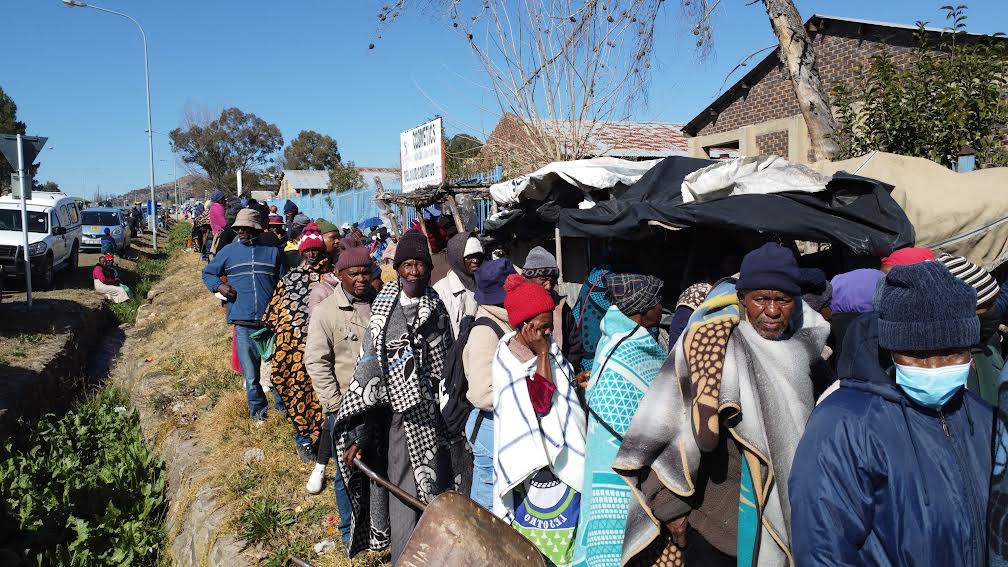
Former miners with permanent lung disease and the dependents of deceased miners queue in Maseru during a Tshiamiso Trust outreach visit in July. Photo: Sechaba Mokhethi
- South Africa’s Medical Bureau for Occupational Diseases (MBOD) has resumed payments of compensation to former miners in Lesotho.
- Payments were suspended in 2024 after the MBOD lost R1.4-million to fraudulent death claims in Lesotho.
- MBOD compensates former miners who contracted disease in South African mines.
- Meanwhile, the Tshiamiso Trust has detected a different pattern of fraud, involving a small number of death-notification claims in Lesotho.
The Medical Bureau for Occupational Diseases (MBOD) in South Africa has resumed payments of compensation to former miners and their dependents in Lesotho, after a suspension triggered by fraud.
Meanwhile the Tshiamiso Trust, which also compensates miners who developed lung disease in South Africa’s mines, has also noted a small number of fraudulent claims.
MBOD has paid R800-million to Basotho claimants so far. But in 2024, 14 fraudulent death claims were filed, supported by forged letters of authority claiming to be from the Master of the High Court in Lesotho. The scam led to R1.4-million being stolen and caused over a year’s suspension of all payments to Lesotho claimants.
A different fraud pattern hit the Tshiamiso Trust, which was formed to implement a settlement between mines and former miners suffering from silicosis and TB. Death notification forms, many from Mafeteng, recorded causes of death inconsistent with medical records. These claims have been flagged and paused pending further investigation, although the trust emphasises that most payments remain unaffected. Tshiamiso says it has paid 10,000 Basotho claimants a total of R935-million so far.
South Africa’s Compensation Commissioner, Dr Barry Kistnasamy, confirmed to GroundUp that the 14 fraudulent deceased-claim files “were based on fraudulent letters of authority from the Master of the High Court in Lesotho”.
MBOD is a South African statutory body under the 1973 Occupational Diseases in Mines and Works Act set up to compensate current and former miners for occupational lung diseases, including asbestosis, coal workers’ pneumoconiosis, silicosis and TB.
Because the matter is under police investigation, Kistnasamy could not provide the names of the individuals involved, copies of the forged letters, or the name of the official whose signature was falsified.
The fraud was first revealed during Lesotho’s Parliamentary Social Cluster Portfolio Committee proceedings last month, when a representative from the Master of the High Court, only identified as Pontšo, admitted that fraudulent claims had been submitted using her office’s letterhead. “Unfortunately, my name was used, but with different signatures,” she said. A case has been opened at Hlotse Police Station, and the office has since ceased using photocopied letterheads.
Kistnasamy said MBOD was alerted to the fraud in October 2024, leading to an immediate suspension of all payments to Lesotho claimants.
He said MBOD has since lifted the suspension and resumed payments. A stronger verification process is now in place. “Confirmation of claims from Lesotho are verified with the Master of the High Court as well as selected banks in Lesotho who have agreed to be part of the verification process.”
Kistnasamy said if police identified the culprits, MBOD would pursue the recovery of stolen funds. “No implications are expected for genuine claimants, as there are funds to pay their claims.”
Currently, MBOD has 5,000 unpaid claims worth R127-million in Lesotho, he said.
More fraud detections
Tshiamiso Trust CEO Munyadziwa Kwinda informed Lesotho’s Parliament that the trust had identified concerning patterns in death notification forms supporting claims.
“We noted a trend of death notification forms issued from Mafeteng Hospital by one doctor,” he said. He said similar questionable documents had been received from other districts, with causes of death inconsistent with available medical records. “All of them were red-flagged because they are suspicious,” he said.
When GroundUp approached Tshiamiso for comment, Kwinda provided a statement dated 26 November 2025, addressing the fraud issues. He said the irregularities involved only a small number of cases. “The processing of these impacted claims has been paused, pending investigation by the relevant parties. Payment continues to eligible Basotho claimants not impacted by the documents in question.”
He said the trust was committed to enabling all eligible Basotho ex-mineworkers and dependents to lodge and finalise their claims. According to him, outreach efforts have already assisted 1,048 people in Qacha’s Nek and Thaba-Tseka “last week”, with more districts to follow.
Support independent journalism
Donate using Payfast

Don't miss out on the latest news
We respect your privacy, and promise we won't spam you.
Next: “Wrest control of the clinics from the hands of the vigilantes” judge tells state
Previous: Facebook promotes rubbish because it doesn’t understand indigenous languages
© 2025 GroundUp. This article is licensed under a Creative Commons Attribution-NoDerivatives 4.0 International License.
You may republish this article, so long as you credit the authors and GroundUp, and do not change the text. Please include a link back to the original article.
We put an invisible pixel in the article so that we can count traffic to republishers. All analytics tools are solely on our servers. We do not give our logs to any third party. Logs are deleted after two weeks. We do not use any IP address identifying information except to count regional traffic. We are solely interested in counting hits, not tracking users. If you republish, please do not delete the invisible pixel.