
Rape cover-up trial: Police officers describe the day victim was arrested
Two witnesses took the stand on Thursday
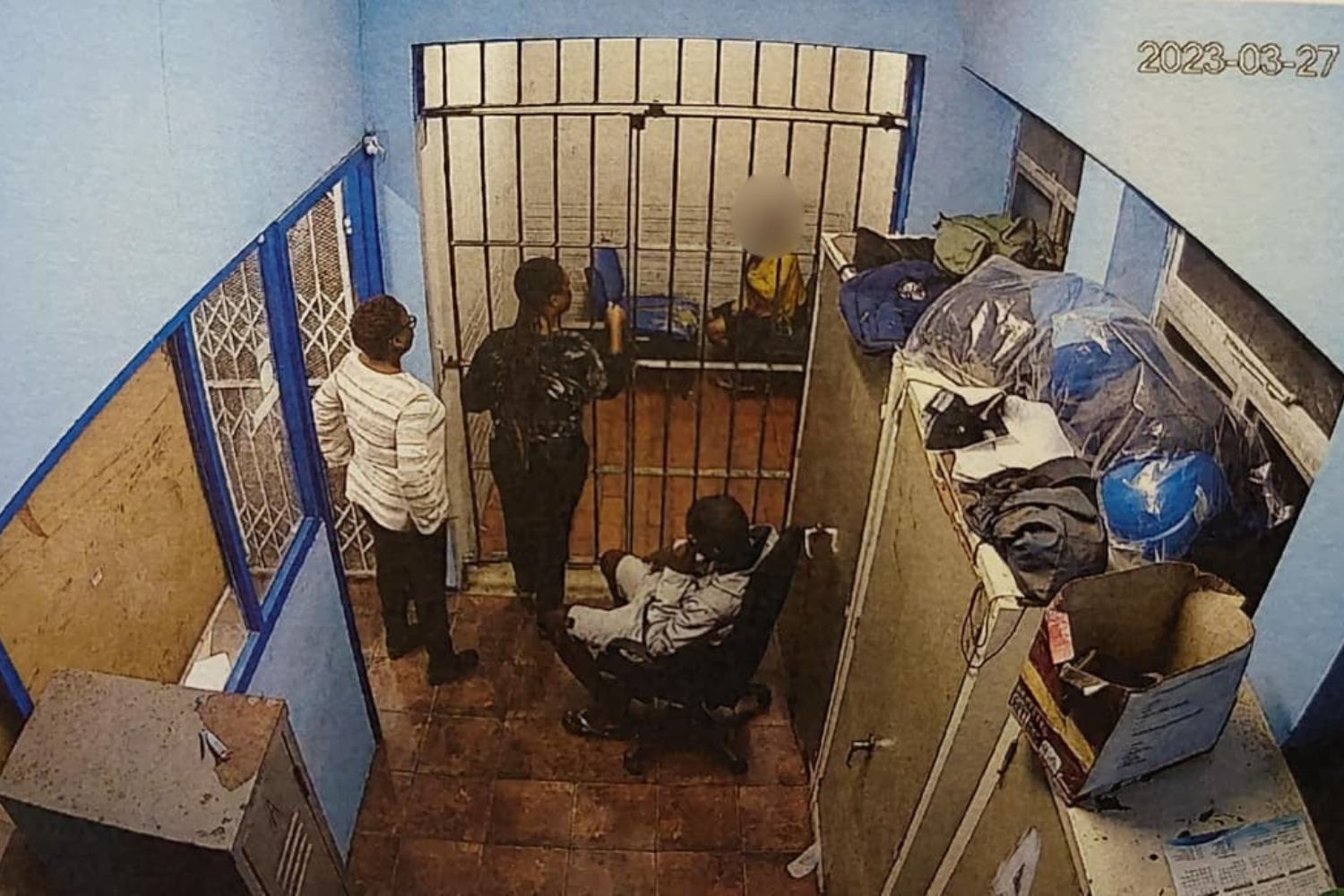
CCTV footage shows Q in a holding cell with her rapist in handcuffs outside. Police officers Gugulethu Buthelezi and Phila Xulu stand outside the cell. They allegedly intimidated Q to withdraw her rape complaint. Image from evidence before court, Q’s face has been blurred.
- Two witnesses testified in the trial of three police officers accused of mishandling a rape complaint and arresting the complainant, Q.
- Detective Juanita Varley said she saw Q in custody and the accused rapist nearby.
- Captain Dennis Njilo confirmed the suspect was released despite medical evidence.
Two witnesses took the stand at the Durban Magistrates Court on Thursday in the trial of three police officers accused of covering up a rape complaint.
Gugulethu Buthelezi, Phila Xulu and Sanele Zuma, attached to the Family Violence, Child Protection and Sexual Offences (FCS) unit based at Brighton Beach police station, are accused of mishandling a rape complaint by Q – a name given to the rape victim by GroundUp. Q is currently in witness protection.
Q was raped in March 2023 at knifepoint by Zwelakhe Mashaba. The state believes that the police officers arrested Q for perjury, transported her in the same vehicle and put her in the same cell block as Mashaba.

Mashaba was released ostensibly due to insufficient evidence and Q was allegedly intimidated into dropping charges.
Last year, Mashaba was convicted and sentenced to ten years in prison for the rape.
Detective Juanita Varley, who is stationed at Brighton Beach police station, testified on Thursday that she was on duty the night Q was detained. Varley said that when she arrived for duty at the charge office about 6pm, she scanned the arrest registry to see if any cases needed her attention. She saw Q in the holding cells. Q appeared “traumatised”. Varley also saw Mashaba, Q’s attacker, seated outside the cell in handcuffs.
Varley said she asked the officers what was happening as it was her responsibility to determine whether detainees had to be charged or further investigated.
Xulu told her that Q had been arrested for perjury.
Varley felt the matter fell outside of her purview, because Xulu was from a specialised unit.
Magistrate Mayne Mewalal asked Varley whether she witnessed any shouting, threats or disturbances while she was in the charge office. She said she did not.
The state submitted that Varley was only in the area for a short time and was not stationed in the charge office when she was on duty.
The state’s next witness, shift commander Captain Dennis Njilo, told the court that on the day of Q’s detention, 27 March, he had reviewed entries in the police occurrence book as soon as his shift started. His duty was to ensure the proper running of the police department. Reviewing arrests and reading through officers’ notes were central to his responsibilities.
Njilo said the records showed that this was not the first time Mashaba had been arrested. He had previously been arrested for rape and intimidation. “I could be mistaken, but I believe the suspect was arrested three times,” he said.
Xulu had told him that after Mashaba was originally arrested on 19 March on the complaint brought by Q, the NPA advised that a witness interview be conducted with Q.
He confirmed that Mashaba was released on a 328 form, which is used to release a suspect where there is insufficient evidence to proceed with prosecution.
This was despite the J88 form – a medical certification of injuries and sexual assault – showing that sexual penetration had occurred.
Njilo said that, to cover himself, he wrote in the occurrence book that he had consulted with FCS detectives on the reasons for Mashaba’s detention and whether he was to be charged or released.
Njilo also wrote in the arrest register that Mashaba had been in custody for close to 48 hours. Police are required to either charge or release a suspect within that period.
When he asked Xulu whether the suspect should be charged or released, she told him that the arresting officer would need to make that decision.
Njilo said that members of the FCS unit were adamant that if the arrest of the suspect had been effected by Brighton Beach police, then the arresting officer from that precinct would be responsible for deciding whether to charge or release him.
Mewalal asked Njilo about allegations of tensions between specialised and general police units, which had been raised during the trial by the defence.
Njilo said he was not aware of any hidden agenda or division between the units.
He told Mewalal that his relationship with the accused officers was collegial.
Mewalal asked what would happen if there was a stalemate between units over who should process a suspect. Njilo said it was not a situation he had encountered before.
The magistrate also asked about the intimidation charge against Xulu and Zuma. Njilo said that while the charge sheet refers to “shouting” at the complainant, he did not hear shouting. He said there may have been raised voices, but not screaming.
He said the charge office is a confined space where shouting would likely have been heard.
The trial was set down to continue on Friday with testimony by Q, but by noon it had not yet started and the defence intended to apply for an adjournment until Monday.
Support independent journalism
Donate using Payfast

Don't miss out on the latest news
We respect your privacy, and promise we won't spam you.
Next: Picket in Cape Town against US war on Iran
Previous: After six years, man is jailed for life in DNA bungled murder case
© 2026 GroundUp. This article is published under the GroundUp Republication Licence Version 1.0. Email info@groundup.org.za to request permission to republish.