
Government is killing the film industry, say protesters
Hundreds of industry professionals marched in Cape Town calling for a meeting with trade and industry minister
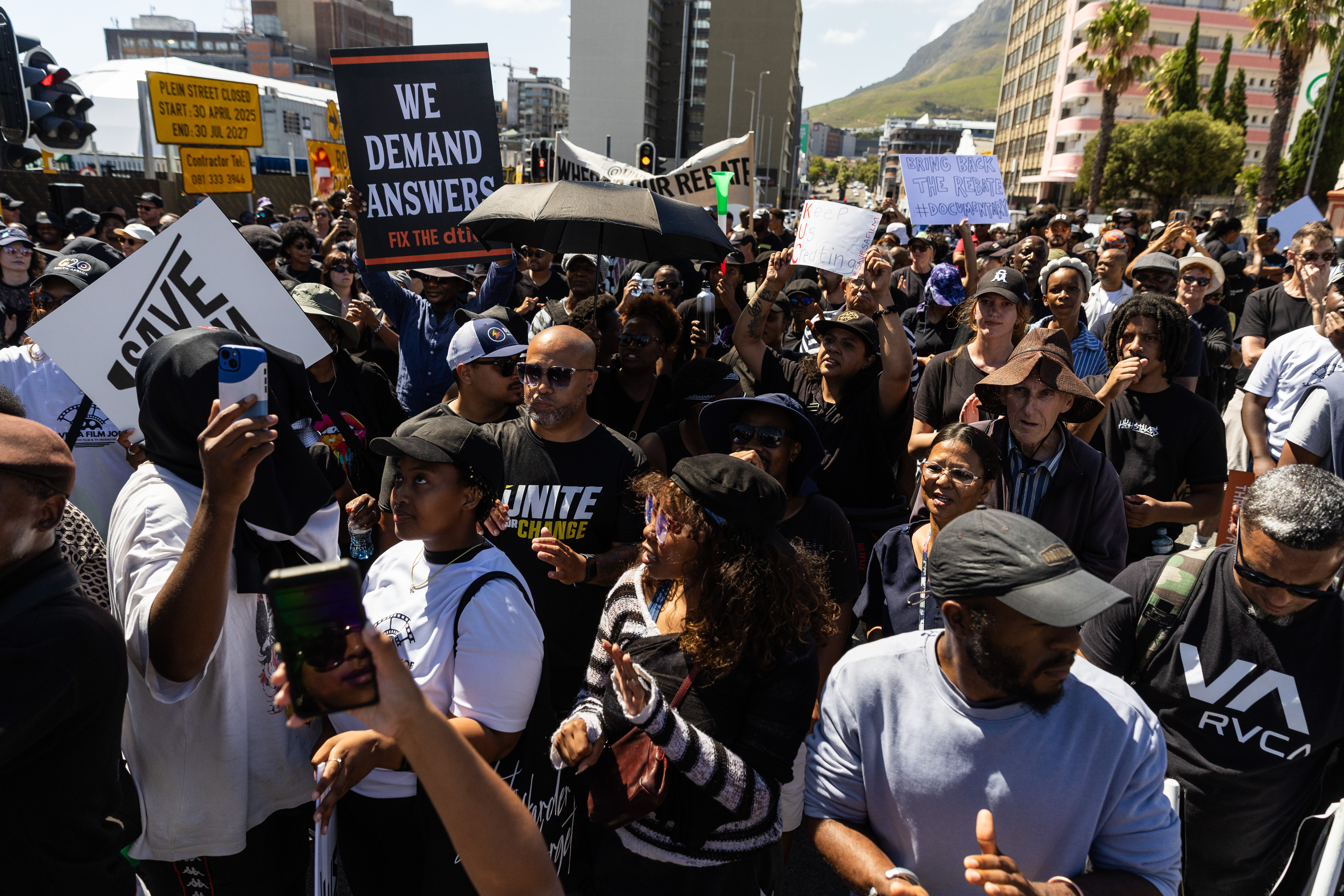
On Wednesday, hundreds of people from the South African film and television industry protested outside Parliament, calling on the Department of Trade, Industry, and Competition to fix delays in its rebate system. Photos: Ashraf Hendricks
- Hundreds of film and television industry workers protested outside Parliament on Wednesday over delays in the Department of Trade, Industry and Competition’s rebate system.
- They demanded an urgent meeting with Minister Parks Tau and an investigation into mismanagement of the incentive scheme.
- Portfolio committee chairperson Mzwandile Masina said he would arrange a meeting with the minister.
- An entertainment lawyer said engagements since 2020 have brought no meaningful change.
On Wednesday, hundreds of people from the South African film and television industry protested outside Parliament, calling on the Department of Trade, Industry, and Competition (DTIC) to fix delays in it rebate system and meet with industry bodies.
South African Film and Television Production Incentive is a rebate programme managed by the DTIC to support the local film and television industry.
The Save SA Films Jobs Coalition says jobs have been lost and productions stalled because of delays in payments and backlogs in processing rebate applications.
Last year, the DTIC blamed the delays on “fiscal constraints”.
“The South African film and television industry has an incredibly important role to promote our culture, to promote national dialogue, and also to bring in jobs,” said writer and director Meg Rickards. “Without the DTIC incentive, those jobs are not happening. It’s just not financially feasible to shoot here anymore.”
Rickards, who has worked in the industry for 24 years, says she has never seen it in such a “dire” state.
She said her production company completed a film in 2020 but was only paid out two years later by the DTIC. To pay the film crew her family had to borrow against their bond.
“We nearly lost everything. It made us very scared to make another film,” she said.
Wandile Molebatsi, deputy chairperson of the Independent Producers Organisation, read a memorandum of demands to three representatives of the portfolio committee for trade, industry and competition.
Demands included an urgent, in-person meeting with DTIC leadership, including Minister Tau, and the establishment of working groups within 21 working days to develop short-and long-term interventions.
They called for adjudication committee meetings, which stopped without explanation in October 2023, according to Molebatsi, to be resumed.
Other demands included an online portal to track applications, and an investigation into the DTIC’s mismanagement of the incentive scheme.
Video: Ashraf Hendricks
Portfolio committee chairperson Mzwandile Masina (ANC) accepted the memo. He told the protesters he would arrange a meeting between film industry leaders and the minister, and request that the department appear before Parliament.
Masina acknowledged the sector’s ability to create jobs across semi-skilled, skilled, and professional categories.
He said a report on the sector would be compiled and made public in order to hold the ministry accountable.
Animation SA, the SA Guild of Actors, Documentary Filmmakers Association, the SA Stunt Association, the Writers Guild of SA were among the organisations that participated in the protest.
In February 2025, the film industry protested over the same issue and delivered a memorandum to the DTIC. According to the latest memorandum, no meaningful change came from this and the industry remained in a “damaging state of uncertainty”.
Responding to GroundUp, DTIC spokesperson Bongani Lukhele said the “department has had consultations with the industry regarding the issue of the incentive”.
Unathi Malunga, an entertainment lawyer, said engagements with the DTIC had been ongoing since at least 2020. “It’s been a long road. They keep making promises, and nothing changes,” she said.
“Producers are not getting their money on time. And yet they continue to tell people they must apply for it, even though they are years in backlog. That is money that is owed to people,” she said.
Support independent journalism
Donate using Payfast

Don't miss out on the latest news
We respect your privacy, and promise we won't spam you.
Next: Leticia Nquma has been warned she’ll be evicted soon. But she’s still painting her shack pink
Previous: State is blocking access to SASSA grants, argue activists
© 2026 GroundUp. This article is licensed under a Creative Commons Attribution-NoDerivatives 4.0 International License.
You may republish this article, so long as you credit the authors and GroundUp, and do not change the text. Please include a link back to the original article.
We put an invisible pixel in the article so that we can count traffic to republishers. All analytics tools are solely on our servers. We do not give our logs to any third party. Logs are deleted after two weeks. We do not use any IP address identifying information except to count regional traffic. We are solely interested in counting hits, not tracking users. If you republish, please do not delete the invisible pixel.