
Shacks demolished while eviction case drags on for Durban’s Piedmont Park
The municipality says it will only be able to provide alternative accommodation in 2027
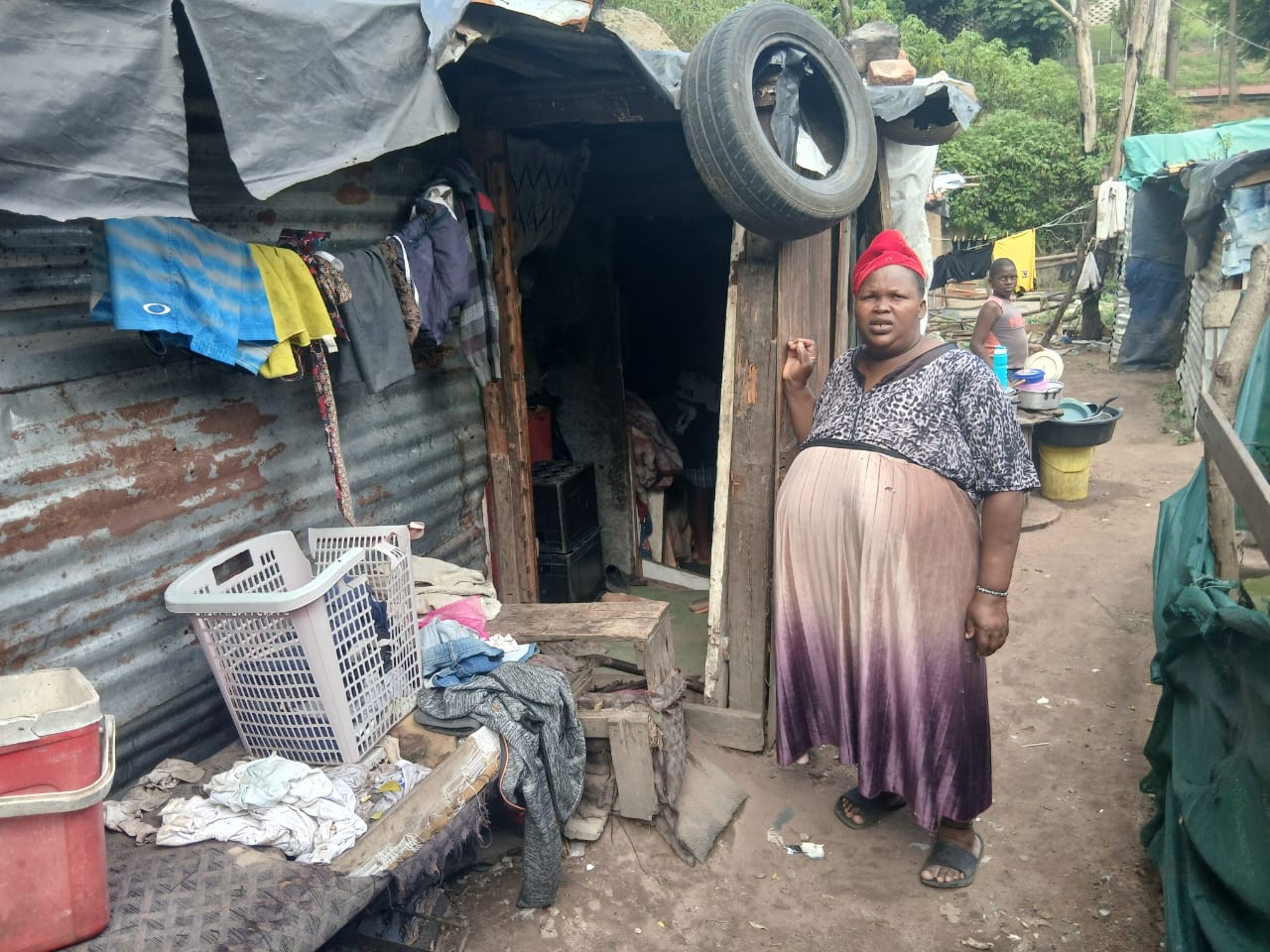
Sofe Zwane stands in front of her home in the informal settlement at Piedmont Park, which she says has been demolished several times by the eThekwini Municipality. Photo: Tsoanelo Sefoloko
“We have nowhere to go,” says Sofe Zwane, whose shack near Sherwood, Durban, has been demolished several times since October by the eThekwini Municipality.
Zwane is one of hundreds of people living in an informal settlement at Piedmont Park. The land owners have applied to evict the residents, but the municipality says it will only have funds to provide alternative accommodation in 2027.
Each time officials arrive, Zwane waits outside while her home is demolished, and then rebuilds the shack when they leave. She has lived there with her three children for five years.
Fanie Malike, originally from Thabazimbi in Limpopo, said he moved to the settlement in 2022 after struggling to afford rent. He survives by collecting cardboard and cans to sell to recycling companies.
Municipal spokesperson Gugu Sisilana said the municipality is “monitoring the site and preventing its expansion by demolishing newly built and unoccupied structures”.

Residents allege that officials damage their belongings, including wardrobes and other furniture, and identity documents have been lost during the demolitions.
Shacks were last demolished on Sunday, 22 February. When GroundUp visited the following Wednesday, some residents had already begun rebuilding.
The Mansoor family, who owns the land, applied to the High Court in Durban in September 2024 to evict the residents. In court papers, the family said that between 200 and 250 households are living on the land.
In April 2025, Judge Lynette Naidoo ordered the eThekwini Municipality to compile a report on the residents and what alternative accommodation could be provided.
The municipality filed its report in December after interviewing 34 households. Based on household income, 29 qualified for a stand and building material, two for a stand only, and three did not qualify for assistance.
To accommodate the residents, the municipality said it would have to purchase land using its Urban Settlement Development Grant and Informal Settlement Upgrading Programme Grant, but funds would only be available in the 2027/28 financial year.
Shackdwellers’ movement Abahlali baseMjondolo is assisting about 54 households with legal representation from the Socio-Economic Rights Institute of South Africa.
In court papers opposing the eviction, the residents say they are willing to relocate if suitable alternative accommodation is provided. They said not all the households represented by SERI were interviewed for the municipal report.
Support independent journalism
Donate using Payfast

Don't miss out on the latest news
We respect your privacy, and promise we won't spam you.
© 2026 GroundUp. This article is licensed under a Creative Commons Attribution-NoDerivatives 4.0 International License.
You may republish this article, so long as you credit the authors and GroundUp, and do not change the text. Please include a link back to the original article.
We put an invisible pixel in the article so that we can count traffic to republishers. All analytics tools are solely on our servers. We do not give our logs to any third party. Logs are deleted after two weeks. We do not use any IP address identifying information except to count regional traffic. We are solely interested in counting hits, not tracking users. If you republish, please do not delete the invisible pixel.