
Small-scale fishers furious about linefish quota cuts
Government has reduced the traditional fishers’ fleet from 547 to just 77 vessels
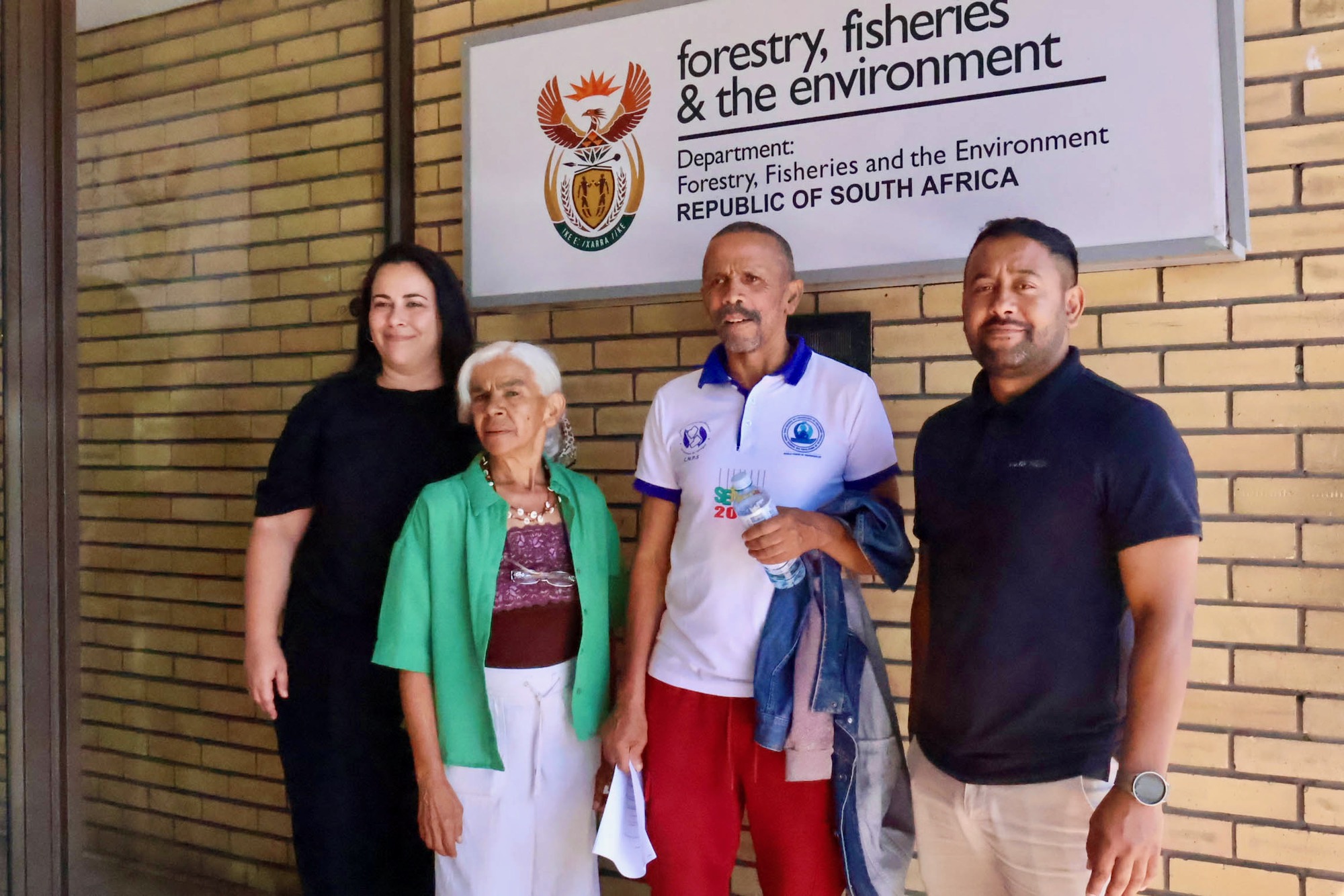
From left to right: Carmen Mannarino (Masifundise Development Trust), Hilda Adams (West Coast Small Scale Fishers Forum), Andre Cloete (Coastal Links), and Faez Poggenpoel (Western Cape Small Scale Fisheries Representative Forum). Photo: Liezl Human
- The Department of Forestry, Fisheries, and the Environment (DFFE) has reduced the number of small-scale fishing vessels allowed to go to sea from over 547 to just 77.
- Fishers say the reduction will jeopardise their livelihoods, which depend on catching linefish the traditional way.
- Small-scale fishers presented a memorandum to the Portfolio Committee on Forestry, Fisheries, and the Environment on 10 February, calling for the department to reverse its decision.
- The DFFE director-general Nomfundo Tshabalala addressed the fishers and committed to respond to their demands.
Small-scale fishers are calling for the Department of Forestry, Fisheries, and the Environment (DFFE) to review its recent decision to reduce the number of linefish boats that small-scale fishing cooperatives may use to fish.
Linefish quota is measured by “total allowable effort” (TAE), which is the number of vessels allowed to go to sea to catch fish.
The DFFE 2026/27 linefish decision reduced the TAE for small-scale cooperatives from over 547 to just 77.
On Tuesday, small-scale fishers presented a memorandum of demands to the Portfolio Committee on Forestry, Fisheries, and the Environment at the DFFE offices in Cape Town. It was signed by 46 cooperatives and nine organisations, including the West Coast Small Scale Fishers Forum, Masifundise and Coastal Links.
“Fishing is not just a job. It is our culture, our identity and intergenerational knowledge passed down over generations,” Andre Cloete, chairperson of Coastal Links Western Cape, told the committee.
“We are traditional small-scale fishers. We are overlooked again … Every time we have to fight for our place in the sea.”
He said fishers wanted to know how the department arrived at its decision, since the fishers had received no answers to their communications, nor been given an opportunity to discuss the quotas.
The fishers are demanding the reversal of the TAE decision, saying the allocation is “unsustainable, unjust, and made without meaningful consultation”. They want the department to engage properly with the communities.
They also want a redistribution of the commercial sector’s linefish allocation, which received 378 of the total 455 vessels.
The DFFE said this split “is in line with best available scientific and management recommendations”.
In a letter, the fishers said linefish is the “backbone” of fishing communities and they depend upon it for survival.
Fishers also asked for an exemption when their permits expire on 28 February.
Hilda Adams, chairperson of the West Coast Small-Scale Fishers Cooperative Forum, said if the DFFE didn’t react quickly, they would not have valid permits to fish this March.
Adams said small-scale fishers use small boats and use less damaging fishing gear.
In a recent statement, the Masifundise, a small-scale fishing advocacy group, said communities are worried that the decrease in TAE will “leave hundreds of households without income, deepen hunger in already vulnerable coastal areas, and create conflict within cooperatives forced to decide which members may fish and which may not”.
DFFE director-general Nomfundo Tshabalala, addressing the fishers at the portfolio committee meeting, said, “We are in full support of ensuring that the livelihoods of the fisheries in the coastal areas are uplifted.”
Tshabalala acknowledged that the department needed to find a “balance”.
“Whatever we come up with as a recommendation is informed by science … We need to balance that with the livelihood and ensure we do not deplete the species in the case [of] traditional linefish.”
Tshabalala committed to respond to the memorandum within five days, and recommended the fishers formally appeal the decision.
Support independent journalism
Donate using Payfast

Don't miss out on the latest news
We respect your privacy, and promise we won't spam you.
Next: Court reverses funding cuts for child care
Previous: KZN flood victims stuck in emergency housing, three years later
Letters
Dear Editor
The reported reduction of the traditional linefish TAE for small-scale cooperatives from over 547 vessels to only 77 for 2026/27 reads less like resource stewardship and more like exclusion by administrative fiat.  Fishers are entitled to meaningful engagement on decisions that strike at the heart of their livelihoods and food security and they are equally entitled to clear, written reasons that can be understood, tested and, if necessary, appealed.
If the DFFE insists that this split is in line with best available scientific and management recommendations, then the evidence base must be made transparent: the stock assessments relied on, the assumptions used, the risk thresholds adopted and the alternatives considered.  Science cannot be invoked as a conversation-stopper; it should be the starting point for co-management and credible compliance.
This is also a question of culture and identity. The small-scale fisheries policy itself recognises small-scale fishing as a means to secure food and livelihood security and frames the sector through a human-rights-based approach, including participatory management practices and equitable access without compromising ecological sustainability.  For many coastal communities, fishing is a lived heritage and an intergenerational practice tied to the sea. 
Sustainability matters. The Marine Living Resources Act expressly aims at conservation, long-term sustainable utilisation and fair and equitable access for all South Africans.  A decision that cuts small-scale vessels so drastically while the commercial sector reportedly receives 378 of the 455 vessels demands more than assurances; it demands justification, proportionality and a lawful process. 
With permits expiring on 28 February, the department should urgently publish its full reasons, provide an interim exemption to prevent hunger and conflict within cooperatives and convene structured consultations in affected communities before finalising any allocation model.
Dear Editor
The West Coast fishing giants with trawlers, have of course no reduction in quota. A brand new trawler was launched within the last two weeks on the West Coast.
The proportions of trawlers vs fishing traditional methods is self explainatory.
Why are the trawlers allowed to expand in numbers and the small fishermans sole income is severed ?
Dear Editor
This is very unfair to the fishing community of South Africa as the trawlers are doing the most damage to this industry. It's a get rich quick industry for the owners and government. Also permits to outside trawlers must stop with immediate effect as other countries are benefitting and not our rightful people.
Dear Editor
I would like ask: has anything been done about the uplifting of small scale fishers to earn a living? The answer is no.
I have been fishing all around the Cape Coast for 65 years and have never experienced a snoek and yellowtail line catch so bad as it has been in 2025. In my opinion, it is the tuna pole boats and trawlers' bycatch that is destroying this industry. This must be stopped immediately for trial three seasons to measure the impact and give these small scale fishers there licence to continue catching.
A three season break from the trawlers and tuna pole boats will judge the outcome for all who live off this industry as that's a fair judgment.
© 2026 GroundUp. This article is licensed under a Creative Commons Attribution-NoDerivatives 4.0 International License.
You may republish this article, so long as you credit the authors and GroundUp, and do not change the text. Please include a link back to the original article.
We put an invisible pixel in the article so that we can count traffic to republishers. All analytics tools are solely on our servers. We do not give our logs to any third party. Logs are deleted after two weeks. We do not use any IP address identifying information except to count regional traffic. We are solely interested in counting hits, not tracking users. If you republish, please do not delete the invisible pixel.