
“I fought for freedom, and now I am going to die without water” says Mpumalanga pensioner
Residents of Lekwa Local Municipality say they have endured years of poor supply
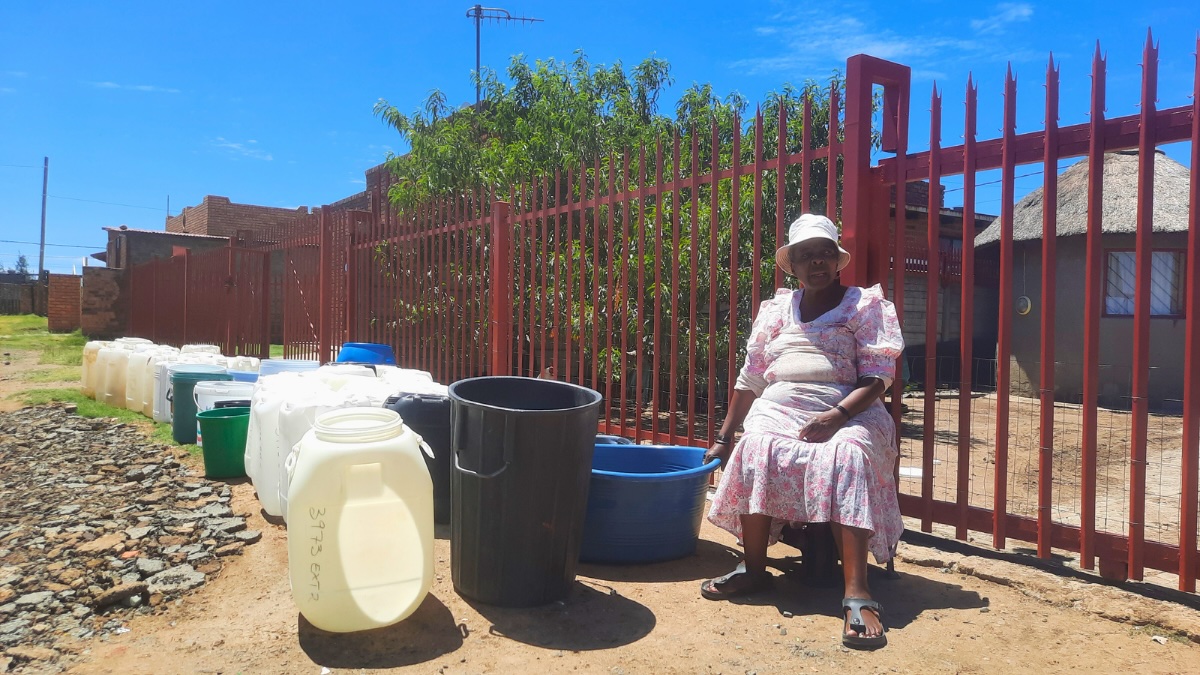
In Standerton, Mpumalanga, pensioner Margaret has lived without a reliable supply of running water for more than a decade. When water tankers do arrive, she has to pay someone between R50 and R60 to carry water into her house. Photo: Seth Thorne
- Residents of the Lekwa Local Municipality in Standerton, Mpumalanga, say they have been living without reliable running water for over a decade.
- A 2021 SA Human Rights Commision report found systemic failures in water and sanitation, including prolonged outages and contaminated supply.
- The municipality blames ageing infrastructure, pump breakdowns and algae at its treatment plant.
- But the Auditor-General’s report shows the municipality spent just R462,909 on infrastructure maintenance and lost R230.6-million worth of water through municipal pipes.
Pensioner Margaret* has lived without a reliable supply of running water for more than a decade, in ward 5 of the Lekwa Local Municipality in Standerton, Mpumalanga.
Margaret supports a household of four on social grants. It has now been three weeks since a water tanker last came to her area. To get water, she must pay R150 for a bakkie to fetch and fill her buckets.
She cannot afford to do this regularly. Instead, she lines the street outside her home with dozens of buckets, waiting day after day in the hope that a tanker will arrive.
When it does, she cannot carry the buckets herself. So she has to pay someone between R50 and R60 to carry water into her house.
“This has been going on for nearly 15 years. Last time we got water in our house was a tiny bit in the night of winter last year,” she said.
“It is like they don’t see us as human.”
Margaret, who bought her house in 1992, is not alone.
Residents across the Lekwa Local Municipality say they have endured dry taps since the early 2010s. For years, water flowed intermittently between midnight and 4am. Now, many areas receive none at all.
DA MP Angel Khanyile raised the matter with the South African Human Rights Commission (SAHRC), saying the municipality has repeatedly failed to meet its own deadlines to restore supply, including a December 2025 target.
A 2021 SAHRC report found systemic failures in basic service delivery in Lekwa, particularly in water and sanitation. These included prolonged outages without adequate alternatives, contaminated drinking water, and extensive leaks.
The Commission cited deteriorating infrastructure, financial mismanagement, and outdated planning, and told the municipality to ensure a minimum daily water supply.
At the launch of the report in 2024, Commissioner Philile Ntuli said little had changed. “The continued lack of access to water violates the residents’ rights in terms of section 27(1)(b) of the Constitution,” she said.
The Department of Water and Sanitation’s 2023 Blue Drop report, which assesses the quality of drinking water and how well municipalities manage their water treatment systems, gave Lekwa a score of 33.53%. This reflects extremely poor water quality management. Its No Drop score, which measures how effectively municipalities prevent water losses through leaks, pipe bursts and poor metering, was 0%. This indicates a complete failure to manage water losses.
“The tankers are not enough”
The municipality, which is currently under national administration, attributed water supply challenges to ageing infrastructure dating back to the 1970s, decades of neglected maintenance, limited funding, and skills shortages.
Municipal spokesperson Lubabalo Majenge said demand exceeds supply capacity, particularly in high-lying areas such as Sakhile Extension 2 in Ward 5, necessitating the use water tankers.
However, he did concede that “the tankers are not enough.”
Majenge said the crisis worsened after one of four water pumping units broke down, reducing the municipality’s ability to extract and process sufficient water for distribution.
Excessive algae growth in the Vaal River has also clogged filtration systems at the Standerton Water Treatment Plant, further constraining supply.
Majenge said the breakdown should to be fixed soon. He added that the municipality is refurbishing the Standerton Water Treatment Plant with support from the Department of Water and Sanitation.
Khanyile said the crisis could have been avoided. She blamed chronic underinvestment in infrastructure maintenance.
According to the Auditor-General’s most recent report, the municipality disclosed spending just R462,909 on repairing and maintaining its infrastructure, including water systems, in its annual financial statements.
The same report found that the municipality had lost water worth R230.6-million, equivalent to 69% of all water flowing through municipal pipelines.
“I do not think anything is going to happen. I fought for freedom, and now I think I am going to die without water,” Margaret said.
* She did not want to give her full name.
Support independent journalism
Donate using Payfast

Don't miss out on the latest news
We respect your privacy, and promise we won't spam you.
Next: Pensioners in court for seizing municipal vehicle
Previous: Hundreds march on Parliament demanding an increase in alcohol tax
© 2026 GroundUp. This article is licensed under a Creative Commons Attribution-NoDerivatives 4.0 International License.
You may republish this article, so long as you credit the authors and GroundUp, and do not change the text. Please include a link back to the original article.
We put an invisible pixel in the article so that we can count traffic to republishers. All analytics tools are solely on our servers. We do not give our logs to any third party. Logs are deleted after two weeks. We do not use any IP address identifying information except to count regional traffic. We are solely interested in counting hits, not tracking users. If you republish, please do not delete the invisible pixel.