
Time to pay up: a look at municipal debt
More than R161-billion owed for electricity, water and taxes
 Add GroundUp on Google
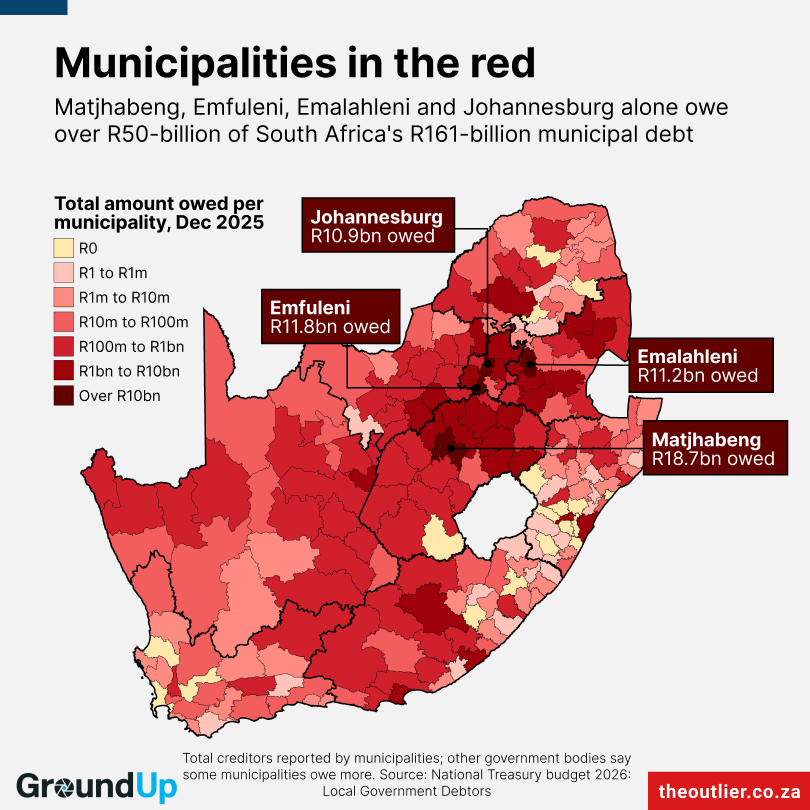
Earlier this week, we reported on Kai !Garib Municipality in the Northern Cape, home to about 85,000 people. It is more than R1-billion in debt, most of it owed to Eskom. Its annual revenue in 2025 was less than R400-million. That is not enough to deliver essential services, let alone pay off its debt.
The municipality is unable to provide clean water or treat wastewater, and its roads are riddled with potholes.
The situation in Kai !Garib is not unique. According to the National Treasury, municipalities owed more than R161-billion in December 2025.
Eskom was owed R110.5-billion, while regional water boards and the Department of Water and Sanitation were owed R30.7-billion. SARS was owed R601-million, and the Auditor General R908-million.

Almost a third of municipal debt belongs to just four municipalities, which each owe more than R10-billion. They are: Matjhabeng (Free State), Emfuleni (Gauteng), Emalahleni (Mpumalanga) and the City of Johannesburg (Gauteng). Together they owe more than R50-billion.
What is the plan?
Recently, National Treasury withheld R13.5-billion in equitable share grants (the portion of national revenue that municipalities receive) to 69 municipalities that had passed unfunded budgets, failed to spend correctly, and had not met their obligations to Eskom, water boards, SARS, the Auditor-General and pension funds.
These municipalities collectively owe R27.4-billion. Ten of them account for nearly 80% of the debt. One of the conditions set by Treasury for the grants to be unfrozen is that the municipalities sign repayment agreements with their creditors.
One of the biggest reasons municipalities owe so much to Eskom is that they struggle to take in revenue for electricity used – billing systems are dysfunctional and illegal connections are rife. This means revenue has not been high enough to pay Eskom and repay the debt.
The National Treasury launched an Eskom debt relief programme in 2023. The idea was that municipalities’ debt would be written off over three years, as long as they met strict conditions, including paying their monthly electricity accounts and increasing their revenue collection through proper billing.
While some municipalities have benefited from it, more than 61 out of the 71 municipalities that signed up for the programme have failed to meet the conditions. “Persistent defaulters” are being removed from the programme.
Another way municipalities can reduce their electricity debt is by signing an agreement with Eskom that gives Eskom control over billing and revenue collection.
National Treasury has also started a new conditional grant to help municipalities roll out smart prepaid meters.
For water debt, there is a programme run by the Department of Water and Sanitation that writes off debt over three months provided that new invoices are paid throughout: if a year’s invoices are paid consistently, a third of the debt is written off.
Outside of this scheme, municipalities can also sign negotiated repayment agreements with water boards.
At the same time as repaying their debt, municipalities need to stop water losses caused by leaks and illegal connections.
There are also other ways provincial and national governments can intervene in dysfunctional municipalities, such as placing them under administration, but the track record is poor.
Support independent journalism
Donate using Payfast

Don't miss out on the latest news
We respect your privacy, and promise we won't spam you.
Next: Police fail to stop vigilantes from targeting immigrants in Alexandra
Previous: As climate change intensifies, animals need the freedom to move
Letters
Dear Editor
Thank you for raising awareness regarding these matters, but I am afraid you can't stop here!
The Mayors & MMs tell blatant lies without giving proof of their "allegations" of non-payment from residents!
Treasury needs to first investigate fully. KGM has previously signed a payment plan but defaulted! It is going on 10 years now! Can you imagine prepaid residents being in arrears? Can you imagine the many farmers being in arrears with their accounts for 9 years with NO CONSEQUENCES? Can you believe that? Never! They will cut the electricity and force them to pay.
The Kai Garib Municipality has not even paid salaries for June as well as May's overtime, as usual. I think an audit is essential now, as they have been withholding funds to cover for shortages in their end-of-financial-year audit!
Dear Editor
Besides the massive debt mismanagement by South African municipalities, another takeaway from this visualisation should be the incomplete data that National Treasury is reporting.
Several municipalities on the graphic show exactly zero debt. This is extremely unlikely to be the case. No organisation working at the scale of a municipality is working on a purely cash basis. Every municipality will carry some debt as part of its operating cycle.
Indeed, the City of Cape Town's 2024/25 annual report shows some R26.4bn in liabilities, including R7.3bn in trade payables. https://resource.capetown.gov.za/documentcentre/Documents/City%20research%20reports%20and%20review/CCT_Integrated_Annual_Report_2024-25.pdf
© 2026 GroundUp. This article is published under the GroundUp Republication Licence Version 1.0. Email [email protected] to request permission to republish.