
SASSA pensioner builds her own house faster than the government
Government has left scores of houses for Eastern Cape storm victims incomplete
 Add GroundUp on Google
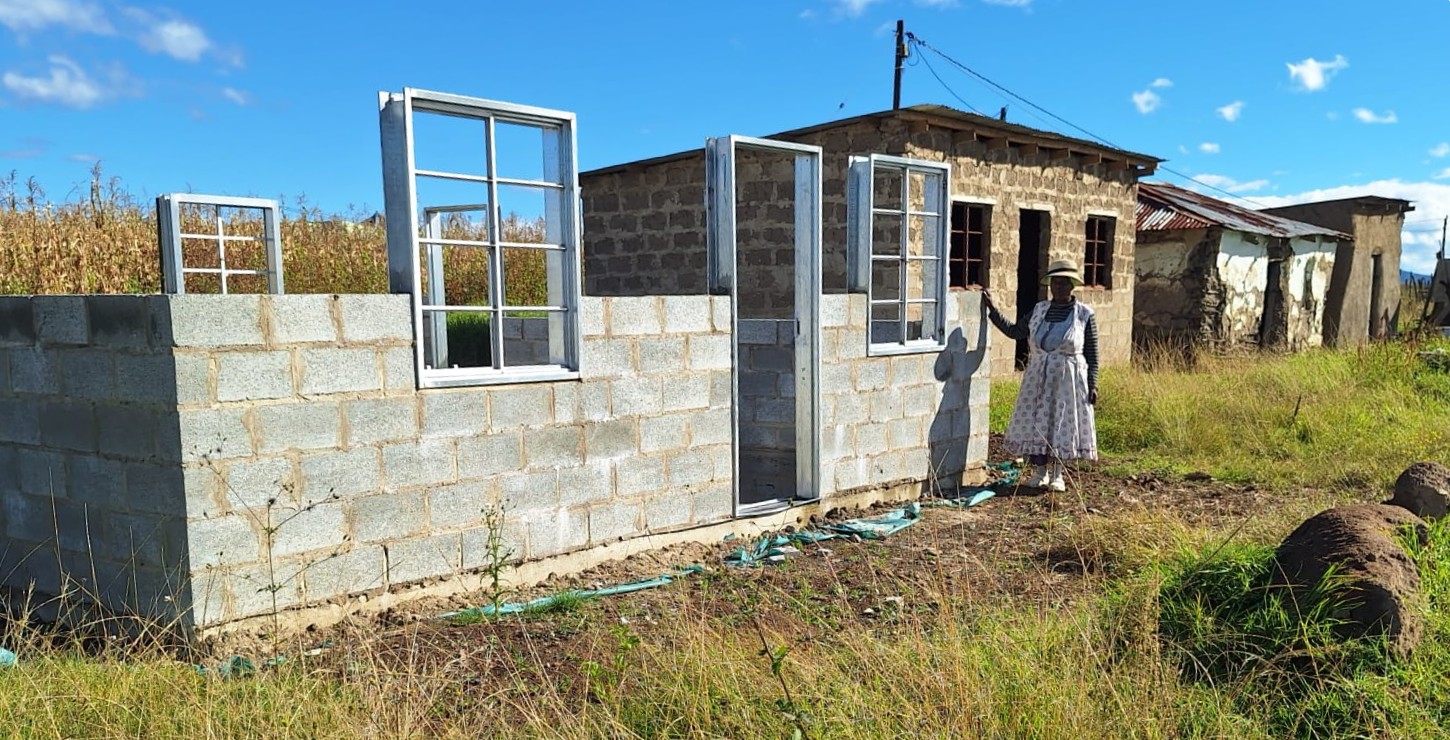
Nomondo Mboyi stands beside a house government has been building since 2023. Behind her is the mud-brick house she has built herself in the meantime. Photo: Yamkela Ntshongwana
- Nomonde Mboyi, 67, has spent three years building herself a mud-brick house with her old age grant.
- Her government house in Ndakeni, Eastern Cape, has only a foundation and part of its walls. Not one of the 200 houses meant for 2019 storm victims has been finished.
- The Eastern Cape Department of Human Settlements says it fired the contractor for poor performance. The contractor says the department hasn’t paid it for a year.
When the government told Nomondo Mboyi, 67, three years ago that they would build her a new house after hers was destroyed in a storm, she didn’t bother waiting. She started building her own house, using mud bricks she made herself and using her old-age grant to buy materials and pay for labour. Since then, the government project has stalled.
Mboyi’s was one of hundreds of households which lost their homes during heavy winds and rain in the Mbizana region of the rural Eastern Cape in 2019. She lost two mud houses. A third house, built from sticks and mud, was left with a leaking roof and holes in its walls.
In 2023, the Eastern Cape Department of Human Settlements appointed ZIBSIPRO (Pty) Ltd to replace the storm-damaged houses with 200 houses across the region for about R34-million – about R170,000 per house. But not one of the houses has been completed.
The brick-and-mortar house the government is building for Mboyi only has a foundation and partially completed walls. This is the case at most of the houses under construction in Mboyi’s village, Ndakeni. 
“When the contractor came here last year to start the foundation, I was already starting the walls of my two-room house. I used my social grant to buy materials and pay for labour. But the process was not quick because I had to spend months saving enough money before I could continue,” she said.
Her new mud house just needs plastering outside and some final touch-ups before she moves in in December. She said Eskom cannot install electricity because the house is not waterproof.
Mboyi said that, during a meeting with the Winnie Madikela-Mandela Local Municipality in February this year, residents offered to finish building the houses themselves, but were told to wait. “Since then, there has been no further explanation. We are just waiting,” she said.
Community leader Nontokozo Nyombo said many of the beneficiaries, who mostly rely on social grants, were in desperate need of housing.
“People are very frustrated, and the sad thing is that we don’t know who to turn to. Our municipality no longer gives us answers on the matter,” she said.
Residents said the contractor left in November last year, promising to return, but had not done so. There is still some construction machinery in the village, watched over by a security guard.
Department spokesperson Yanga Funani said ZIBSIPRO’s contract was terminated during the 2025/26 financial year because of poor performance.
He said the department planned to reinstate the project. Houses where construction had already started would be prioritised, and those not yet started would be dependent on funding availability.
But ZIBSIPRO director Palesa Phara said she was not aware the contract had been terminated. She claimed that non-payment by the department had made it financially impossible to continue. However, she acknowledged that the department sent the company a letter of default and that the company tried to cede the work to a subcontractor, which the department verbally rejected.
“All I know is that the department has owed us payment for a year, which is why I stopped working with them,” she said.
Phara said the company was appointed in September 2023, but only received a formal contract towards the end of November, shortly before the annual construction shutdown.
Work could not start immediately, she said. Geotechnical investigations, soil assessments and approval processes delayed construction further. The approved foundation design was also “heavily over-engineered” and the company hired another engineer to redesign it.
Conditional approvals from the National Home Builders Registration Council were also required before work could proceed.
She said construction effectively began around October 2024, more than a year after the company was appointed. She also said working across 34 villages created logistical challenges, while heavy rain disrupted construction.
Phara also alleged that the company was verbally instructed to “slow down” because the department did not have sufficient funds available. Also, the payment arrangements changed from paying at each building stage (milestones) to paying only when a unit was finished, she said. This placed financial pressure on the company, which had to keep buying materials and paying workers without receiving corresponding payments.
“Eventually, site operations became unsafe. Certain labourers, local workers, security personnel and community stakeholders effectively prevented further access to the site until outstanding [labour] disputes and payments were resolved,” she said.
“Some company equipment and infrastructure remain on site to this day, continuing to generate storage and security costs while also remaining inaccessible,” she said.
Funani did not respond to Phara’s allegations. The municipality did not respond to our questions, referring us to the department.
Support independent journalism
Donate using Payfast

Don't miss out on the latest news
We respect your privacy, and promise we won't spam you.
© 2026 GroundUp. This article is published under the GroundUp Republication Licence Version 1.0. Email [email protected] to request permission to republish.