
“We can go weeks without water, and no one seems to care”
Elderly residents of Lehae in Johannesburg battle to fetch water
 Add GroundUp on Google
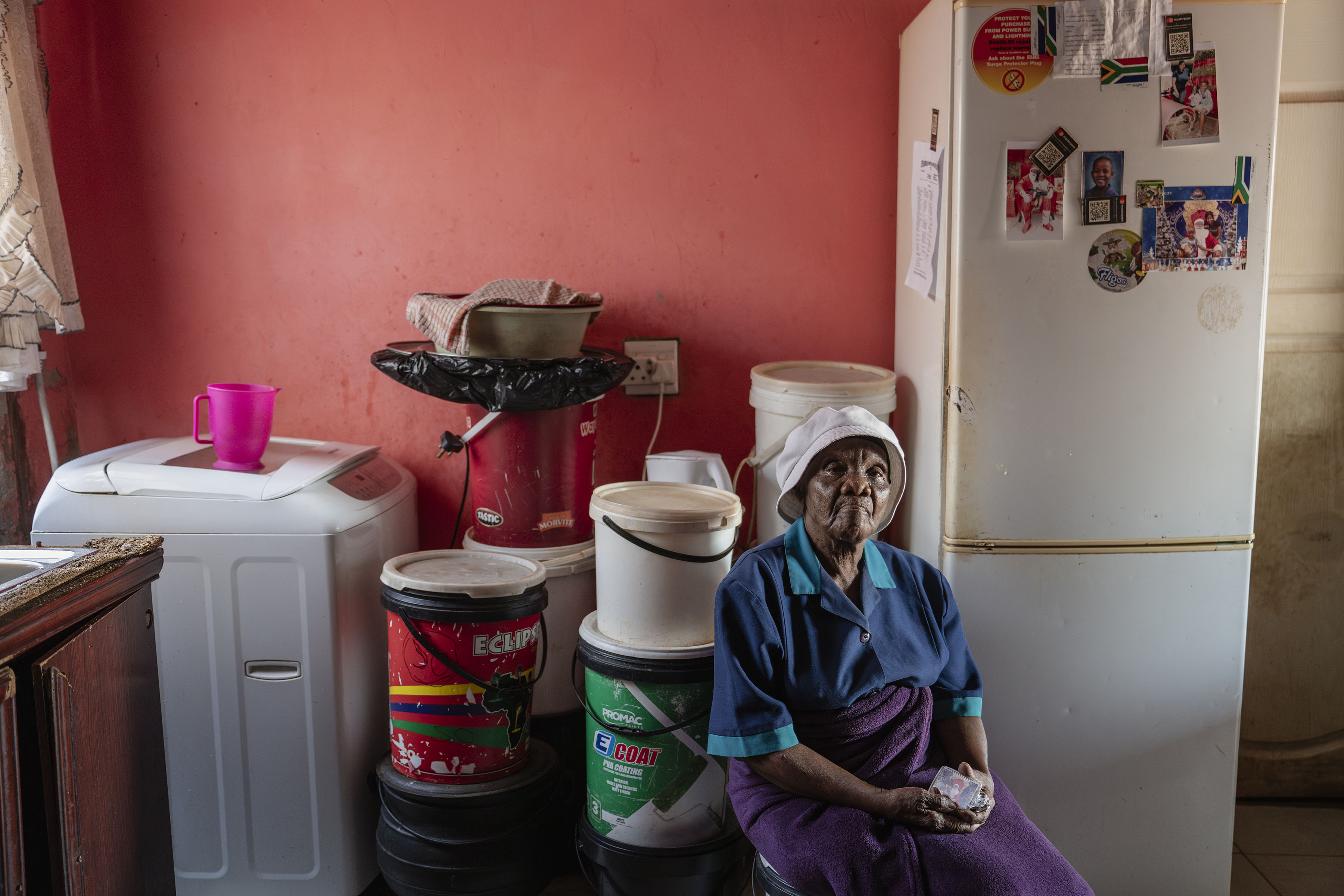
79-year-old Lehae resident Dorothy Harvey sits on the plastic buckets she uses to store water for her daily needs. Photos: Ihsaan Haffejee
Lehae, a township in the South of Johannesburg, is experiencing persistent water outages.
The area was developed in the 2010s with about 5,000 houses.

Residents told GroundUp that water supply has been unreliable since 2014 and water outages have become unbearably frequent in the past few years.
One part of Lehae, called Phase 1, is particularly affected because it is at a higher altitude. “We can go weeks without water, and no one seems to care,” said Phase 1 resident Muzi Nkosi.
Nkosi said the community has contacted officials at Johannesburg Water, and told to liaise with the ward councillor. “We have tried speaking with our councillors and the municipality, but they ignore us all the time,” he said.
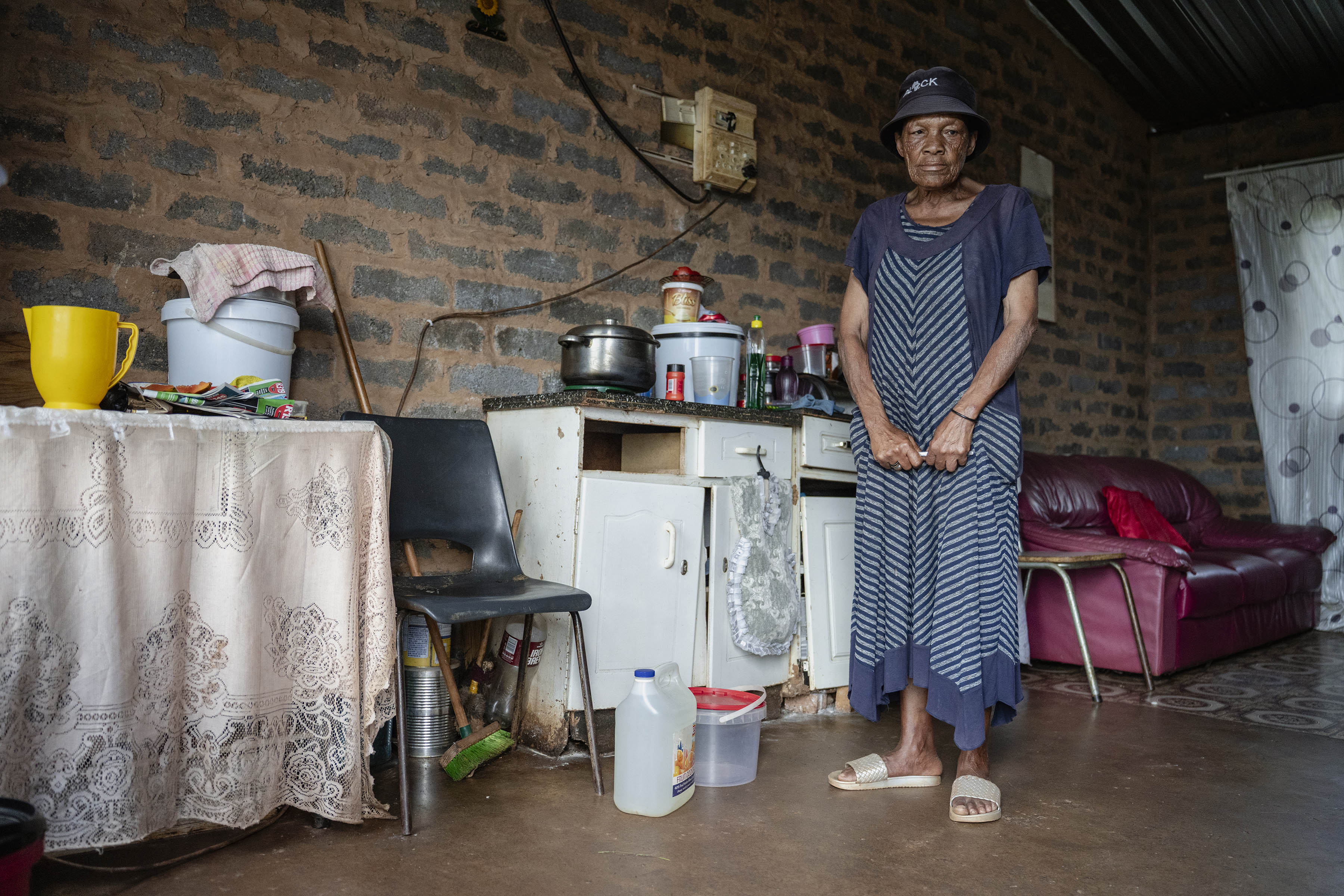
70-year-old Pinky Chakela, from Lehae, says she is too old to carry a 20-litre bucket. She uses a 5-litre bottle and often makes multiple trips a day to collect water.
Phase 1 resident Esther Tshabalala, who is in her fifties, walks with crutches because of a problem in her hips. This makes it extremely difficult for her to carry buckets of water to and from collection points.
“I have fallen and hurt myself trying to carry a water bucket home. I don’t always have people to help me collect water for cooking and especially for the toilet. How can I survive?” said Tshabalala.
She said elderly and disabled residents like her often have to pay youngsters from the neighbourhood between R10 and R20 for them to collect and deliver one 20-litre bucket of water.
Asked about the upcoming local government elections, Tshabalala was sceptical. “Voting? Voting for what? For who? We are not going to vote because nothing changes. Things are only getting worse. They can’t even provide us with the most basic thing, which is water,” she said.
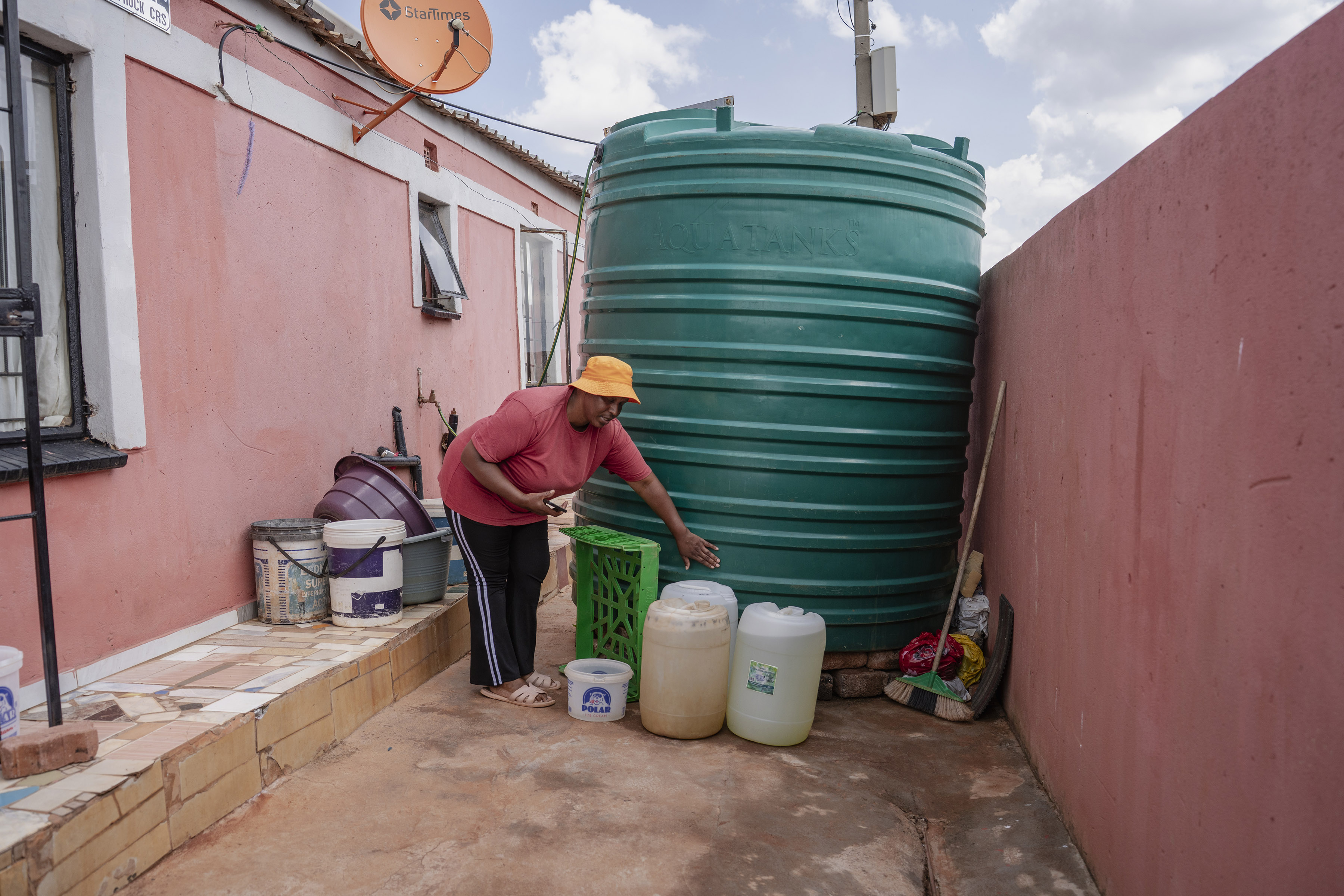
Resident Nomsa Mofokeng shows the water tanks provided by Johannesburg Water. Residents say the tanks are not big enough and haven’t been filled since December.
Two water tanks were provided by Johannesburg Water, but these have not been filled since December, and residents say they are not big enough.
“We have to pick and choose carefully what we use our water for,” said Mesesi Kubheka.
“Cooking, cleaning and toilet come first, and then I can do some laundry if I still have some water left over,” she said. She has about 60 litres of stored water in containers.
Ward 122 councillor Sithembiso Zungu, who also serves as the City of Johannesburg’s mayoral committee member for Group Corporate and Shared Services, acknowledged that reliable supply was an issue.
“Residents do receive water, but it comes on very early in the morning, so people need to get up early to get water. So the situation is not as we would like, and we are engaging with Johannesburg Water to work on a solution,” said Zungu.
Johannesburg Water spokesperson Nombuso Shabalala said the issues in Lehae are caused by illegal water connections, which have placed strain on the Lenasia Water Supply System.
“As part of capacity management measures, the Hospital Hill and High-Level Reservoirs are isolated twice daily to allow for system recovery. During these isolation periods, areas such as Lehae are affected, leading to reduced pressure or intermittent water supply.”
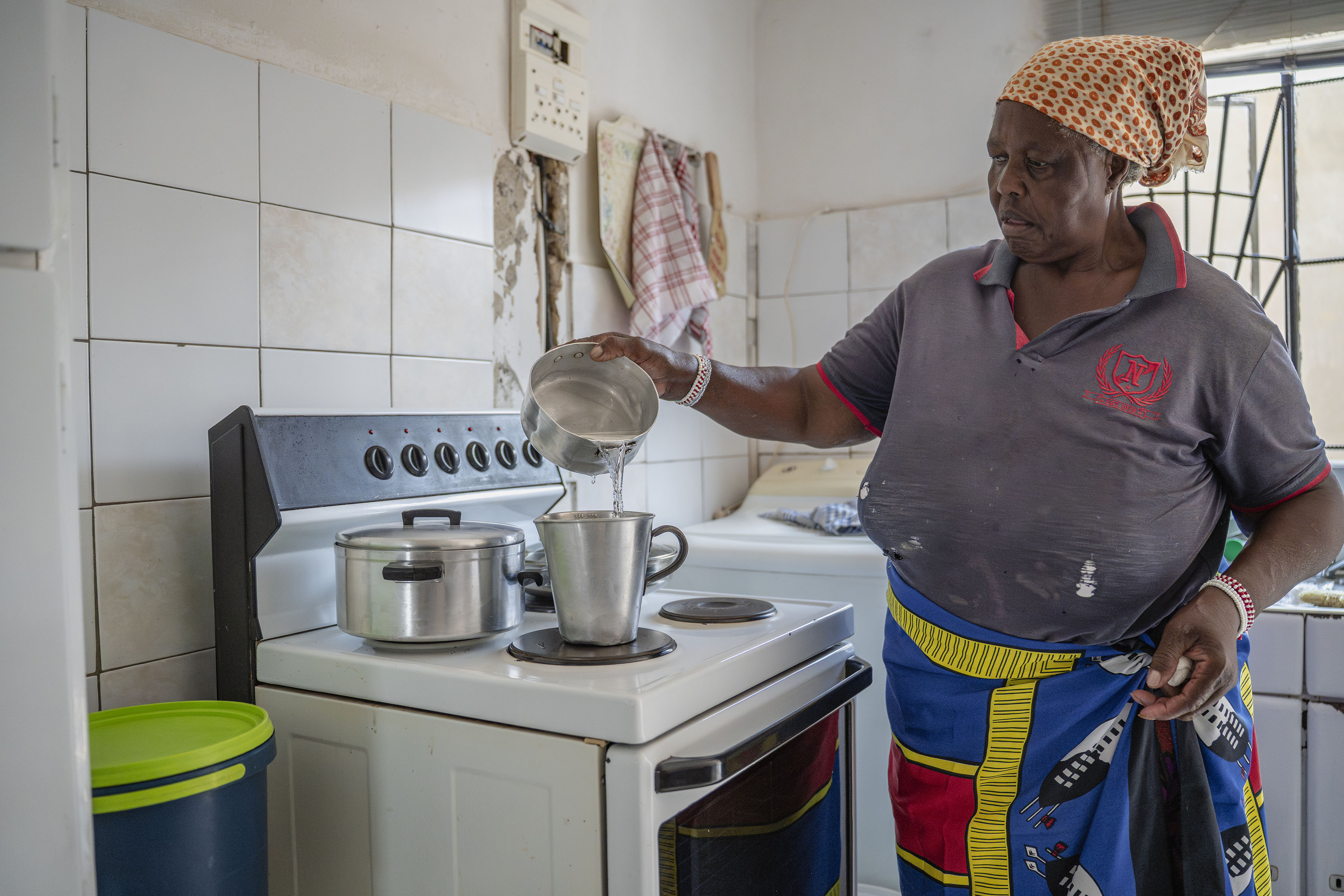
Masesi Kubheka, 67, who is diabetic, says she has to preserve water carefully for her daily needs.
Support independent journalism
Donate using Payfast

Don't miss out on the latest news
We respect your privacy, and promise we won't spam you.
Next: Durban flood victims left without power
Previous: Court blocks building along Cape Town’s Diep River floodplain
Letters
Dear Editor
The two faces of water: A critical distinction
Water is a fundamental human right, yet millions of South Africans struggle daily to access clean, affordable drinking water. In our public administration and management research across the country’s 257 municipalities, we often refer to "water" as a singular concept, without recognising its different categories. Traditionally, we distinguish between seawater and freshwater or surface water and groundwater, but this is insufficient. A more practical classification differentiates between the following:
1. Water for Use (WfU) – (Raw / Bulk water used for, amongst other things, agriculture, gardening, construction, sanitation, and household washing).
2. Water for Consumption (WfC) – (Potable water used for, amongst others, drinking, cooking, and personal hygiene).
While WfU is widely available at relatively low costs (R20 – R50 per Kilolitre, or 2 – 5 cents per litre), WfC is sold at an exorbitant R1.50 – R5 per litre — an unaffordable markup for the country’s poorest!
Private water supply enterprises, in most instances, acquire the municipality-provided raw water from the nearest water reticulation point, purify it by passing the tap-water through some combination of carbon and micron filters that help to remove chemicals, pesticides, metals like copper or lead, and foul odours and tastes, and lastly, chemical pollutants, bacteria, fungi and algae.
Is water a right or a commodity?
South Africa's Constitution (Act 108 of 1996, Section 27(1)(b)) states that "everyone has the right to have access to sufficient water." However, "sufficient water" is not explicitly defined in terms of quality or affordability. This vague wording has allowed the commercialisation of a basic human need in the country, disproportionately impacting millions of the poorest citizens.
The current government does not guarantee potable water, focusing instead on just providing raw water. This is a dangerous oversight in a developing country where over 64 million people depend on clean and safe water for use as well as drinking.
© 2026 GroundUp. This article is licensed under a Creative Commons Attribution-NoDerivatives 4.0 International License.
You may republish this article, so long as you credit the authors and GroundUp, and do not change the text. Please include a link back to the original article.
We put an invisible pixel in the article so that we can count traffic to republishers. All analytics tools are solely on our servers. We do not give our logs to any third party. Logs are deleted after two weeks. We do not use any IP address identifying information except to count regional traffic. We are solely interested in counting hits, not tracking users. If you republish, please do not delete the invisible pixel.