
Constitutional Court stops deportation of asylum seekers
Asylum seekers without transit visas may not be deported, apex court rules
 Add GroundUp on Google
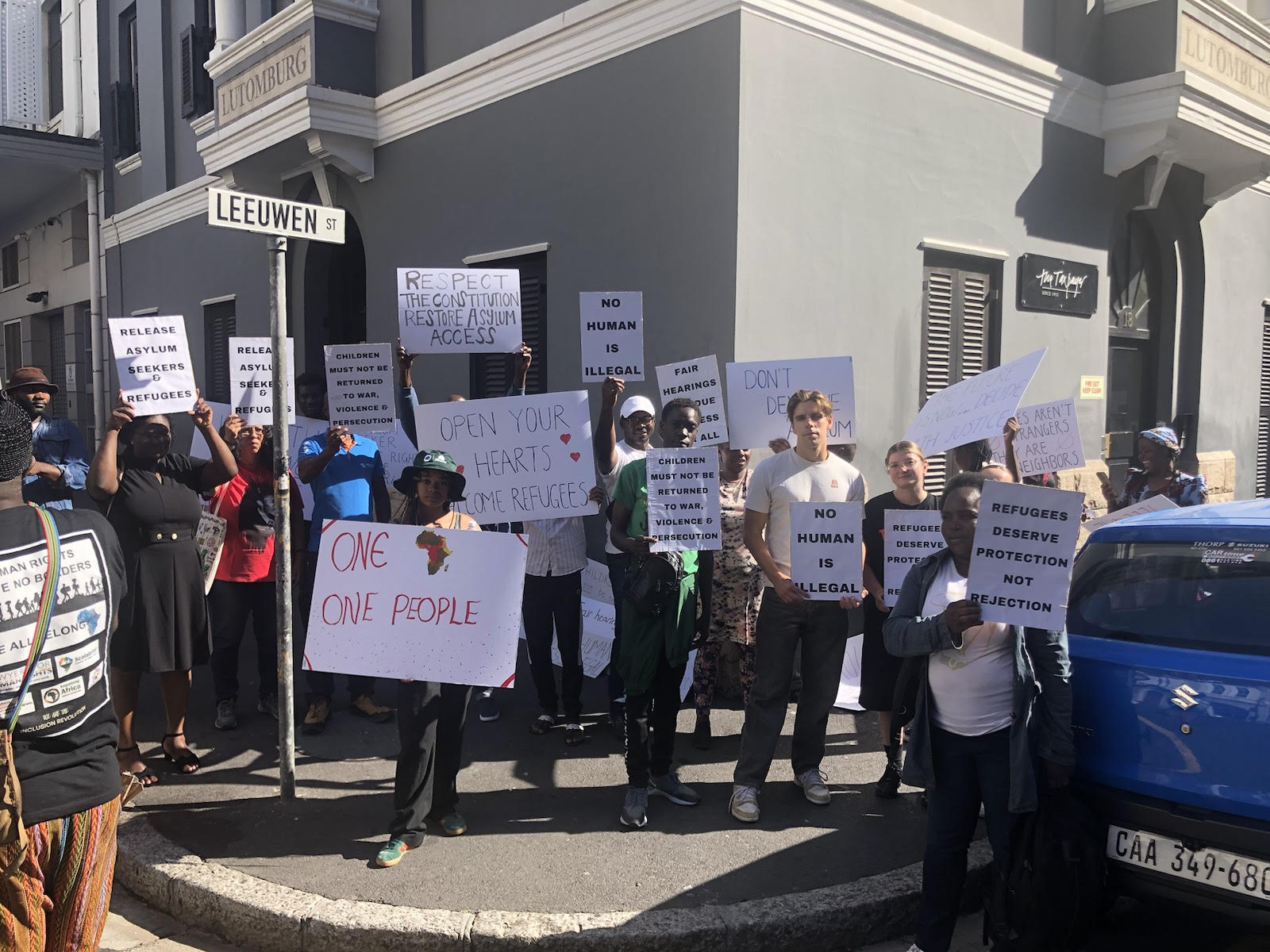
Supporters of the Scalabrini Centre of Cape Town picket outside the Western Cape High Court in February 2025. Archive photo: Daniel Steyn.
- The Constitutional Court has confirmed that sections of the Refugees Act are unconstitutional.
- Amendments to the act allowed immigration officers to deport asylum seekers who did not have valid transit visas.
- This violated the international legal principle of “non-refoulement”, the court ruled.
- The court admonished Home Affairs for litigating “extremely poorly” and making “unsupported assertions regarding Afghan and Bangladeshi nationals’ involvement in human trafficking”.
The Constitutional Court has unanimously confirmed that asylum seekers cannot be deported before they have properly accessed the asylum system.
The court declared sections of the Refugees Act, which allowed for immigration officials to deport an asylum seeker if they are in the country without a transit visa, unconstitutional. A transit visa is issued at a port of entry to allow a person to travel to a refugee reception centre and apply for asylum.
The court said the act violated the international legal principle of “non-refoulement”, which prohibits governments from sending people back to countries where they face persecution or danger.
The ruling will have immediate effect. It confirms the Western Cape High Court’s ruling last year in an application brought by the Scalabrini Centre of Cape Town.
Scalabrini had argued that the amendments to the act, which came into effect in January 2020, blocked people who did not have valid transit visas from accessing the asylum system.

Scalabrini argued that the amendments gave Home Affairs officials at refugee reception offices the “sole discretion” to determine whether asylum seekers without transit visas should be deported or allowed to proceed to the next step of the asylum seeker system.
The minister and director-general of Home Affairs opposed the application. They argued that the provisions created a “safety valve”, not an automatic bar. People without transit visas were not shut out as long as they could show valid and compelling reasons.
In the apex court’s judgment, handed down on Tuesday, Justice Steven Majiedt said that before the amendments came into effect, any person who presented at a Refugee Reception Office could enter the asylum system, regardless of whether they had initially reported themselves at a port of entry, and regardless of whether and for how long they had been in South Africa illegally.
Majiedt said the amendments had “fundamentally altered this position” by introducing “procedural filters”. It had the practical effect of preventing an asylum seeker from proceeding to a merits-based determination and exposing them to deportation if they could not give valid reasons for not being in possession of an asylum transit visa.
He said at various stages of the process, the law required the applicant to variously provide “good cause”, “valid reasons” and “compelling reasons”, but nowhere were these defined, “creating a real risk of arbitrary and inconsistent decision making”.
“All asylum seekers are protected by the principle of non-refoulement and the protection applies as long as the claim to refugee status has not been finally rejected after a proper procedure on the merits,” said Majiedt.
He said the principle could only be departed from if there were reasonable grounds to regard a refugee as a danger to state security or the community, or having been convicted of a particularly serious crime.
Majiedt said there was no justifiable basis for preventing asylum seekers from applying for refugee status “based on procedural missteps”. The respondents claim that this is only a “safety valve”, was ill-conceived, he said.
Majiedt said the sections of the Act gave unguided discretion to immigration officers.
“It also provides no consequence for having, or not having, valid reasons for not being in possession of a transit visa. This cannot be said to be advancing a legitimate purpose. It subjects vulnerable asylum seekers to yet another bureaucratic step. This is an arbitrary exercise of state power.”
The court took aim at the government respondents, saying they had “litigated extremely poorly” and “the gross laxity and disturbing ineptitude were matters of grave concern and should not be repeated”.
Majiedt said that, over and above the myriad procedural shortcomings, the respondent’s lawyers had made sweeping and unsupported assertions regarding Afghan and Bangladeshi nationals’ involvement in human trafficking in South Africa.
“Advancing such claims, particularly in the absence of evidentiary foundation, not only undermined the integrity of the State’s case but also introduced rhetoric that risks being perceived as xenophobic and racially charged.”
“This is not inconsequential. Submissions of this nature, when advanced before this court, carry the potential to shape broader societal narratives about refugees and may adversely affect the protection of their rights.”
The court ordered the respondents to pay the costs of the application.
Support independent journalism
Donate using Payfast

Don't miss out on the latest news
We respect your privacy, and promise we won't spam you.
© 2026 GroundUp. This article is published under the GroundUp Republication Licence Version 1.0. Email [email protected] to request permission to republish.