
Constitutional Court is far too slow
The apex court is well-resourced and should not have so many rulings outstanding for longer than six months
 Add GroundUp on Google
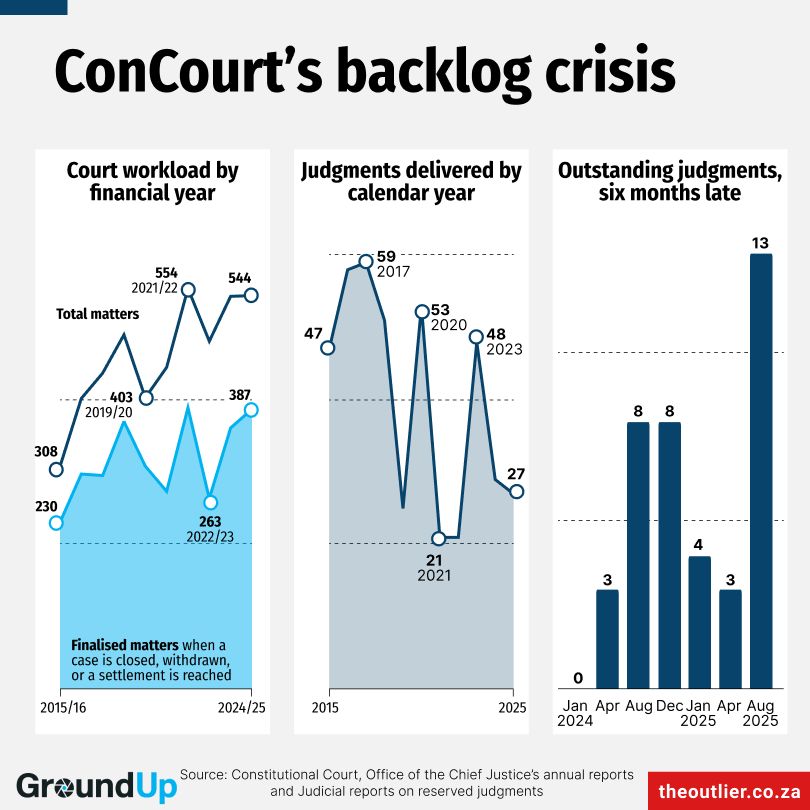
The Constitutional Court’s workload increased substantially from 2015 but began to stabilise from 2021, and has even declined a bit from its peak. Yet the number of judgments handed down appears to be gradually declining and the number of late judgments spiked to 13 in August 2025.
The Constitutional Court has become notoriously slow at handing down judgments. In August 2025, the latest month reported, 13 cases had been awaiting judgment for longer than six months. Yet the Judicial Norms and Standards state that judges should rule within three months of a final hearing.
It sets a poor example for lower courts when the country’s apex court takes so long to deliver. It’s also a problem that very important cases, like Phala Phala, which took the court 17 months to rule on, are taking so long to be finalised.
We recently explained an analysis by Freedom Under Law (FUL) of the Constitutional Court’s backlog, and what to do about it. One of the main reasons for the slowdown has been the increased workload on the court. A 2012 constitutional amendment means the court now goes beyond hearing cases that deal with constitutional issues, but also cases that raise “arguable points of law of general public importance”.

This has flooded the court with applications, many that it should not hear. Yet currently, all the court’s judges sit and decide whether or not to hear these applications, even if they have no chance of success.
But the increase in applications isn’t sufficient to explain the court’s backlog and slowdown. Applications peaked in 2021/22. Yet, as the The FUL report states: “[T]he number of cases in which the court has set matters down for hearing and given written judgment has reduced substantially since 2022.”
There may be a good reason for this, says the FUL report: “[T]he reduction in the number of cases heard by the Court may be the result of a deliberate effort to reduce its workload, by being more selective about the new applications it chooses to hear, possibly in recognition of its capacity constraints.”
Nevertheless, this cannot explain the spike in late rulings or that there are any late rulings at all.
The FUL report discusses several recommendations for remedying this situation. For example, compelling applications to stick to strict limits and formats so that the judges’ time isn’t wasted. But there is also, what the report tactfully refers to as “inefficiency” with the court itself:
“Various potential causes of the court’s inefficiency have been identified. They include: insufficient or diminished judicial capacity; the court disposing of all matters in all respects [with all the judges sitting]; and matters before the court growing more complex, with a greater body of jurisprudence to consider. Concerns have also been raised about whether judicial appointments to the court have been up to the necessary standard, a problem which has been exacerbated by long delays in filling permanent vacancies – it has been a decade since the court last had a full complement of permanent judges.”
Well-resourced
Constitutional Court judges have at least two interns, usually top students freshly graduated from the country’s law faculties. There are also about a dozen international interns, also highly competent lawyers. In other words, there are at least 40 lawyers in the court, all of whom should be excellent at their jobs. The court also has the finest law library in the country, with highly proficient staff. The court’s judges have a salary package worth over R2.7-million a year. Their pensions are especially generous compared to most civil servants.
The court is, in other words, very well-resourced, and its judges are well remunerated. That the court is unable to deliver its judgments on time strongly suggests that management of the court needs to improve and some of the judges need to work more efficiently. Most importantly, there needs to be decisive leadership from the Chief Justice and her deputy.
Chart produced by The Outlier in partnership with GroundUp
Support independent journalism
Donate using Payfast

Don't miss out on the latest news
We respect your privacy, and promise we won't spam you.
© 2026 GroundUp. This article is published under the GroundUp Republication Licence Version 1.0. Email [email protected] to request permission to republish.