
The high cost of negligence in the public health system
Billions of rands are paid out every year in legal claims
 Add GroundUp on Google
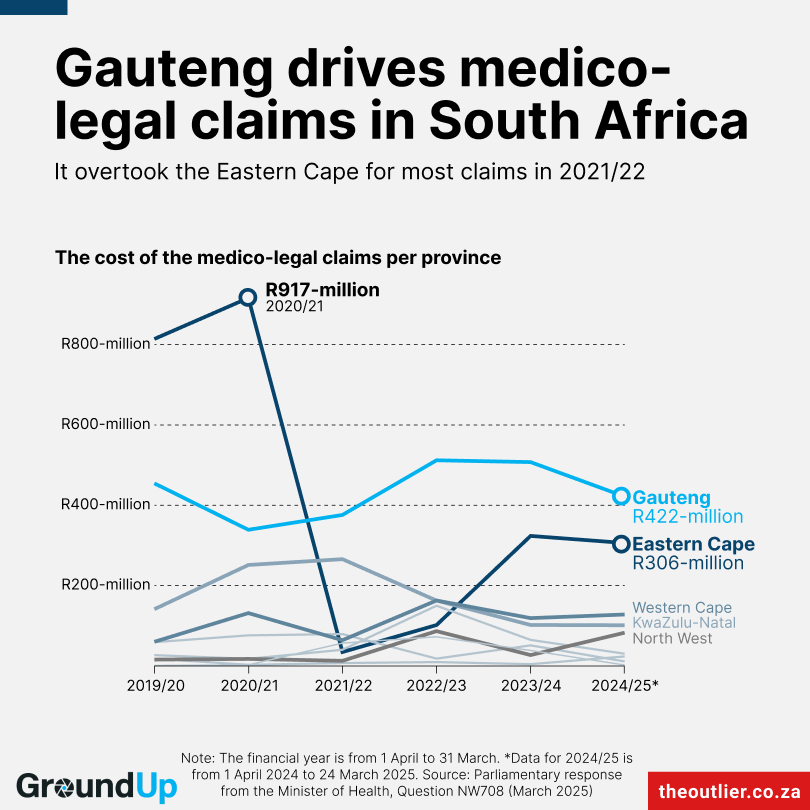
Claims against the state for medical negligence were about R62-billion, more than 20% of the public health budget, as of March 2024. But ultimately only a fraction of claims get paid, because many claims are settled for lower amounts and many have no realistic chance of success. Chart produced by The Outlier in partnership with GroundUp.
- Medical negligence claims against the state ballooned from 2014 to the 2020s.
- But after a concerted effort by the state to contest claims, negligence claims and payouts on claims have dropped sharply.
- Nevertheless, the “contingent liability” — an accounting term for the total amount of claims against the state — is over 20% of the health budget.
- An attempt by the state to replace lump-sum payouts to patients with payments of their medical costs as they arise, was recently rejected by the Supreme Court of Appeal.
Payouts by provincial health departments for damages as a result of negligence have come down sharply in the last few years. But billions of rands are still paid out each year in legal claims.
The claims largely stem from cases involving obstetric injuries, including cerebral palsy, from orthopaedic surgery and from trauma-related incidents.
From about 2014 until the early 2020s, negligence claims against the state ballooned. By March 2020, the total value of claims (not payouts) against the state amounted to 45% of public health spending for the year, threatening the capacity of the provincial health departments to provide proper care. But after a concerted effort by the state, negligence claims and payouts on claims have dropped sharply.
Payouts of negligence claims decreased from R1.8-billion in 2019/20 to R1.5-billion in 2023/24, according to the National Treasury. In 2024/5, the government paid out R1.1-billion in negligence claims,health minister Dr Aaron Motsoaledi said, answering a parliamentary question in March last year.

But while actual payouts are falling as the state successfully contests more claims, the value of claims against the state is still very high. Only a fraction of claims are paid out; many claims are reduced upon settlement and many have no realistic chance of success. (Claims take years to be finalised in the court system, and claimants and the state incur huge legal costs.) But the state still has to take into account that claims may succeed, and to account accordingly. As of 31 March 2024, this “contingent liability” amounted to R62-billion, over 20% of the public health budget.
In a recent case, the Supreme Court of Appeal (SCA) ruled that damages for future medical expenses must always be paid as a lump sum, rejecting an attempt by the Eastern Cape health department to provide ongoing treatment instead, a model sometimes referred to as a “voucher system”.
The case involved a child born in 2011 who sustained severe disabilities due to negligence at birth. The Eastern Cape MEC for Health argued that the child could be treated within the public health system at a lower cost, and that large lump sum payouts were placing unsustainable pressure on provincial budgets.
The high court in Bhisho had initially agreed, ordering the department to provide treatment rather than pay damages. But the SCA overturned this decision.
In a unanimous judgment, the SCA reaffirmed the long-standing “once and for all” rule, which requires that damages, both past and future, be paid in a single lump sum.
In an expert opinion offered to the court on behalf of the department, economist Andrew Donaldson warned that because the state has to take into account the possibility that claims will succeed, “the rise in medical negligence claims against the state represents a threat to the capacity of the state to provide and improve health service delivery”.
“On present trends, the annual increase in claims against state health departments already exceeds the real (after inflation) increase in resources available for health service delivery, and will soon exceed even the nominal annual increase in resources.”
In a paper on the liabilities of the provincial departments Zeenat Emmamally, a legal researcher at the Helen Suzman Foundation, wrote that “large awards of compensation cannot accurately be budgeted for because they are unpredictable and case-specific, leaving health departments to scramble to reallocate funds from their budgets to pay such claims”.
“As a consequence, money is diverted away from the delivery of healthcare services, causing facilities to be consistently under-funded and resulting in even more claims of medical negligence.”
Donaldson suggested in the SCA case that a system where costs are paid as they arise would better align with how public finances are managed and solve the problem of estimating future needs.
He said this would “bring the court system into sync with the way the budgetary and appropriation of funds systems operate” and allow the state to “better match its actual expenditure to needs and to adapt those commitments over time if needed”. Moving to a pay-as-you-go basis would prompt parties to settle claims sooner, he said.
Paying claims over time rather than upfront would help protect the state’s ability to deliver services, given existing fiscal constraints and rising medico-legal costs, he said.
Upfront settlements might still be appropriate in certain instances, but a flexible, needs-based approach could help balance compensation with the state’s broader service delivery responsibilities, Donaldson said.
But Justice Ashton Schippers, writing for the SCA, warned against “drastically” changing established legal principles, saying such reforms should be left to the legislature.
The court also found that shifting away from lump sum payments would create uncertainty for patients and could expose them to the risk of inadequate care in a public system that had already failed them.
Support independent journalism
Donate using Payfast

Don't miss out on the latest news
We respect your privacy, and promise we won't spam you.
Next: Homeless people tell their story in new Mike van Graan play
Previous: Sunday Times editor Makhudu Sefara placed on “special leave” after SIU announces investigation
© 2026 GroundUp. This article is published under the GroundUp Republication Licence Version 1.0. Email [email protected] to request permission to republish.