
Thousands march in Cape Town for freedom in Palestine
More than 74,000 Palestinians have been killed since 2023
 Add GroundUp on Google
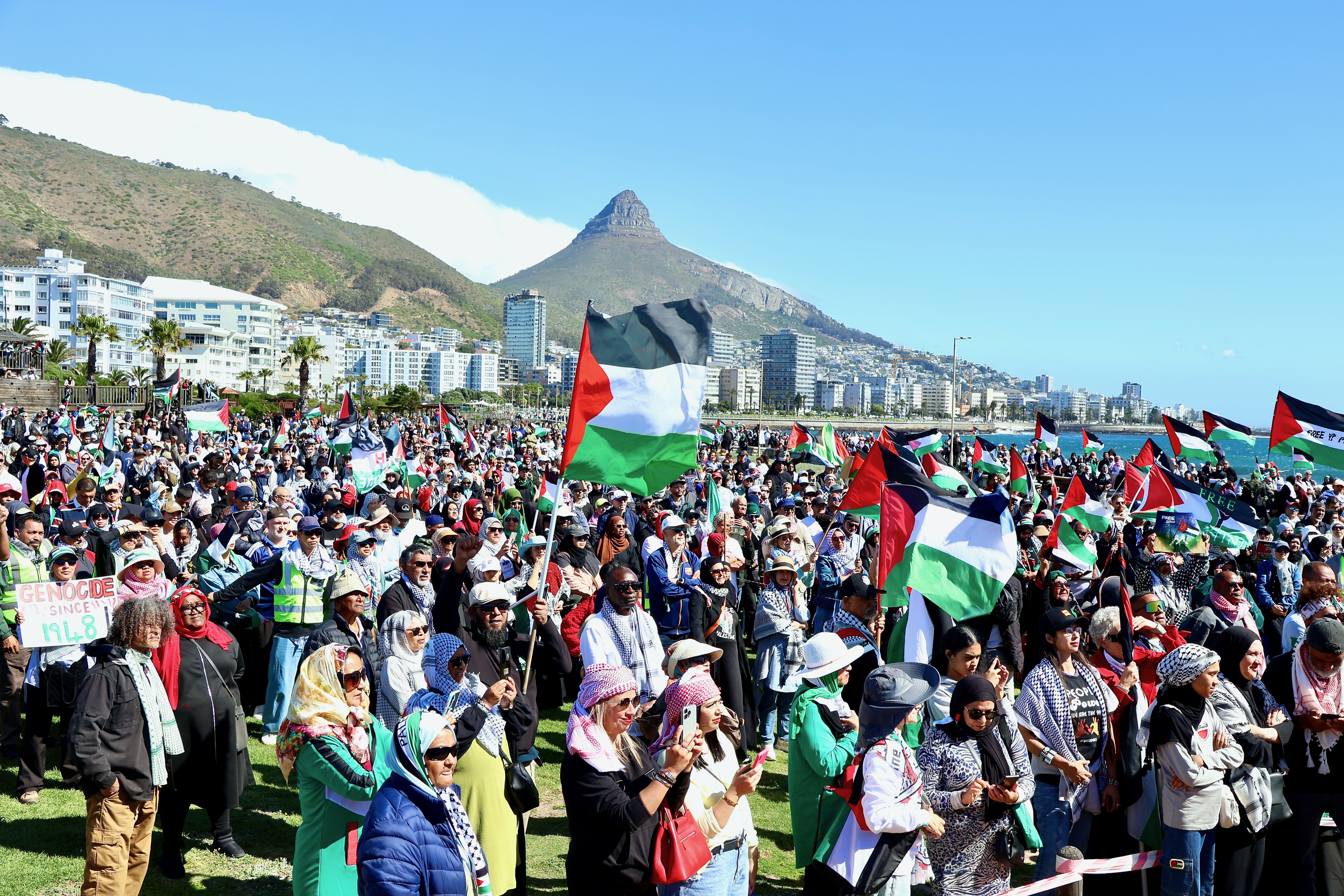
Thousands of people marched along the Sea Point promenade on Saturday, in a peaceful protest demanding an end to Israel’s war on Palestine. Photos: Matthew Hirsch
In probably the biggest pro-Palestine march in at least a year, thousands of people marched along the Sea Point promenade on Saturday afternoon, calling for an end to genocide in Gaza.
They carried placards and chanted “Free, free Palestine” and “Sudan, Congo, Palestine … An end to all genocide”.
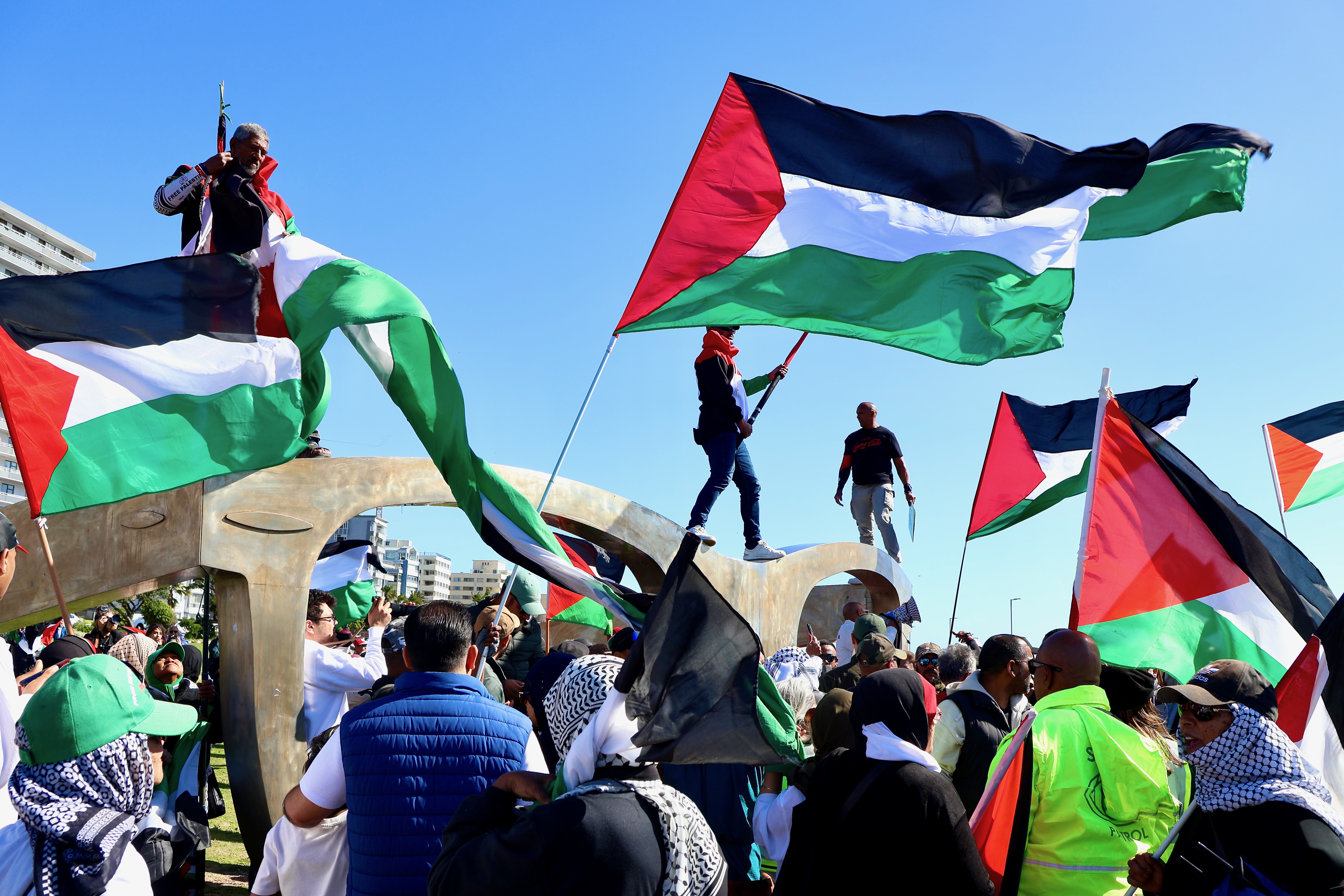

The march started at the lighthouse and ended at Mandela’s glasses.
The event was organised by the Palestine Solidarity Campaign (PSC). “We have seen more than 1,000 days in which Palestinians have walked among the ruins of their homes,” said PSC chairperson Jaamia Galant. “Clutching their exhausted bodies and the torn limbs of their children. Facing hunger, thirst and freezing cold. In the longest trial of humanity’s failing conscience.”
More than 74,000 Palestinians have been killed in the last three years, including more than 20,000 children.
“For Palestinians who live in Gaza and the West Bank today, their very existence is the ultimate act of resistance,” she told the crowd. She said Israel is also committing genocide in the West Bank.
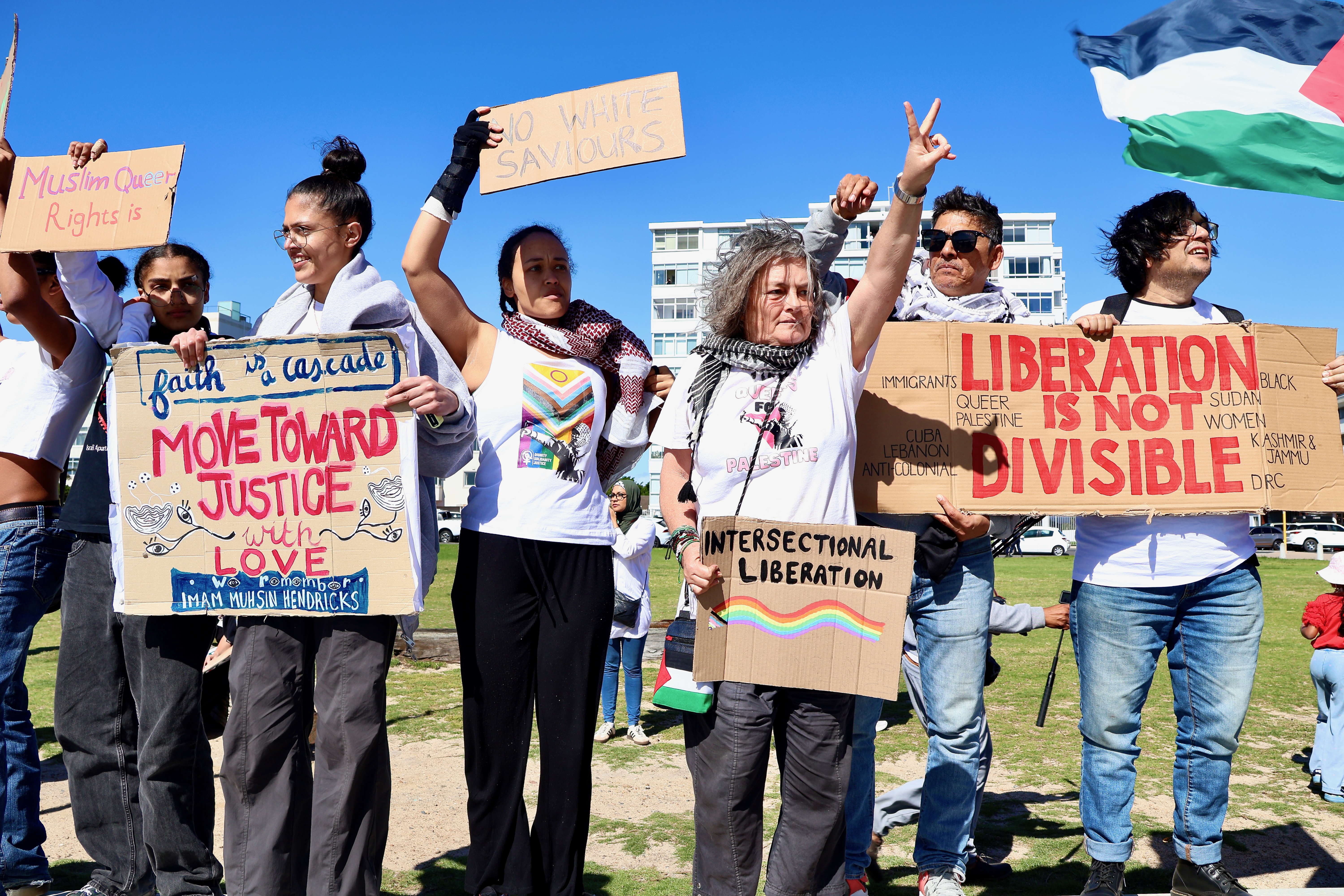
Megan Choritz from SA Jews For a Free Palestine takes part in a small side protest emphasising queer rights and inclusivity.
“We are just days away from entering the fourth year of genocide,” said Sharif Moosa, a Palestinian journalist based in Cape Town. “And you still see people have the audacity to come to you and ask you what about October 7th? Well, what about 100 years of colonisation? Of a British and Israeli occupation? What about the Nakba?”
He said marches like this one remind him of his grandmother, who was forced to leave Palestine in 1948.
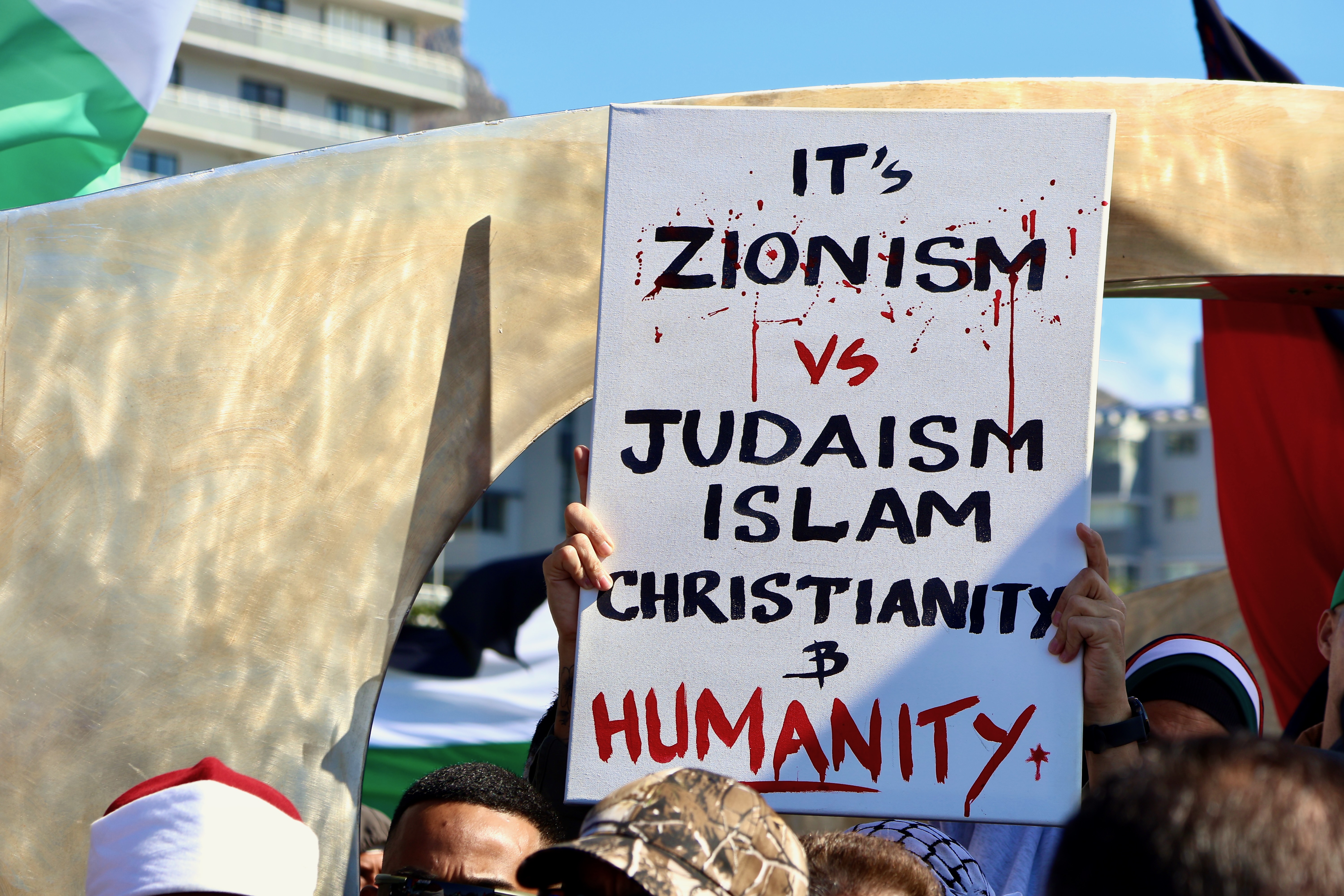
One of the placards seen at Saturday’s march.
Before the march, organisers emphasised that they condemn all forms of hate speech, including “xenophobia, homophobia and antisemitism”.
British politician and broadcaster George Galloway also spoke. “The winds of change are blowing. Israel has never been so hated as it is today. Palestine has never been so loved as it is today,” he said.
The march was also supported by several political parties: the ANC, PMC, EFF, Al-Jama-ah and the newly formed One Love Alliance.
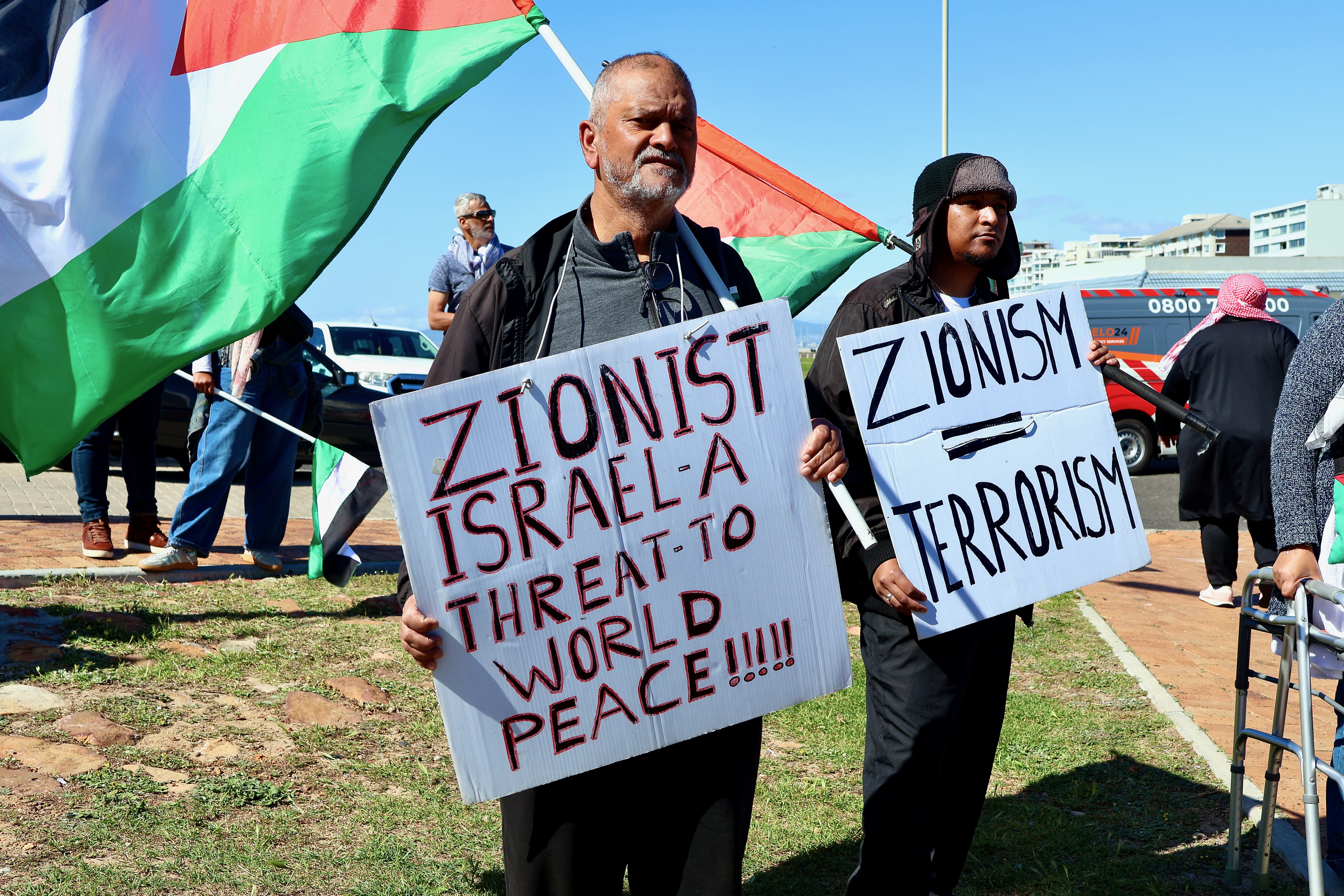
Marchers condemned Zionism.
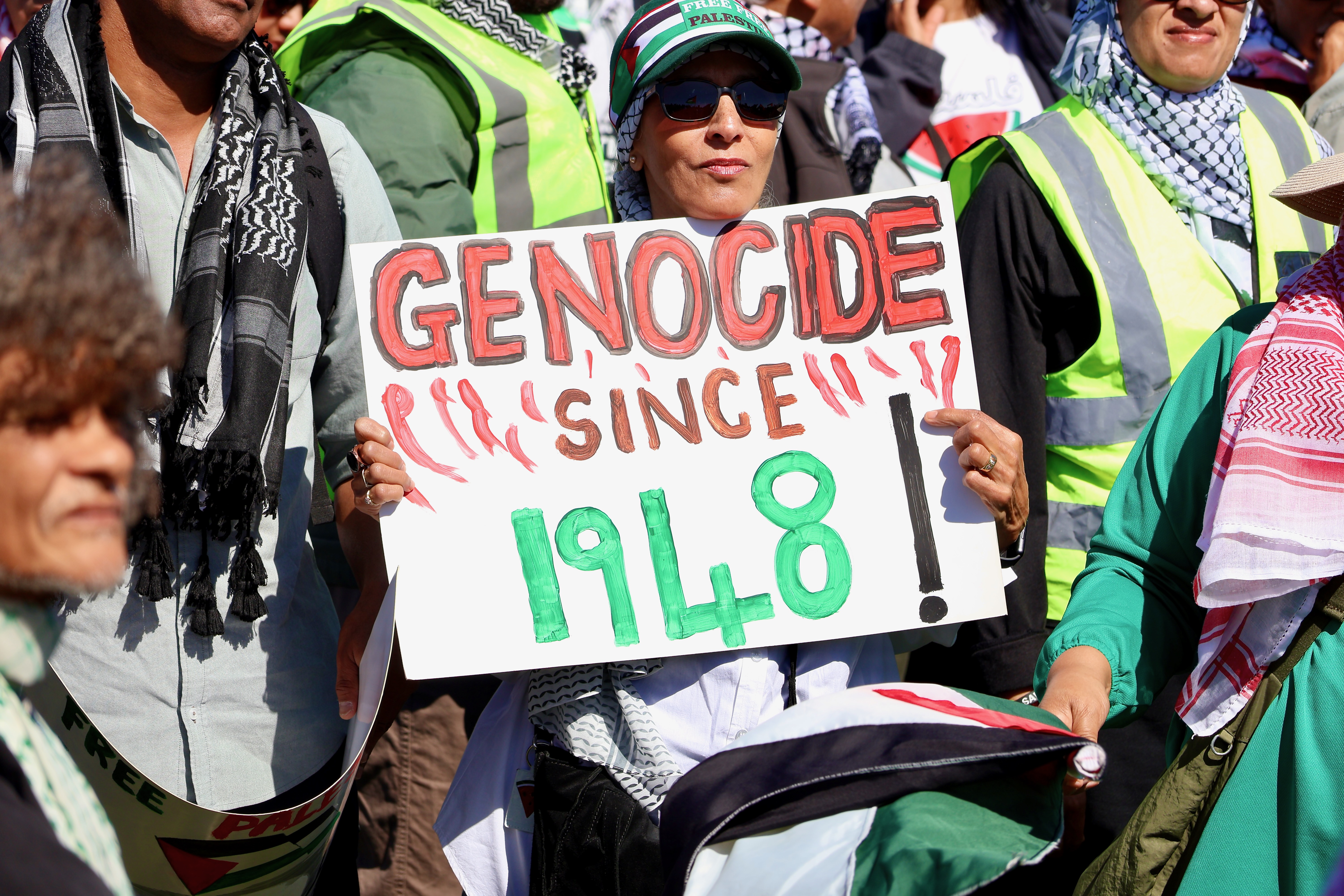
A sign refers to the 1948 Palestine war.
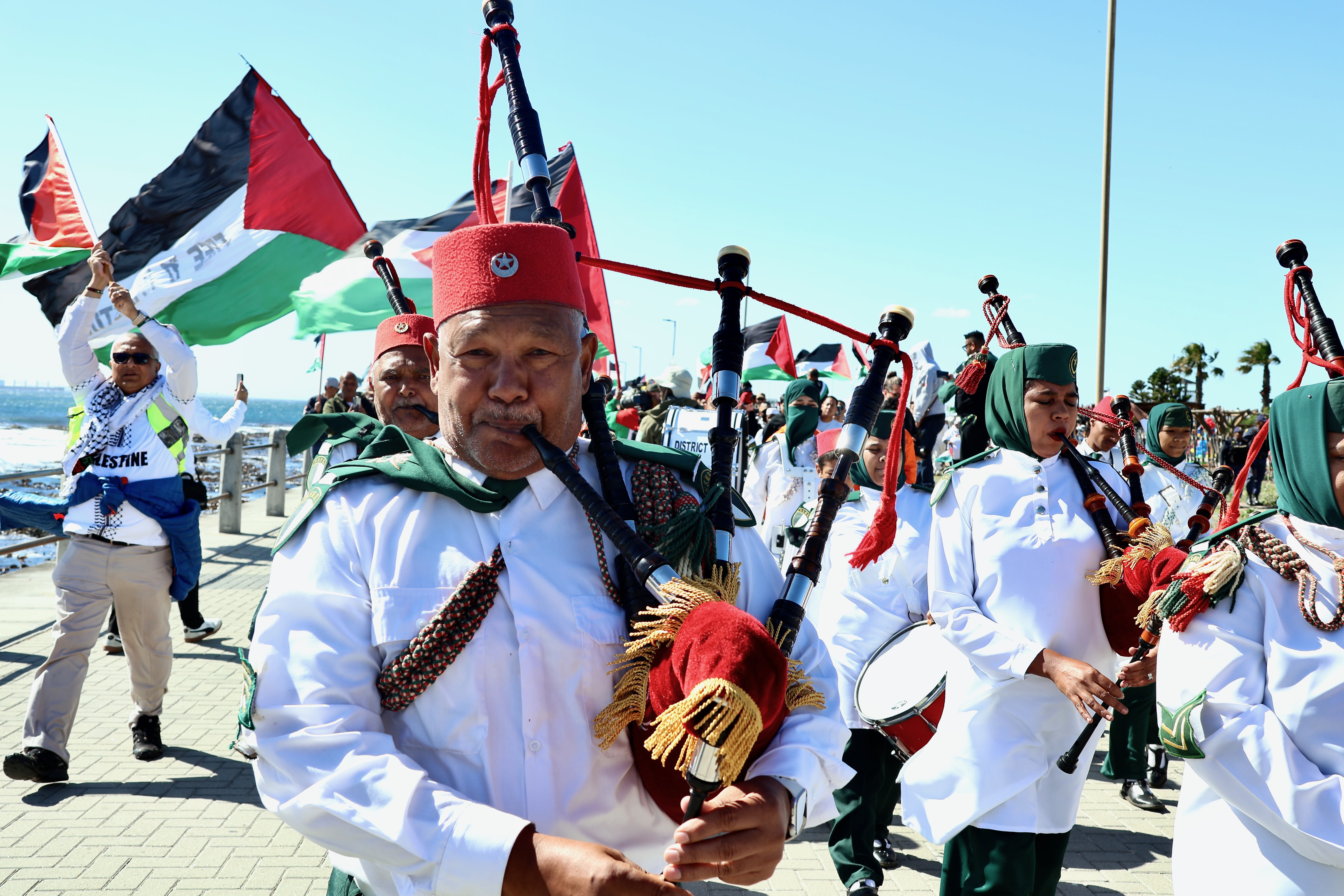
The marchers were led by the Habibia Siddique Muslim Pipe Band.
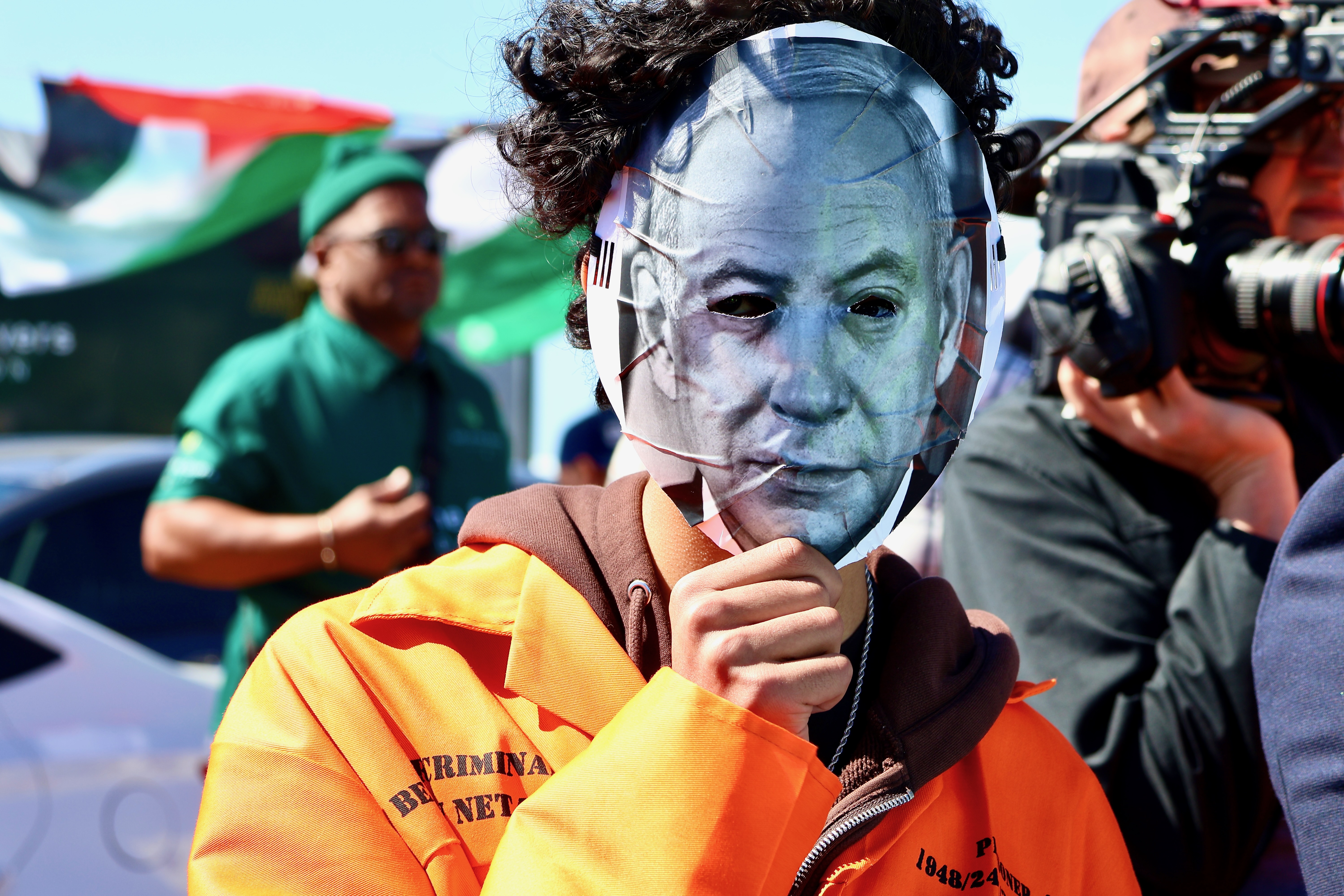
Someone wears an orange prison jumpsuit and a mask of Israeli prime minister Benjamin Netanyahu. In November 2024 the International Criminal Court issued a warrant for Netanyahu’s arrest on charges of war crimes and crimes against humanity in Gaza.
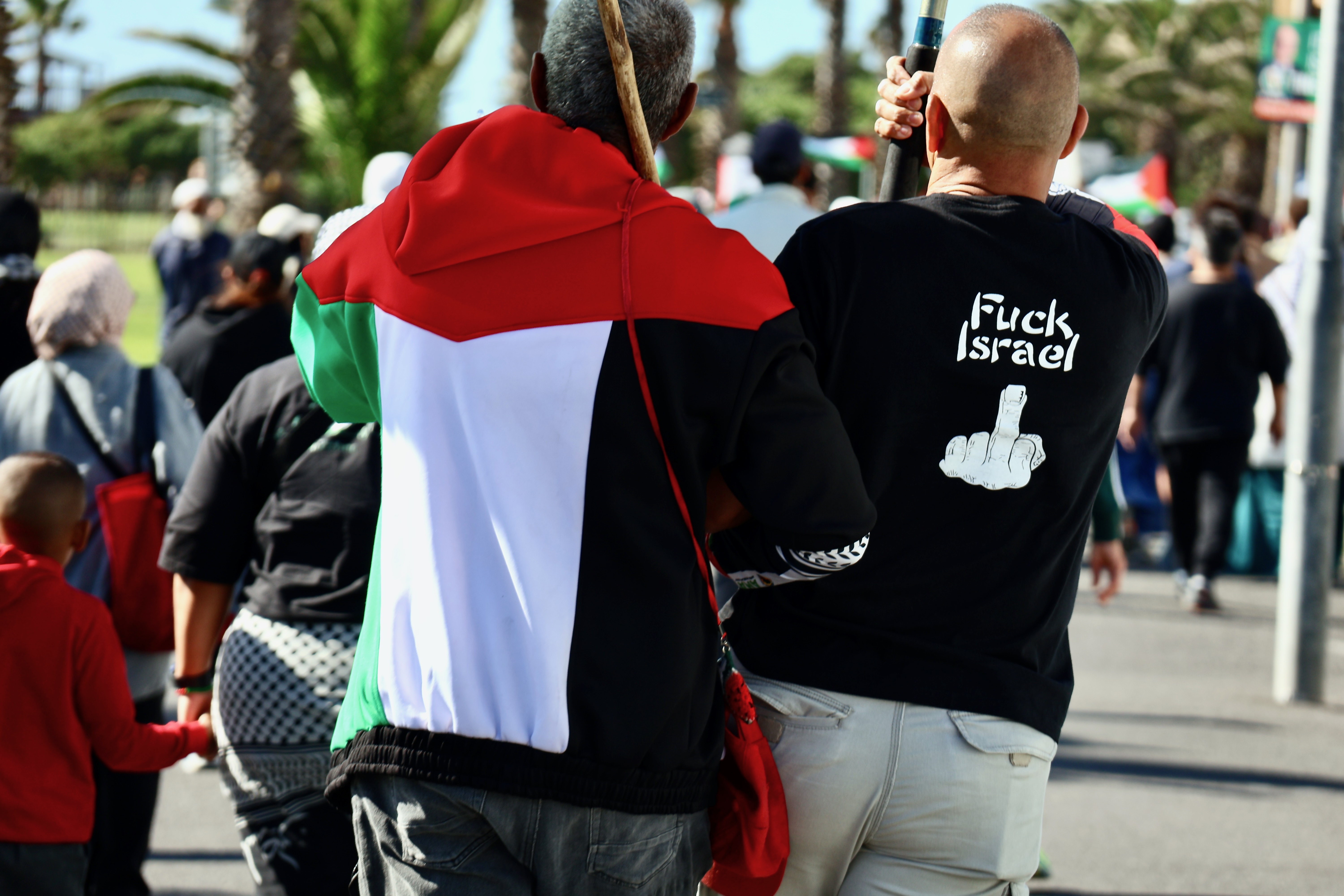
A provocative t-shirt at Saturday’s march.
by GroundUp Editors
The struggle for Palestinian rights has mobilised people across the world, perhaps like no other political movement since the fight against apartheid. At last there is an increasingly loud global call for Palestinian people to have freedom of movement, be liberated from state repression, not to be subjected to genocide and to have a state. Saturday’s rally that gathered thousands to demand freedom for Palestine is testament to this.
Recent satellite images show how 82% of structures in Gaza have been damaged, mostly destroyed. In the past three years, 74,000 people have been killed in Gaza including more than 20,000 children. Daily, the Sumud Network reports the atrocities committed by settlers in cahoots with the Israel Defense Forces against villagers in the West Bank. Settlers invade Palestinian farmland, steal their harvests, assault people and occupy their homes, supported by soldiers. Frequently Palestinians, often teenagers, are shot dead, such as 19-year-old Bahaa al-Natsheh on Friday. Over 80 Palestinians have been killed in the West Bank this year. Nearly 1,400 have been killed in Gaza since the ceasefire in October last year. The need for urgent global action is indisputable.
In South Africa, the Palestine Solidarity Campaign (PSC) has been at the forefront of the movement for Palestinian freedom.
George Galloway was billed as one of the main speakers at Saturday’s rally in Cape Town, and the PSC has hosted Galloway at several other events in recent days.
Galloway has supported various authoritarian regimes, including in Syria, Iraq and China. He lives in Russia and supports the Russian autocrat Vladimir Putin, who he has described as the most popular politician on the planet. He promotes Kremlin propaganda on Russia’s invasion of Ukraine, an act in violation of international law that has led to the deaths of hundreds of thousands of people.
He has aligned himself with Iran’s repressive government, has worked for its state broadcaster Press TV and accepted an award in Tehran in 2025 (before the US and Israel’s illegal war on Iran), where he praised then Supreme Leader Ayatollah Ali Khamenei. Controversially, he has donated to Hamas and supported Hezbollah.
He has been disrespectful to gay and trans people, which is at odds with the South African Constitution.
If Galloway wishes to take part in a pro-Palestine rally, he should feel free to do so. Successful movements unite people across political divides. Often at pro-Palestinian rallies, including those organised by the PSC, there is an impressive diversity of people and views. But the decision of the PSC to give him the main platform at their protest shows disrespect for human rights and international law, which are key to realising the rights of Palestinian people.
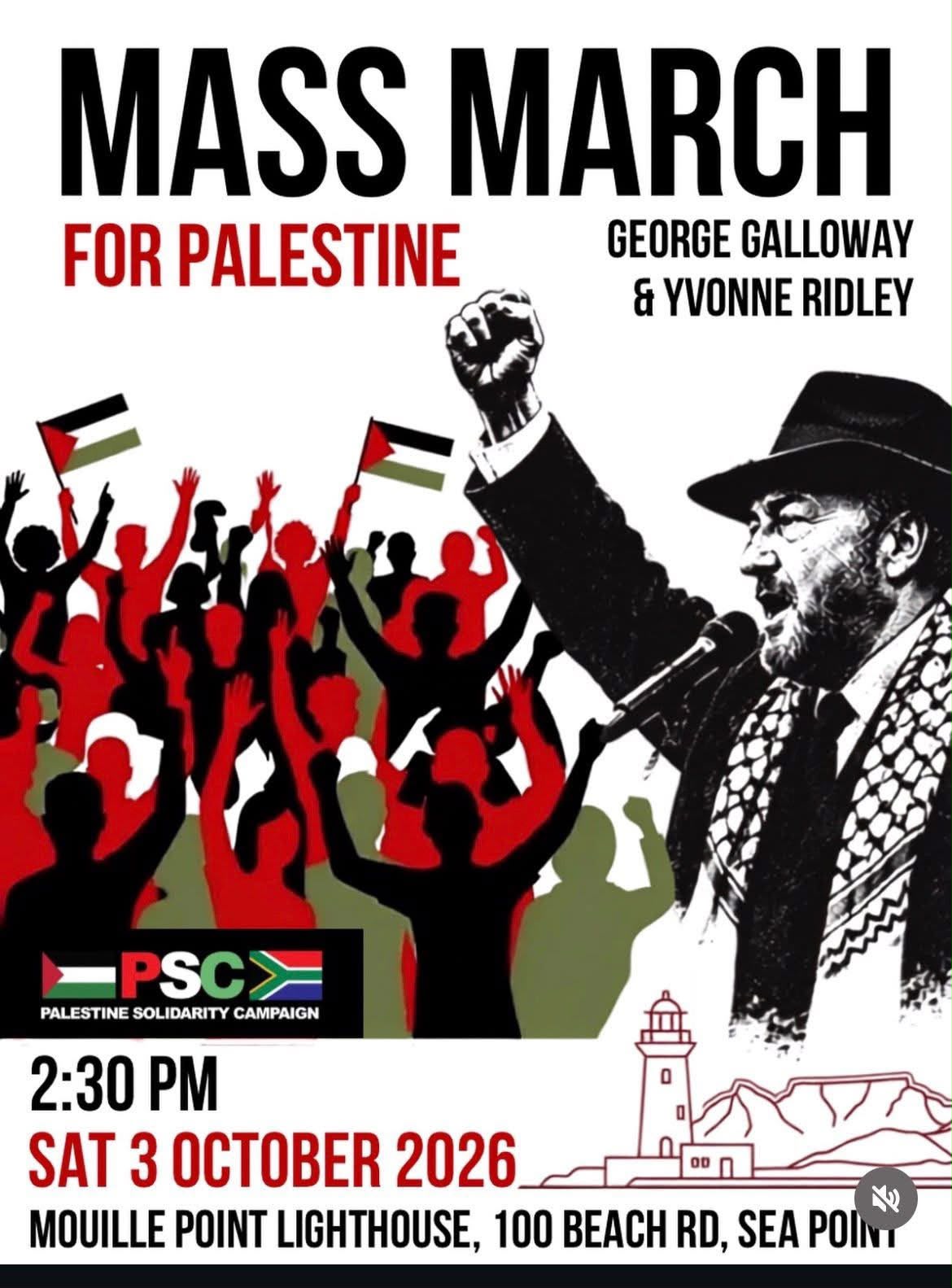
Poster distributed by PSC on social media.
Support independent journalism
Donate using Payfast

Don't miss out on the latest news
We respect your privacy, and promise we won't spam you.
Next: Elections 2026: this village in the Langkloof orchards is strewn with rubbish
Previous: Rubber bullets fired at Rhodes graduation ceremony
Letters
Dear Editor
In its recent article, Thousands march in Cape Town for freedom in Palestine, by Matthew Hirsch on 3 October 2026, GroundUp appended an editorial focused on one of the speakers, George Galloway, a prominent British politician and Palestine solidarity campaigner. We are not aware of any previous occasion on which GroundUp has appended an editorial of this kind to a news
report. The editorial is headed Editorial: We cannot support George Galloway. As the organisers of the march and mass rally, we at no point sought the support of GroundUp, or of any media organisation, for Galloway or any other participant for the event. We invited all media to a press conference with Galloway and journalist Yvonne Ridley in Cape Town on Wednesday 30 September. GroundUp chose not to attend and therefore did not put those criticisms to Galloway when it had the opportunity.
Thousands of people marched through Cape Town in solidarity with Palestine. That was the event. They marched because of Gaza, because of the continuing destruction, and because of the broader Palestinian cause. Yet GroundUp chose to append to its report an editorial attack on Galloway, one of the speakers, thereby shifting the focus from the march and its purpose to its
own objections to a particular individual.
GroundUp is perfectly entitled to criticise Galloway. His record, views and associations are legitimate subjects for scrutiny, and an editorial devoted to them would have been entirely proper. But that is precisely what it should have been: a separate editorial. By attaching it to coverage of the march, GroundUp invites the reader to view the event itself through the prism of
its hostility to one speaker.
That is a serious conflation. The thousands who marched were not endorsing every statement that Galloway, or any other participant, has made over decades in public life, nor were they marching in support of his views on Russia, Syria, Iran or anything else GroundUp chose to catalogue. They were marching for Palestine, against the genocide in Gaza, the occupation and the apartheid practised by Israel. Yet by placing that catalogue immediately alongside the march, GroundUp effectively saddles the demonstrators with every cause, association and position it attributes to Galloway. It is guilt by association, and it leaves the march and the PSC having to answer for matters that had nothing to do with why thousands of people were in the streets.
The placement also matters journalistically. GroundUp labels the section an editorial, but a label does not erase the effect of attaching it to the news report. The reader moves directly from coverage of a mass demonstration into the publication's case against Galloway. GroundUp has thus placed its objections to one speaker directly alongside the event itself, so that those
objections inevitably colour the way the march is presented.
There is an agenda at work in that framing, whether GroundUp wishes to acknowledge it or not. GroundUp could have reported the march on its own terms and then, separately, challenged Galloway as vigorously as it pleased, including at the press conference to which it was invited. Instead, it chose to use the report on Palestine as the vehicle for that argument. In doing so, it made its quarrel with Galloway part of the reader's understanding of the march.
That is precisely why the placement of the editorial is objectionable. By attaching to its report, a catalogue of allegations about Galloway's positions on Syria, Iran, Hamas and Hezbollah, GroundUp did more than criticise one speaker. It invited readers to transfer those associations to the PSC and to the thousands of people who marched for Palestine. The effect was to taint the
march by association rather than report it on its own terms.
GroundUp’s decision to graft an editorial attack on Galloway onto its report of the march was more than poor editorial judgment. It is a shabby way of inserting an ideological rebuke into what purports to be reporting and then allowing that rebuke to hang over thousands of people who came out for Palestine. GroundUp was free to write whatever it wished about Galloway in a separate editorial. What it should not have done was use him to tarnish the PSC and the march itself. If it was prepared to publish that editorial alongside the report, it should also publish this response.
© 2026 GroundUp. This article is published under the GroundUp Republication Licence Version 1.0. Email [email protected] to request permission to republish.