
Tongaat: A ticking time bomb set to go off in April
The company’s mills must open soon for the sugarcane harvest, but its bank accounts are frozen
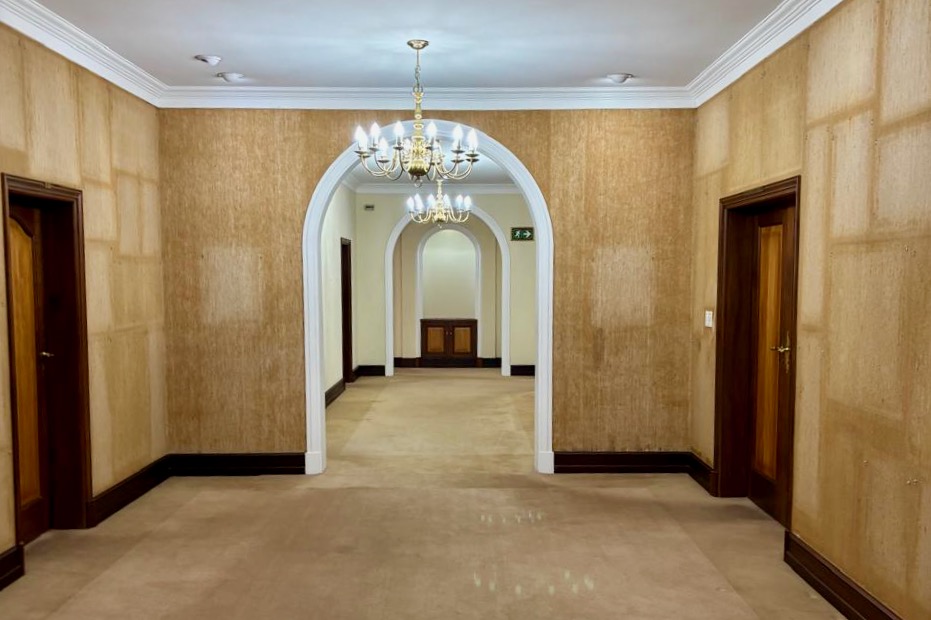
Tongaat head office stripped of expensive paintings and antiques ahead of a possible visit by liquidators. Photo supplied
- Tongaat Hulett has two critical deadlines in April: The liquidation hearing and the opening of its mills for the harvest season.
- But the company’s bank accounts are frozen after its business rescue practitioners filed for liquidation.
- The livelihoods of 27,000 small-scale and 1,100 large-scale growers and their workers are at stake.
The clock is ticking for embattled sugar giant Tongaat Hulett and the hundreds of thousands of people who depend on it. The company has two critical deadlines looming in April: the opening of its mills, and a court case to determine whether the company is placed in provisional liquidation.
The winding up application, brought by business rescue practitioners (BRPs), will be argued in the Durban High Court on 16 and 17 April.
Unless the matter is resolved by consent, judgment might be reserved for weeks or even months.

In the meantime, sugarcane – which must be processed soon after harvesting – needs to be delivered to Tongaat’s mills. But most of the company’s bank accounts have been frozen because the liquidation application.
Thomas Funke, CEO of SA Canegrowers, which represents 27,000 small-scale and 1,100 large-scale growers, told GroundUp: “Although there is still hope that a negotiated solution may be found to avoid liquidation completely, we are also hoping to ensure that if a liquidation does proceed, it would at least be a funded liquidation which would allow operations to continue.”
As of this moment, Tongaat Hulett’s mills and refinery are in an operational condition, he said. “The mills were being prepared for the 2025/26 season when the application for provisional liquidation was lodged by the business rescue practitioners.”
“All parties involved understand what is at stake should Tongaat Hulett face an unfunded liquidation or even temporary stoppage of work: the majority of South Africa’s small- and large-scale sugarcane growers will immediately lose market access, leading to devastating income and job losses in rural KwaZulu-Natal.
“With a little over a month to go until the liquidation hearing, everything is being done to avert such an outcome,” said Funke.
The liquidation application is being opposed by several parties, including the canegrowers, Minister of Trade and Industry Parks Tau and the Industrial Development Corporation (IDC), which provided R2.3-billion in post commencement funding.
Questions have been raised about the conduct of the BRPs, including the fees charged over their three-year appointment, and how the Vision Group could scupper the preferred rescue plan, triggering the present crisis.
The Vision Group acquired the loans held by the lender group, making it the controlling creditor and effectively giving it the voting power to approve its own rescue plan.
Late last year, the BRPs approached the IDC for a further R600-million to tide the company over until the Vision deal was concluded. But the IDC said Vision should contribute at least R200-million.
Vision refused. The rescue plan lapsed and the company entered the current crisis.
Some creditors have questioned the legality of the lender group transaction with Vision. They are demanding a full investigation, amid allegations that Vision may not have paid for the loans. They also believe that the transaction had not been legally concluded when the business rescue plan was voted on in January 2024.
In their latest affidavit, however, the BRPs maintained they acted lawfully throughout the process.
They said while they are aware of the potentially devastating consequences of liquidation, their options are limited. They added that although the IDC expressed “speculative optimism”, it had not committed to providing more funding.
“The objective facts are that the adopted plan has failed, sale agreements have lapsed, the conditions have not been fulfilled.”
“Vision has refused IDC’s proposals and has issued a demand for the payment of R11.7-billion [the lender group claim],” BRP Gerhard Albertyn said in his latest affidavit.
“The IDC portraying itself as the proverbial ‘white knight’, is nothing more than smoke and mirrors. At the time of deposing to this affidavit, there is no funding that will enable the company to conduct business, even in business rescue, beyond the end of this month.”
Albertyn said the BRPs had considered the consequences of liquidation. But, he said, there were no reasonable prospects of rescue.
The BRPs blame Vision for their failure, which they say undermined the rescue plan by introducing new conditions, such as reforms to the sugar industry.
Vision, they noted, is neither opposing nor supporting the liquidation application. Yet as the controlling creditor, its co-operation was essential to any restructuring if the company were to continue in business rescue.
“Only a few hours prior to me deposing to this affidavit … Vision continues to frustrate genuine ongoing efforts by the BRPs to responsibly manage Tongaat’s affairs,” Albertyn said.
Responding to the minister’s affidavit, Albertyn said Tau’s intervention would have been “more constructive and certainly welcome” had it come before the liquidation application was launched.
Support independent journalism
Donate using Payfast

Don't miss out on the latest news
We respect your privacy, and promise we won't spam you.
Next: Langa learners escape the heat in their “pocket forest”
Previous: Eastern Cape pensioners must give back the road grader they seized, court rules
© 2026 GroundUp. This article is licensed under a Creative Commons Attribution-NoDerivatives 4.0 International License.
You may republish this article, so long as you credit the authors and GroundUp, and do not change the text. Please include a link back to the original article.
We put an invisible pixel in the article so that we can count traffic to republishers. All analytics tools are solely on our servers. We do not give our logs to any third party. Logs are deleted after two weeks. We do not use any IP address identifying information except to count regional traffic. We are solely interested in counting hits, not tracking users. If you republish, please do not delete the invisible pixel.