
Tongaat Hulett liquidation avoided after government provides R200-million lifeline
Last-minute funding deal allows the struggling sugar giant’s mills to open for the season, buying time for more than 18,000 KZN canegrowers
 Add GroundUp on Google
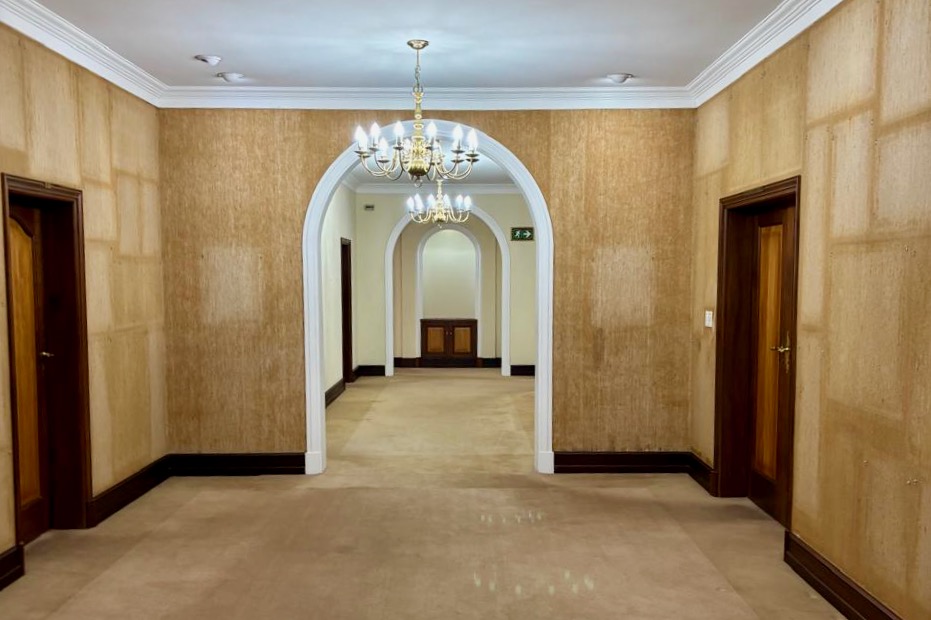
Tongaat head office stripped of expensive paintings and antiques ahead of a possible visit by liquidators. Photo supplied.
- Tongaat Hulett escaped liquidation on Thursday after the Industrial Development Corporation (IDC) agreed to increase its funding to R2.5-billion, allowing mills to open and 3.8 million tons of cane to be processed.
- More than 18,000 growers – mostly small-scale – have no other mills to use.
- But the IDC’s fresh R200-million lifeline only keeps the company trading until mid-year.
Canegrowers in KwaZulu-Natal breathed a sigh of relief on Thursday when the liquidation of sugar giant Tongaat Hulett was avoided through additional funding of R200-million.
This means that crucial milling of sugar cane can begin. More than 18,000 growers, the bulk of whom are small-scale growers, have no other option than Tongaat Hulett’s mills to process their sugarcane.
Had the company been placed in unfunded provisional liquidation, their farms would have become economically unviable, leading to thousands of rural job losses, the South African Canegrowers association said.

While the milling season had opened in other regions, Tongaat’s mills remained closed pending the outcome of Thursday’s winding up application before Judge Rithy Singh in the Durban High Court.
Dr Thomas Funke, CEO of SA Canegrowers, said the extra funding would be a “massive relief”.
“Thousands of jobs and entire rural communities depend on these operations, and today’s agreement helps safeguard that economic lifeline, at least until a sustainable solution to the Tongaat Hulett business rescue process can be negotiated.”
Business rescue plan fails
Tongaat was placed in business rescue in October 2022. The Vision Group became the controlling creditor after acquiring its bank loans. It then used its creditor voting power to approve its own business rescue plan.
But in February this year, the business rescue practitioners (BRPS) lodged a winding up application, saying the plan was incapable of being implemented because the Vision Group had shifted the goalposts and was demanding further funding from the Industrial Development Corporation (IDC) and reforms in the sugar industry.
With the milling season approaching, the company simply had no cash left to continue trading.
The liquidation application was opposed by some creditors, canegrowers, the IDC, Minister Parks Tau, and the RGS consortium, which had previously put up an alternate business rescue plan and has repeatedly cried foul about Vision’s plan.
Prior to the court proceedings, copies of a new, signed agreement, in which the IDC agreed to provide further post commencement funding (PCF) of R200-million, were circulated, and posted on the company’s website.
The IDC agreed to increase its PCF commitment from R2.3-billion to R2.5-billion. The R200 million would be available until the end of June.
It will allow the company to continue to trade until mid-year.
Fraying lifeline
While some described it as a “lifeline”, others said it was merely a Band-Aid, given the company’s perilous financial situation and that the Vision plan could never be implemented.
Lawyers for the BRP’s and Vision said the liquidation application should simply be adjourned in the hope that the main parties, Vision and the IDC, could agree on a way forward.
Advocate Ruan van Rooyen, for the canegrowers, said, “From the growers perspective we want the mills to open. This means that 3.8-million tons of cane can be delivered. So we don’t oppose the adjournment.”
Others argued that the application should be dismissed, otherwise it meant effectively that the BRPs and IDC can only negotiate with Vision.
Advocate Ruan Kotze, for RGS, said Vision’s plan needed to be set aside because it “failed” and had been deemed “abusive” by Minister Tau.
“It’s clear Vision does not have the funds to implement its own plan. It wants the IDC to pay in full for the costs of its own plan and give it the working capital it needs to conduct [to run] Vision Sugar with Tongaat assets.
“It needs the IDC to cave to all of its demands and expose itself to the tune of R6-billion,” said Kotza.
He said it was not open to the IDC to negotiate with other parties over the next few months if the matter was simply adjourned because Vision’s plan was the only legal one on the table.
Advocate David Aldworth, for a group of intervening shareholders, urged the court to give guidance to the BRPs, including a process setting aside Vision’s plan in order to consider alternate proposals which could then be voted on by creditors.
Advocate Arnold Subel, for the BRPs said, it was inescapable that until that morning there was no reasonable prospect of rescuing the company, but the agreement with the IDC had changed that.
“It gives us a further chance,” he said, urging the judge to adjourn the application.
Vision supported the adjournment.
Judge Singh said it was common cause that it was not in the interests of the stakeholders at this stage that Tongaat “the lifeblood of this province”, be taken out of business rescue.
She granted the adjournment until 17 June.
Support independent journalism
Donate using Payfast

Don't miss out on the latest news
We respect your privacy, and promise we won't spam you.
Next: JSC overturns tribunal decision, finds Judge Mbenenge guilty of gross misconduct
Previous: Cape Town health workers protest, demand permanent jobs
© 2026 GroundUp. This article is published under the GroundUp Republication Licence Version 1.0. Email [email protected] to request permission to republish.