
A new study suggests HIV prevention has stalled. But there may be a silver lining
Infections dropped sharply in the 2010s, but progress since 2019 is unclear. More studies are needed across the country
 Add GroundUp on Google
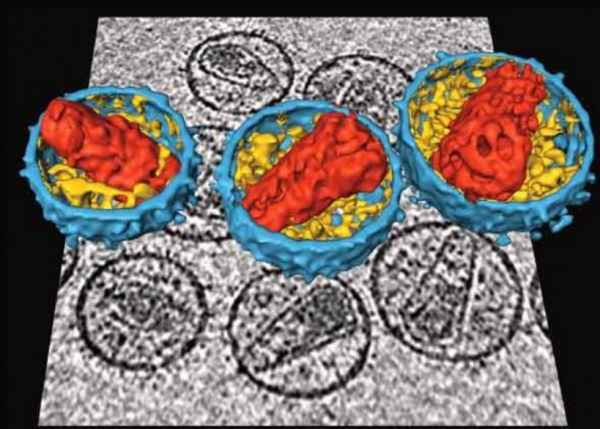
Three-dimensional images of HIV superimposed on electron micrographs of the virus. Constructed by Stephen Fuller, Centre for Human Genetics, Oxford University and taken from front cover of Equal Treatment March 2006.
The two key goals in managing the HIV epidemic are getting as many people with the virus as possible onto ARV treatment and reducing the number of new infections. The results of a study from KZN, published in The Lancet HIV, suggest we’re stalling on the prevention front. The study is well done and important, but the situation may not be as bleak as the authors suggest.
Following the abrupt cuts in United States aid last year, many feared that South Africa’s HIV treatment and prevention efforts would suffer. Though early signs are that the worst-case scenario hasn’t unfolded, figures published in May this year did indicate that South Africa’s ARV treatment programme stalled in 2025.
Now a major new study published by Elphas Okango and his colleagues in The Lancet HIV suggests that the country’s HIV response may have been losing steam even before the aid cuts. But the study took place in one district, uMkhanyakude in KwaZulu-Natal (KZN), so one should be cautious about generalising to the whole country. The authors found a large reduction in new infections in the mid-2010s, but the picture from 2019 onward is less clear.
From 2013 to 2018, the researchers estimate that HIV incidence (the rate of new HIV infections) declined by 52% in males and 37% in females. After that, HIV incidence plateaued from 2019 to 2025 in both men and women, according to the authors. One interesting nuance in the data is that HIV incidence continued to decline among young adults, but this was offset by increasing incidence in older adults. Moreover, the number of people with detectable HIV viraemia increased from 2019 to 2025 by 10%.
The researchers estimate the lifetime risk of people in the study population becoming HIV-positive at about one in two for women and three in ten for men.
While the new data is from only one district, the nature of the data is particularly well suited for calculating HIV incidence. That is because it is cohort data. In short, researchers from the Africa Health Research Institute (AHRI) have been testing largely the same tens of thousands of people in the same communities for HIV every year from 2003 to 2025. This means they could observe when people’s test results went from negative to positive. There are other methods for estimating HIV incidence, but this is one of the most reliable.
The researchers suggest several factors may have contributed to the loss of momentum.
First, they say that early gains during the scale-up of antiretroviral treatment may have already been made and that further declines will be “increasingly difficult to sustain as ongoing transmission becomes concentrated in harder-to-reach groups”.
Second, they suggest that the ageing of the HIV epidemic has shifted the burden of new infections towards increasingly older adults, who might be less likely to perceive themselves as being at risk and remain underserved by existing prevention programmes.
And finally, “behavioural changes, including declines in condom distribution reported in some settings, might also have contributed by making earlier reductions in transmission more difficult to sustain”.
Silver lining?
The study appears to be well conducted and the authors’ analysis is sound. But are the authors’ conclusions too pessimistic? Possibly.
It could be that, for reasons beyond the authors control, the data are too messy to capture what progress there may have been. Covid disrupted so much of South African life, and is likely one reason why the data is a bit chaotic after 2019.
Incidence in this population declined in 2019. There was a disruption in 2020 and 2021 due to covid and so no incidence is given. The decline continued in 2022, then rose in 2023, declined again in 2024 and then reached its lowest ever level in 2025. While the numbers from 2019 to 2025 are a bit all over the place and the decline isn’t statistically significant (and consequently may be due to random fluctuations), it could still be real.
Even so, there is no obvious explanation as to why the percentage of people with detectable viraemia has increased in this population. We also don’t know whether the same thing is happening in other parts of the country. All of this is concerning.
To better understand what is going on, South Africa needs more such HIV incidence studies in several more districts spread across multiple provinces. The Minister of Health together with the Department of Health and the Department of Science, Technology and Innovation can show leadership by making that happen.
Support independent journalism
Donate using Payfast

Don't miss out on the latest news
We respect your privacy, and promise we won't spam you.
Next: Taps dry as Eastern Cape town waits for water works upgrade
Previous: Lesufi said 80,000 panic buttons were distributed. It was 2,000
© 2026 GroundUp. This article is published under the GroundUp Republication Licence Version 1.0. Email [email protected] to request permission to republish.