
Auto workers suspend 11-week strike as talks continue
Workers at the Beijing Automotive Industry Corporation’s vehicle assembly plant near Gqeberha are expected to resume work next week
 Add GroundUp on Google
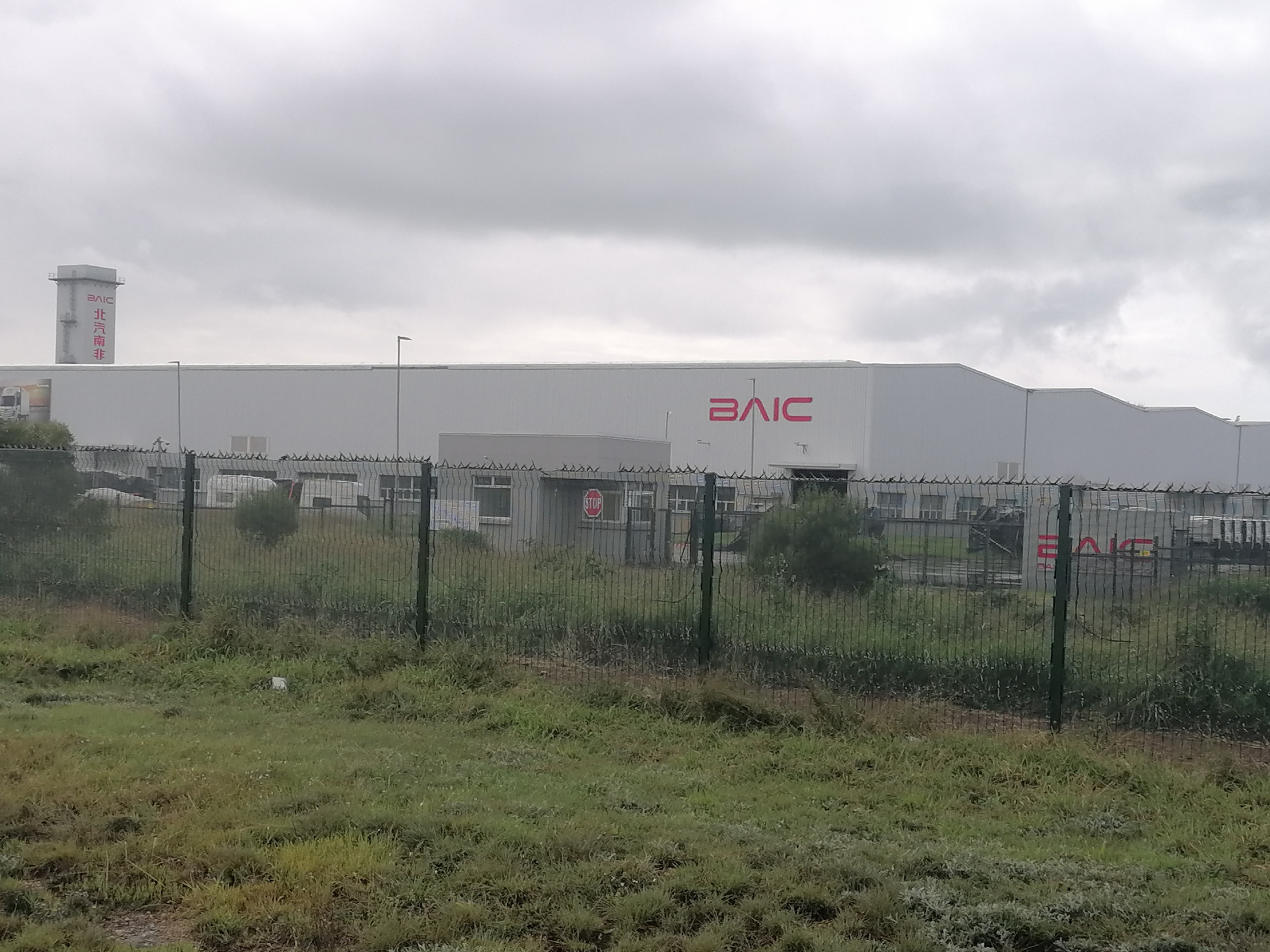
Workers at the Beijing Automotive Industry Corporation’s vehicle assembly plant near Gqeberha have been on strike since 15 June. They have agreed to return to work next week while negotiations continue. Archive photo: Joseph Chirume
- Workers at the Beijing Automotive Industry Corporation’s vehicle assembly plant near Gqeberha went on strike on 15 June, demanding wages increase to match other auto companies.
- Unlike other manufacturers, the corporation is not part of the National Bargaining Forum.
- This week, workers agreed, through NUMSA, to return to work while negotiations continue under a CCMA facilitation process.
- Production at the plant is expected to resume next week.
Workers at the Beijing Automotive Industry Corporation (BAIC) vehicle assembly plant near Gqeberha have agreed to suspend a strike that had brought production to a standstill for nearly three months.
However, tensions are high as workers say their central demands remain unresolved.
The strike, which started on 15 June, centres on whether BAIC should increase wages to match other auto companies. Unlike other manufacturers, BAIC is not part of the National Bargaining Forum.

In July, we reported that the lowest-paid workers at BAIC earn R48 per hour, compared with the National Bargaining Forum entry-level rate of R121. Spray painters earn R84 per hour instead of the industry rate of R163.24, and welders earn R48 per hour compared with R180.53.
The Department of Employment and Labour said BAIC’s wages met the statutory national minimum wage. But the National Union of Metalworkers of SA (NUMSA) contends that workers should be paid in line with other automotive manufacturers in the sector.
This week, NUMSA Eastern Cape regional secretary Mziyanda Twani told GroundUp that workers had agreed to return to work while negotiations with BAIC continue under a Commission for Conciliation, Mediation and Arbitration (CCMA) section 150 facilitation process.
Production at the plant is expected to resume next week.
“The dispute is still alive,” said Twani.
Workers will not be required to sign conditional letters and will not be locked out. Twani said this was agreed at the latest round of CCMA talks, which only dealt with the conditions under which workers would return.
Demands still being negotiated include permanent employment for qualifying fixed-term workers, the absorption of Youth Employment Service graduates and BAIC’s participation in the automotive industry’s bargaining arrangements.
Twani said there had been “no movement” on these demands. “In the interim we can accept a plant-level agreement to correct the anomalies that exist now,” Twani said. “But the long-term plan is to make BAIC part of the National Bargaining Forum with all other original equipment manufacturers.”
Major shareholder not part of negotiations
According to Twani, a major challenge to resolving the dispute is the ownership structure. BAIC holds 65%, while the state-owned Industrial Development Corporation (IDC) holds 35%.
Twani said only BAIC’s local human resources management had participated in the negotiations. Twani said representatives from China were present within BAIC’s local management structure but had not participated in the CCMA talks.
“That’s the key issue for why the talks couldn’t come to any kind of agreement,” Twani said.
NUMSA has been trying to engage the Chinese counterparts, while also seeking intervention from the Department of Trade, Industry and Competition (DTIC) and IDC.
IDC head of corporate affairs Tshepo Ramodibe said the IDC was willing to fund a mediation intervention between BAIC SA management and NUMSA. However, he added, “The IDC is awaiting BAIC SA’s response.”
While the IDC said it supported “lawful, constructive dialogue” to protect jobs and fair labour practices, the operational and labour decisions remained the responsibility of BAIC.
The IDC said that it was considering longer-term interventions at the plant, including strengthening employee relations, supporting labour law and collective-bargaining processes, reviewing HR policies and regular audits.
Bongani Lukhele, DTIC spokesperson, said a meeting was held with BAIC’s management in Beijing during the minister’s visit to China in August.
“It is of interest for the DTIC to see this matter amicably resolved,” he said.
The department said the minister was briefed on developments and that there had been a commitment by the parties to resolve the prolonged strike.
Workers under pressure
The decision to suspend the strike was also motivated by the financial pressure on workers who have been without their usual wages for more than two months.
“It was a long strike, so workers were struggling,” Twani said, “to the extent that they were not even reporting to the picket line because of the strenuous financial situation that they are in.”
NUMSA will use the period of suspension to regroup while continuing discussions with BAIC, the IDC, the DTIC and Chinese representatives.
GroundUp approached BAIC for comment on the suspension of the strike and the ongoing negotiations but had not received a response at the time of publication.
Support independent journalism
Donate using Payfast

Don't miss out on the latest news
We respect your privacy, and promise we won't spam you.
Next: Pro-Palestine activists lose Cape Union Mart case
Previous: SAFM apologises for Jacinta Ngobese-Zuma interview
© 2026 GroundUp. This article is published under the GroundUp Republication Licence Version 1.0. Email [email protected] to request permission to republish.