
How to fix government’s websites
This is an opportunity for Minister Solly Malatsi to show leadership (part 4 of 4)
 Add GroundUp on Google
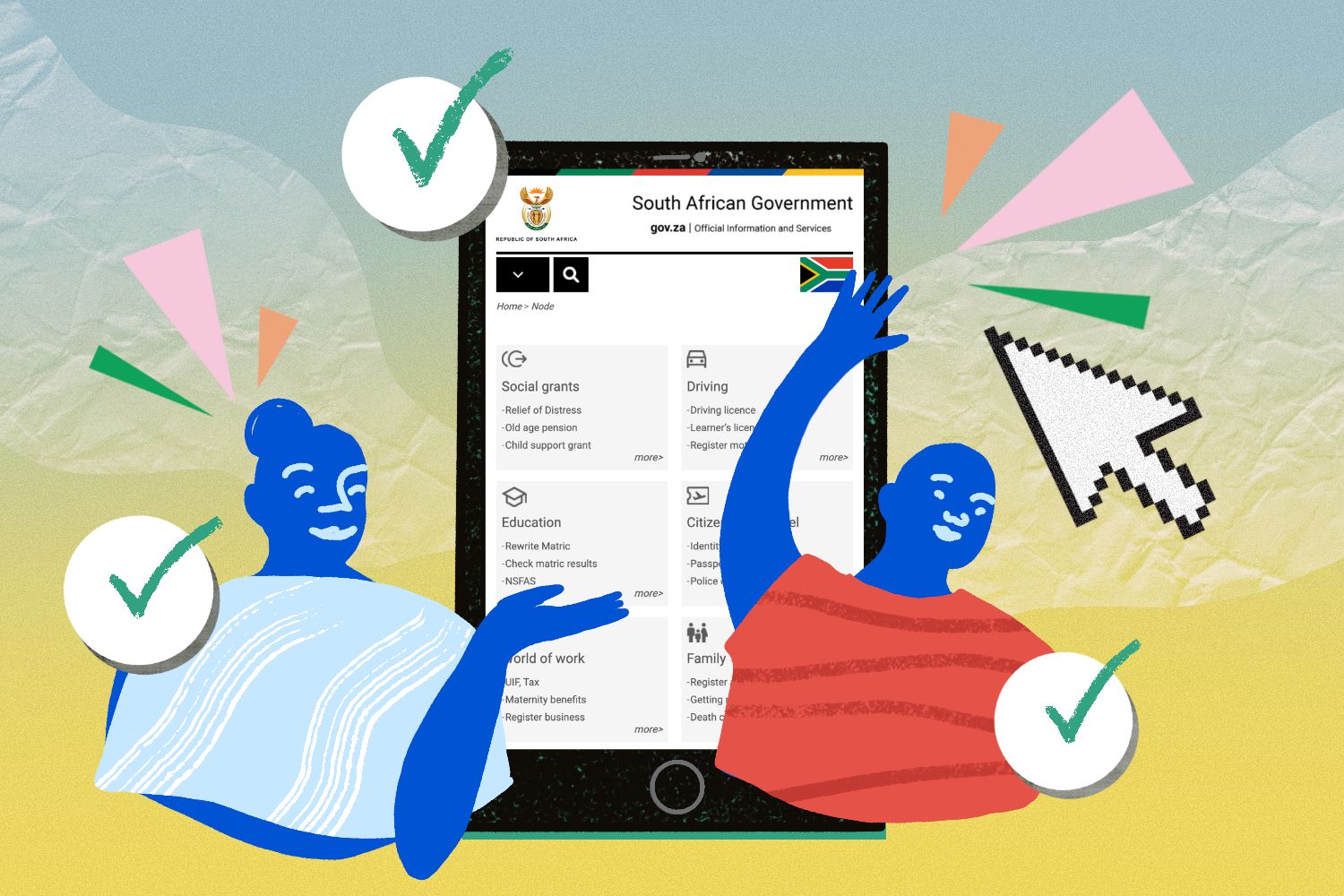
The state has a duty to provide “timely, accessible and accurate information” according to the Constitution. It can only do this in the 21st century if it has user-friendly, secure, functioning websites, which it currently doesn’t. Illustration: Lisa Nelson
Government’s websites – those ending gov.za – are a mess. In our previous articles we described how they are broken, insecure, inconsistent, duplicated and unreliable. But it wasn’t always so: in the early 2000s the gov.za sites were well organised, easy-to-navigate and had useful information.
The State Information Technology Agency (SITA) is supposed to have been responsible for developing a high-quality IT infrastructure for the state. Instead, it has been mired in incompetence, corruption, failed projects and failed audits. It has had about 25 CEOs since its inception in 1999. The latest, Magatho Mello, was appointed in April.
The government websites are a small part of the IT budget. But they are vital to communication and public confidence in the state. It should be a priority to fix them. The question is who can be relied upon to do that.
DA MP Tsholofelo Katlego Bodlani has been outspoken about SITA’s failures. Last year, she issued a statement welcoming that government departments would no longer be compelled to procure IT services from SITA.
Nevertheless, in response to a query from us, she wants SITA to be given a chance. “With the new managing director and board in place, we believe SITA will turn the corner and position itself as a reliable and preferred service provider for government IT services.”

Read our four-part series on government websites
SITA is ultimately a responsibility of the Minister of Communications and Digital Technologies. The DA’s Solly Malatsi became the minister in the government of national unity. With a new political party overseeing it and a new boss, perhaps it is not unreasonable to give SITA one more chance. But if it has yet another miserable audit next year, coupled with complaints of a multitude of delayed and unimplemented projects, then drastic action will need to be taken.
In the meanwhile, here are some suggestions for fixing the government’s websites:
- The criteria for who gets hired to develop gov.za websites should be qualifications, track record and price.
- It is the nature of IT that knowledge is asymmetric: the client knows far less than the provider. To avoid overselling, over-designing and wool being pulled over users’ eyes, all specifications and quotes should be reviewed by third-party experts.
- Gov.za websites should be simple. There’s no need for AI chatbots or fancy widgets. They should be designed and implemented by humans according to consistent standards. They shouldn’t cost a fortune. Their aim, for the most part, is to provide clear information, quickly. Where possible, high quality open source software should be preferred over proprietary software.
- Shun complexity. Stick to web standards. Prefer plain user interface design that works over fancy gizmos that invariably confuse, are often insecure, and eventually fail.
- Every website development must be accompanied by a sustainable maintenance plan, that includes keeping content up-to-date and keeping software secure.
- If a site or domain is no longer used, it should be taken completely off the internet. There should never be two sites serving the same purpose (e.g. UIF applications).
- Where people need to fill in forms (such as applying for an ID document from Home Affairs) the system should be designed to be as easy-as-possible for users. Only absolutely essential information should be requested. If there is an option to, say, book an appointment at a given branch, the system absolutely, every time, must provide available dates and accept the booking on the date selected by the user (yes, Home Affairs, we’re thinking of you). Design for users, not bureaucrats.
Finally, something needs to be done to end this alarming situation: Our state officials have taken to using proprietary, usually US platforms to publish information: Facebook, WhatsApp, and Instagram. This is a dangerous situation.
First, it often becomes impossible to know if a statement is real or fake. This is especially with WhatsApp, as messages are forwarded across groups and users.
Second, these platforms are under the control of corporations, answering to an increasingly capricious foreign government (see: Credit cards cancelled, Google accounts closed: ICC judges on life under Trump sanctions).
Even if the US was on friendlier terms with South Africa, as a matter of principle, our state information should be hosted on our own websites and servers.
A rule should be enforced for members of national and provincial legislatures, ward councillors and state officials: statements should first be placed on an appropriate government website, with a link at the top or bottom to the original URL of publication. From there they can be distributed on social media.
All of the above can only work if there is leadership from Minister Malatsi. He has to campaign to get government’s sites working properly. Deadlines need to be set for all departments. Parliament needs to hold those who fail to fix their websites accountable.
Section 195 of the Constitution states: “Transparency must be fostered by providing the public with timely, accessible and accurate information.”
This can only be done in the modern age if government websites are well-designed, clear, accurate and up-to-date. Right now they are not. Fixing this dire situation must be a priority.
Support independent journalism
Donate using Payfast

Don't miss out on the latest news
We respect your privacy, and promise we won't spam you.
Next: Unemployed doctors protest in Pietermaritzburg
Previous: 200 refugees, legally in SA, forced to join thousands camping outside Sherwood Hall
© 2026 GroundUp. This article is published under the GroundUp Republication Licence Version 1.0. Email [email protected] to request permission to republish.