
Judge accused of racism by court registrar
A Judicial Conduct Tribunal is probing whether Belinda Hartle made racist remarks to Eastern Cape High Court registrar Thozamile Semekazi
 Add GroundUp on Google
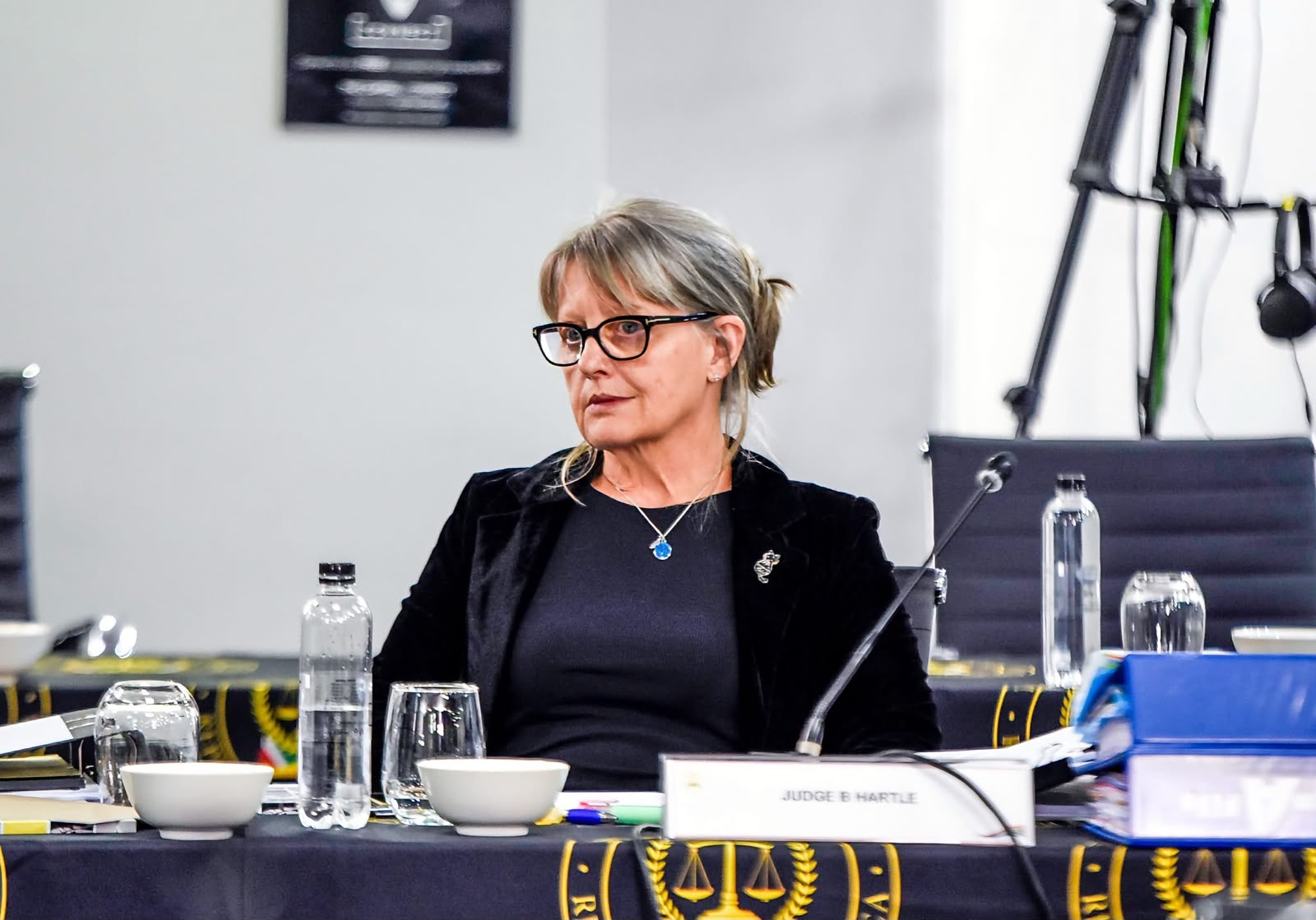
Eastern Cape Judge Belinda Hartle is before a Judicial Conduct Tribunal probing an incident in which she is accused of making derogatory and racist remarks to a registry clerk. Photo: The South African Judiciary/Facbook
- A Judicial Conduct Tribunal is probing an incident in which Eastern Cape Judge Belinda Hartle is accused of making a racist remark to a registrar in May 2025.
- This follows a finding by the Judicial Service Commission of a prima facie case against Hartle in December 2025.
- If the tribunal finds her guilty of gross misconduct for the remarks, which Hartle denies making, she could face impeachment.
Eastern Cape High Court registrar Thozamile Semekazi, who accuses Judge Belinda Hartle of calling him the k-word and belittling him, regards Hartle’s stated intention to buy him a gift following the incident, which she called a “peace offering”, as a bribe. This was revealed during a hearing by the Judicial Conduct Tribunal probing his allegations.
The Judicial Service Commission (JSC) announced in May that it decided to recommend Hartle’s suspension, following a Judicial Conduct Committee recommendation to the Chief Justice that a tribunal be appointed. If the tribunal finds her guilty of gross misconduct for remarks, which Hartle denies making, she could face impeachment.
The JSC clarified that only the President can suspend a judge, and that Hartle would keep sitting until he decides.
The tribunal, presided over by Justice Boissie Mbha, began hearing evidence on Monday and it is expected to run until 18 November.
Semekazi, who worked as a clerk for more than 20 years, stated in his complaint that he had gone to Hartle’s secretary’s office late on 15 May 2025 to drop off files for case flow management.
According to him, Hartle, after seeing the pile of documents, swore at him several times and used the k-word while in front of her secretary, Shakira Frost, who appeared amused at her outburst.
Semekazi said he had been transferred from Mthatha to the East London in July 2024 and had been assigned to manage the case flow roll for the first time, without any training.
The rolls and files had to be ready by noon on Wednesdays. There were usually about 15 files. However, the day before the alleged incident, he said he could not compile the roll because his computer was not working.
On 15 May 2025, a colleague assisted him, a process which took until about 4pm.
When he took the files to Frost’s office, Hartle arrived and shouted insults at him, including a reference to “bleddy f*** k***”, before both her and Frost left the room.
He said he had cried when reporting the incident to his manager and then when he fetched his children from school that afternoon. The following day he saw a doctor and was admitted to a mental health facility where he was diagnosed with severe depression, he said.
During his testimony before the tribunal on Monday, Semekazi raised his voice and hands, apparently mimicking what Hartle had said to him on the day of the alleged incident.
Hartle admitted to using “one expletive”, which she said was not directed at Semekazi but rather at the incompetence of the general office, and emphatically denies using the k-word.
Hartle’s advocate, Jan Heunis, told the tribunal that the charges against her are “trumped-up”.
He accused Semekazi of being an emotionally unstable employee who was often absent from work and relied on others to do his work.
He said the files were delivered a day late and on the day of the incident, a Thursday, the judge had just come out of court after a long day, during a busy week.
“She expressed her dismay at the registrar’s office by using one expletive for which she immediately apologised,” he said.
Heunis said Semekazi had reported the incident to his superiors and was seen by three doctors, but had only mentioned the k-word allegation in a complaint he made to the police on 12 June.
“It is incredibly unfair that she should even be here to answer charges that even on paper are patently false. We have reason to suspect … that the charge is the outcome of an act of revenge or reprisal,” he said.
Evidence leader advocate Benny Kalakgosi said, “Judges are not judged by the standard of ordinary citizens … but by the code of conduct.”
The test was objective – whether a reasonable person would understand Hartle’s comments to be abusive, demeaning and inconsistent with the high standards expected of a judge – and not whether she intended, in her own mind, to be racist.
Referring to the WhatsApp exchange between Hartle and Semekazi after the incident, Kalakgosi said this evidence could decide whether there was an apology, a denial or an explanation.
The hearing will continue on Tuesday.
Support independent journalism
Donate using Payfast

Don't miss out on the latest news
We respect your privacy, and promise we won't spam you.
© 2026 GroundUp. This article is published under the GroundUp Republication Licence Version 1.0. Email [email protected] to request permission to republish.